SpaceX Replacing MRAPs with Cybertrucks Beginning with Crew-13
NASA and SpaceX are getting ready to launch Crew-13 to the International Space Station in September. For the first time, if an emergency occurs on the launch pad and the crew needs to escape, Tesla Cybertrucks will be waiting for them instead of the usual Mine-Resistent Ambush Protected vehicles or MRAPs.
NASA’s Richard Jones explained at a press conference today that SpaceX decided to move to a “private rescue capability” to avoid potential conflicts with other NASA launches. In February, SpaceX was getting ready to launch Crew-12 at the same time NASA was preparing a launch attempt for Artemis II, putting a strain on those resources. An added advantage is that Cybertrucks accelerate more quickly than MRAPs.
“The speed at which a Cybertruck can exit the blast danger area is definitely one of the reasons why SpaceX has chosen to go in that direction, but I think really the main thing that I want to iterate is that it decouples a conflict in terms of trying to compete for the same resources for an MRAP for the personnel associated with those operations. So SpaceX is just going in a direction that they have freedom to manage those resources.” — Richard Jones, Deputy Program Manager, Commercial Crew Program, NASA
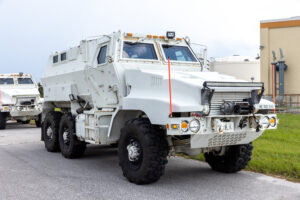
Jones said no modifications were needed to the Cybertrucks, but they did go through a certification process to make sure they can start with a gloved hand and astronauts can get in and out wearing spacesuits.
Crew-13’s launch is targeted for September 12 at 6:30 pm ET with NASA’s Jessica Watkins (commander) and Luke Delaney (pilot), the Canadian Space Agency’s Joshua Kutryk (mission specialist), and Roscosmos’s Sergey Teteryatnikov. Delaney, Kutryk, and Teteryatnikov are rookies, but this is the second flight for Watkins. She was a member of Crew-4 in 2022. She’ll be the first NASA astronaut to fly twice on a Crew Dragon. Her 2022 mission was on Crew Dragon Freedom. This time it’s Crew Dragon Grace, the newest capsule, making its second flight.
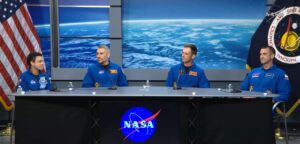
Though she’s the first NASA astronaut to gain that distinction, non-NASA astronauts including Jared Isaacman before he became NASA Administrator, and Roscosmos’s Andrey Fedyaev currently aboard the ISS, have flown twice on Crew Dragons.
Originally planned for November, Crew-13’s launch was moved up to September, restoring NASA’s typical 6-month schedule. Funding constraints briefly led the agency to consider shifting to eight month missions, as Russia has done. NASA Administrator Jared Isaacman, however, sees the ISS as a step towards igniting the orbital economy and wants frequent missions. Dana Weigel, Manager of NASA’s Low Earth Orbit (LEO) program, noted today that they need to order flights three years in advance so had to consider the shift when budget resources were tight, but “we ended up healthier” after Congress finalized funding.
In addition to regular appropriations, Congress allocated $10 billion to NASA over several years in last summer’s One, Big Beautiful Bill Act (OBBBA, also known as the Working Families Tax Cut). The OBBBA specified not less than $250 million per year for the ISS every year from FY2025 through FY2029.
Weigel also said that air leaks in the Russian segment that led five of the seven ISS crew members to shelter in Crew Dragon in June have stopped. Leaks in the PrK transfer tunnel at the end of the Russian segment have been a problem since 2019 and were thought to have been sealed, but new leaks were detected. Cosmonauts Sergey Kud-Sverchkov and Sergei Mikaev were preparing to make repairs that required removing a bracket and the others were directed to stay in Crew Dragon as a precaution. Roscosmos ultimately decided not to do that repair, using a temporary technique instead and it worked.
“There is no ongoing leak,” according to Weigel.
User Comments
SpacePolicyOnline.com has the right (but not the obligation) to monitor the comments and to remove any materials it deems inappropriate. We do not post comments that include links to other websites since we have no control over that content nor can we verify the security of such links.