Five ISS Crew Members Temporarily Take Shelter Due to Russian Segment Air Leak
Five of the seven crew members aboard the International Space Station temporarily sheltered in the Crew Dragon spacecraft today while two cosmonauts prepared to make extensive repairs to air leaks in one portion of the Russian segment. Ultimately Roscosmos decided to postpone the repairs and use sealant as they have in the past and the crew returned to regular duties. The leaks have been a problem for several years, but recently were thought to be under control. Late this afternoon NASA provided more information about today’s developments.
The 420 Metric Ton space station is composed of two interdependent segments, the Russian segment (ROS) and U.S. segment (USOS) that includes modules from Europe and Japan and a Canadian remote manipulator system. Construction of the ISS began in 1998 and it’s been permanently occupied by rotating crews for more than 25 years.
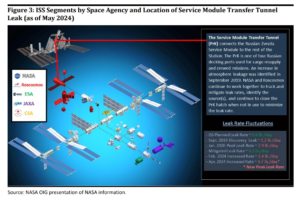
The Russian segment includes a transfer tunnel in Russia’s Service Module dubbed PrK that connects that end of the space station to a port where Russian Progress cargo vehicles dock. Air leaks in the PrK tunnel were observed beginning in September 2019 and have been managed by applying sealants and keeping the tunnel closed except when cargo is being moved in or out of a Progress vehicle.
One year ago this month, NASA postponed the launch of the Axiom-4 private astronaut mission to the ISS apparently as it sought to confirm that recent leak repairs were successful. A month later they confirmed the leaks had stabilized and on March 25, 2026, NASA’s Acting Associate Administrator for the Space Operations Mission Directorate, Joel Montalbano, told the House Science, Space, and Technology Committee there were no more leaks.
A month later, however, Bob Cabana, chair of NASA’s ISS Advisory Committee that meets semi-annually with its Russian counterpart, offered a cautionary assessment. While the U.S. and Russian sides made progress in understanding and mitigating the root cause of the leaks, they disagree on their severity and consequences. They did concur on a list of recommendations for additional testing and analysis. Earlier NASA had instituted a procedure that every time the PrK tunnel is opened, the “Node 1 aft hatch” between the Russian and U.S. segments is closed with crew members on their respective sides and they agreed to continue that practice.
The situation changed in the past few days. The first public sign was at 9:03 am ET when NASA mission control notified ISS crew members to take safe haven in the Crew Dragon spacecraft. At 9:16 am ET, NASA spokesperson Bethany Stevens posted a thread on X explaining that “Out of an abundance of caution, NASA has directed all four of the agency’s SpaceX Crew-12 members and NASA astronaut Chris Williams to assume an elevated safety posture in the Dragon spacecraft.” The reason was “new leaks” and Roscosmos’s decision “to proceed with a more extensive repair operation” today. About two hours later, however, she said Roscosmos paused the repairs “as more measurements and data is assessed” and the crew members were reentering the ISS and resuming normal operations. “We look forward to working with Roscosmos on a collaborative approach to address the leaks.”
Roscosmos has paused Friday’s structural repair efforts inside the Zvezda service module transfer tunnel, known as PrK, as more measurements and data is assessed. Given this development, NASA has instructed the crew members inside the Dragon spacecraft to end the safe haven…
— Bethany Stevens (@NASASpox) June 5, 2026
The four members of Crew-12 are NASA’s Jessica Meir and Jack Hathaway, ESA’s Sophie Adenot, and Roscosmos’s Andrey Fedyaev. NASA astronaut Chris Williams is a member of the Soyuz MS-28 crew along with Russian cosmonauts Sergey Kud-Sverchkov and Sergei Mikaev. Together they comprise Expedition 74. At least one person from NASA and one from Roscosmos is needed aboard the ISS at all times to operate the joint facility, so NASA crews include a Russian and Russian crews include an American.

According to Stevens’ post, Kud-Sverchkov and Mikaev stayed on the ISS to effect repairs, while Fedyaev joined his Crew-12 crewmates in Dragon, which remained docked at the ISS, but ready to depart if necessary. Kud-Sverchkov and Mikaev would have used the Soyuz MS-28 spacecraft at the other end of the station.
Roscosmos posted on Telegram (translation via Google) that earlier today while pressuring the PrK tunnel “specialists from the Russian ISS segment’s main operations control team detected a leak” and the cosmonauts “identified two potential air leak sites.” One then was sealed with Germetall, used for previous repairs, and preparations were underway to seal the other. Roscosmos said “NASA astronauts” temporarily relocated to Crew Dragon without mentioning Fedyaev.
As of mid-afternoon, conversations between NASA mission control and the ISS astronauts appeared nominal with various tasks underway.
At 6:01 pm ET, NASA posted more information on the ISS blog explaining what led up to today’s surprising events. NASA said Roscosmos noticed an increasing leak rate over the past several days and decided “to work toward a more extensive inspection and structural repair effort” today that involved cutting a bracket to inspect a possible leak source. That procedure “could have resulted in elevated risk to the structure in the area,” leading NASA to instruct crew members to shelter in Crew Dragon. Roscosmos then decided instead to conduct additional measurements and data assessments.
“NASA strongly supported that decision, and as a result, following that decision, Crew-12 and Williams ended their safe haven activities and returned to normal operations” on the ISS. “NASA will continue to work with our Russian counterparts, along with the rest of the international partners that support the space station, to assess and ensure a resolution to this matter.”
This article has been updated with the link to the 9:03 am ET audio where ISS crew members were instructed to take safe haven in Crew Dragon, and NASA’s explanation of today’s events in the 6:01 pm ET blog post.
User Comments
SpacePolicyOnline.com has the right (but not the obligation) to monitor the comments and to remove any materials it deems inappropriate. We do not post comments that include links to other websites since we have no control over that content nor can we verify the security of such links.