Crew-13 Arrives at ISS as Crew-12 Prepares to Depart
NASA’s 13th operational Crew Dragon mission arrived at the International Space Station today about 8 hours after launch. That’s the fastest trip on a SpaceX Dragon thanks to an opportune orbital alignment between the launch pad and the ISS after a recent reboost. Crew-12 will depart as soon as October 5, weather permitting, after a short handover. By coincidence, today is the 68th anniversary of NASA opening its doors.
Liftoff of Crew Dragon Grace with Crew-13 aboard was on time at 11:10 am ET despite weather that remained iffy throughout the countdown. This was just the second launch of Grace, SpaceX’s newest Crew Dragon. The first was a little over a year ago with the Axiom-4 private astronaut mission.
What a way to spend our 68th birthday! 🚀🎉
This morning, a new crew launched to the @Space_Station for a long-duration science mission. Tune in to watch with us as Crew-13 arrives at the orbiting laboratory. Live coverage begins here at 5:20pm ET (2120 UTC). pic.twitter.com/08FSqJmFLg
— NASA (@NASA) October 1, 2026
The four-person crew is commanded by NASA astronaut Jessica Watkins on her second flight to the ISS. With a Ph.D. in geology, Watkins was a member of Crew-4 in 2022 when she spent 170 days on the ISS. She’s the first astronaut to fly on a Crew Dragon twice. Joining her are three rookies: NASA astronaut and Navy test pilot Luke Delaney, Canadian Space Agency astronaut and fighter pilot Josh Kutryk, and Roscosmos cosmonaut and naval engineer Sergey Teteryatnikov.
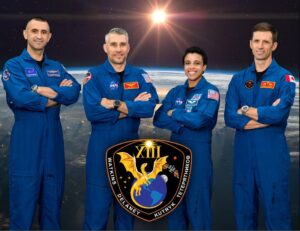
In spaceflight, the number 13 is associated with Apollo 13, the 1970 mission to the Moon that almost ended in catastrophe when the Apollo capsule’s service module exploded soon after they left earth orbit. Today’s Crew-13 embraced the heroism and resilience of the crew and the teams on the ground that led to Jim Lovell, Fred Haise and Jack Swigert safely making it back home. The mission patch “harkens back to Apollo 13, embodying resilience and gazing upward to the dawn of a new era of discovery.”
This actually is the 14th Crew Dragon mission. The first was a test flight, Demo-2, in 2020 with Bob Behnken and Doug Hurley.
After a successful liftoff, Crew-13 docked with the ISS at 7:05 pm ET. The 7 hour 55 minute trip from Florida to the ISS is the fastest ever for a SpaceX Dragon. Until now, the uncrewed Cargo Dragon CRS-31 held the record at 12 hours according to Space X’s Julianna Schieman at today’s post-launch press conference. Russia’s Soyuz can dock more quickly, in about 3 hours, because the Baikonur Cosmodrome at 45.6ºN allows a favorable trajectory to the ISS’s inclination at 51.6º. By contrast, Cape Canaveral is at 28.5ºN.
The fortuitous timing today was due in part to a reboost by Northrop Grumman’s Cygnus XL on September 25.
CSA astronaut Josh Kutryk is making his first spaceflight and the timing of the mission overall isn’t quite as fortuitous for him and his family who are expecting a third child in November. He’ll be the fourth astronaut to welcome a newborn while in space. Austrian astronaut Franz Viehböch was first in 1991. His daughter was born shortly after launch while he was still enroute to Russia’s Mir space station for a one-week stay. NASA astronauts Mike Fincke in 2004 and Randy Bresnik in 2009 welcomed newborns while on the ISS. Fincke was on a long-duration mission (186 days), while Bresnik was on an 11-day space shuttle flight.
Kutryk will be on the ISS for about six months. He has two children already and shared a photo of himself with his wife and children on the crew access arm to Crew Dragon a day before liftoff, along with his thoughts about heading off to space while they remain on Earth.
“Behind me lay all I held dear in life. And what lay before me? Happy child, little do you know what life is — how strangely mingled and how full of change… and now, a farewell to home. It was the darkest hour of the whole journey.” pic.twitter.com/iQOy9G9d9Y
— Joshua Kutryk (@Astro_Kutryk) September 30, 2026
Kutryk and his Crew-13 crewmates joined seven crew members already aboard: Crew-12 (NASA’s Jessica Meir and Jack Hathaway, ESA’s Sophie Adenot and Roscosmos’s Andrey Fedyaev) and Soyuz MS-29 (Roscosmos’s Pyotr Dubrov and Anna Kikina and NASA’s Anil Menon). NASA and Roscosmos routinely fly crew members from each other’s countries on their spacecraft to ensure at least one American and one Russian are aboard at all times to operate the interdependent U.S. and Russian segments.
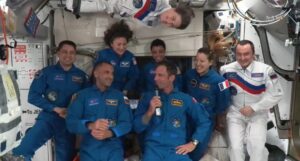
Crew-12 will return as soon as October 5. That’s a shorter turn-around than usual. NASA Low Earth Orbit (LEO) Program Manager Dana Weigel explained at the post-launch press conference that NASA needs to free the Crew-12 docking port to allow SpaceX’s next cargo spacecraft, CRS-35, to dock. It’s delivering the final set of ISS Roll-Out Solar Arrays (iROSAs) and NASA wants to install them before beta angle cutouts prevent it. Beta angle cutouts occur several times a year when the angle of the Sun to the ISS precludes spacewalks.
NASA is celebrating its 68th anniversary today. Congress established NASA in the 1958 National Aeronautics and Space Act nine months after the Soviet Union opened the Space Age with the launch of Sputnik on October 4, 1957. The law was enacted on July 29, 1958 and the agency opened its doors on October 1, using the National Advisory Committee for Aeronautics (NACA) as its foundation.
User Comments
SpacePolicyOnline.com has the right (but not the obligation) to monitor the comments and to remove any materials it deems inappropriate. We do not post comments that include links to other websites since we have no control over that content nor can we verify the security of such links.