Everything Still on Track for Artemis II Launch to the Moon on April 1
Just over a day from now, four astronauts may well be on their way to the Moon. Weather continues to be 80 percent favorable for launch at 6:24 pm ET on April 1 from Kennedy Space Center, FL, the opening of a two-hour launch window. No technical issues are being worked. If all goes as planned, three NASA astronauts and one from Canada will be the first humans to travel around the Moon since the Apollo era.
Nothing is certain, of course. Weather or technical problems can always intervene, but it’s looking good.
At an L-1 briefing — one day before launch — this afternoon, U.S. Space Force’s 45th Weather Squadron Launch Weather officer Mark Burger confirmed the weather remains 80 percent “go.” While that’s not the same as 100 percent, it’s pretty good.
Cumulus clouds and showers, ground winds, and now space weather are watch items.

Space weather is a new addition after yesterday’s intense solar flare. Burger conveyed that a scrub due to a radiation burst from the Sun is unlikely, but added space weather forecasting makes terrestrial weather forecasting look easy. NOAA’s Space Weather Prediction Center is closely monitoring solar activity and there’s a 55 percent chance of a lower level M-class flare in the next 48 hours and a 10 percent chance of an additional higher level X-class flare, “but that doesn’t say anything of how that energy is directed.” Most of the energy from yesterday’s flare was directed away from Earth, for example. In any eruption, x-rays arrive first and are detected by satellites, followed by the more problematic protons, so they will have some lead time to decide.
Jeff Spaulding, Senior NASA Test Director, reported there are a lot of smiles in the Firing Room at KSC today as the countdown proceeds smoothly.
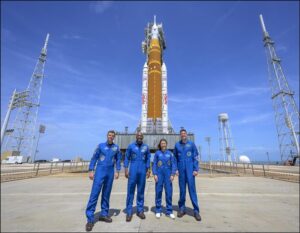
The four crew members posed for a photo in front of the Space Launch System (SLS) rocket and Orion crew capsule yesterday.
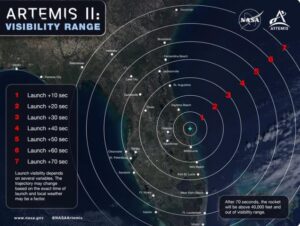
Timelines of pre-launch and post-launch milestones are available. NASA coverage of “tanking,” when they load fuel into SLS and its Interim Cryogenic Propulsion Stage (ICPS), starts at 7:45 am ET on NASA’s YouTube channel. Full launch coverage begins there and on NASA+ at 12:50 pm ET. For anyone who lives in the Florida area, NASA posted this Artemis II visibility map of where to look at and just after launch time.
Artemis II is a test flight and the crew will not attempt to orbit much less land on the Moon. Their 9-day lunar journey uses a “free-return” trajectory that will bring them back to Earth even if Orion’s propulsion system does not work as planned.

They will spend about a day in Earth orbit before setting off on their lunar expedition to check out Orion’s systems. If the life support system malfunctions during the mission, their spacesuits can sustain them for six days. In the event of a solar flare, they can shelter in a compartment under the floor surrounded by stowage bags filled with clothing and other items to shield them from the radiation.
The United States is the only country to send humans to the Moon — Apollo 8, 10, 11, 12, 13, 14, 15, 16 and 17 between 1968 and 1972. Apollo 17 in December 1972 was the final lunar Apollo mission, so Artemis II will be the first crew to get that close to the Moon in more than 53 years.
Artemis is the name of Apollo’s twin sister in Greek mythology.
User Comments
SpacePolicyOnline.com has the right (but not the obligation) to monitor the comments and to remove any materials it deems inappropriate. We do not post comments that include links to other websites since we have no control over that content nor can we verify the security of such links.