House Approves $25 Billion for Golden Dome, But Saltzman Worries About Resources
One day after President Trump received a draft plan for the Golden Dome missile defense system, the House passed the reconciliation bill that includes the first tranche of funding, $25 billion. Trump assigned U.S. Space Force Vice Chief of Space Operations Gen. Michael Guetlein to lead the project, a layered defense system that will include space-based interceptors. At the same time, however, the head of the Space Force is warning that the service already is under-resourced.
After an all-nighter, the House passed the reconciliation bill — officially the “One Big Beautiful Bill Act” (H.R. 1) — at 6:57 am ET this morning. It will implement Trump’s agenda to extend his 2017 tax cuts, create more tax cuts, increase spending for defense, border security and energy, all while cutting spending elsewhere to reduce the nation’s debt.
The vote was 215-214-1. The current party split in the House is 220 Republicans and 212 Democrats, with three Democratic vacancies due to deaths (Turner, Grijalva and Connolly). Of the 220 Republicans, 215 voted yes, two voted no, two did not vote, and one voted present. All Democrats voted no.

House Speaker Mike Johnson (R-LA) was determined to pass the bill before the Memorial Day recess and succeeded. The House adjourned about 10 minutes later. Trump is widely credited with convincing enough Republican hold-outs to vote yes despite reservations in particular that the bill does not cut funding sufficiently.
The bill now goes to the Senate with a goal for them to pass it before the July 4th recess scheduled to begin on June 30. The Senate is expected to make changes, which means it will have to go back to the House for another vote. Both chambers must pass the identical bill before it can be sent to the President to sign.
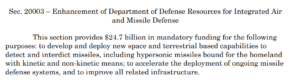
Many aspects of the bill are controversial, but so far not the proposed spending for Golden Dome. The House and Senate Armed Services Committees were two of the lucky committees that got to decide how to spend more money — $150 billion — rather than cutting it. They jointly recommended $24.7 billion for Golden Dome and HASC approved it on April 29. The language in the bill that passed today is unchanged.
Trump signed an Executive Order on January 27 directing the Secretary of Defense to submit a reference architecture for Golden Dome, originally named Iron Dome, within 60 days. In an Oval Office meeting yesterday, Trump announced “we have officially selected an architecture,” but didn’t provide any details other than to say it will cost $175 billion and be completed within three years, before the end of his term. That’s a significantly shorter time frame and lower cost than other estimates.
Golden Dome will include air-, land-, sea- and space-based elements. Trump’s choice of Guetlein to lead the effort may help highlight the importance of the space-based components.
The United States already has many space-based assets that support national security like sensors and communications systems, but Golden Dome will add space-based interceptors to attack incoming missiles during their ascent and mid-course phases. The concept builds on President Ronald Reagan’s Strategic Defense Initiative of the 1980s.
The Space Force is expected to play a major role, but the service’s Chief of Space Operations, Gen. B. Chance Saltzman, is worried about having the resources needed for everything it’s already been asked to do.

At a Senate Armed Services Committee hearing on Tuesday, Saltzman spelled out all the new responsibilities the Space Force has been asked to take on over the past three years including ground and air Moving Target Indications, new space control capabilities, modeling simulation, force design analytics, a three-fold increase in launch tempo at the national spaceports the Space Force manages, and now Golden Dome. But its budget has been going down, not up.
“With about 3 percent of the DOD budget and less than 1 percent of the personnel, the Space Force is a great value proposition for the Department. For this tiny fraction of resources you enable a service that has become indispensable to modern power projection. However, despite the dramatic rise in threats and increasing importance of space over the last few budget cycles, the Space Force has experienced shrinking resources. This disconnect between value and investment creates risk for our nation, further exacerbating the situation.” — Gen. B. Chance Saltzman
Of particular concern is the loss of 14 percent of their civilian personnel due to the Trump Administration’s directive to cut the federal workforce. “We were in a period of managed growth” trying to increase the workforce, but then were asked to “stop and offer some to resign.” By the end of 2025, he said there will be almost 1,000 fewer civilian workers than planned. Civilians comprise about one-third of the Space Force’s 14,000 personnel.
“These new mission areas will require new and stable resources,” Saltzman stressed. “If we want a force that can secure our nation’s interests in, from, and to space, we must resource it accordingly.”
User Comments
SpacePolicyOnline.com has the right (but not the obligation) to monitor the comments and to remove any materials it deems inappropriate. We do not post comments that include links to other websites since we have no control over that content nor can we verify the security of such links.