Japan’s ispace Expanding into Lunar Infrastructure
Japan’s ispace robotic lunar landing company is expanding into the lunar infrastructure business through an agreement with SpaceX. Instead of just landing on the Moon, they are offering end-to-end services starting with design through landing and mobile operations on the lunar surface.
The new plans were announced today at the SpaceTide 2026 conference taking place in Japan this week. During a later online media briefing, ispace’s Takeshi Hakamada and Hideari Kamiya emphasized they are not abandoning their current ULTRA lander plans, but evolving into a lunar infrastructure business. Hakamada is ispace’s Founder and CEO. Kamiya is Executive Vice President for Program and Business Development.
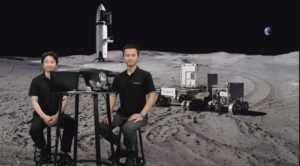
Through their new Lunar Asset Integrator, payloads under 500 kilograms will be delivered to the lunar surface on SpaceX’s Starship. Customers can contract with ispace for end-to-end services including mission planning, cargo integration, Starship interface integration, transportation and deployment by Starship, and surface operations with a new Mobile Cargo System. Deliveries will begin as early as 2030.
📣 Today, we’re expanding our commercial lunar services with a new offering, providing a lunar transportation service that will launch aboard @SpaceX‘s Starship!
As the world enters a new era of lunar exploration, ispace is evolving into a “Lunar Access Integrator,” providing… pic.twitter.com/jo2fBzxQmz
— ispace (@ispace_inc) July 8, 2026
Hakamada and Kamiya said they anticipate both government and commercial customers for these services.
ispace has an established relationship with SpaceX. Their first two lunar landers were launched on Falcon 9s: Hakuto-R Mission 1 (M1) in 2022 and Mission 2 (SMBC x HAKUTO-R Venture Moon) in 2025. Both failed to land successfully, however. Mission 1 ran out of propellant just before reaching the surface due to a software error. Mission 2’s fate was caused by a hardware failure.
In March, ispace announced revisions to the schedule for its next several launches as it changes to a different engine provider. The new engine will be used for all future ispace landers. ispace had been developing two lander designs, one at ispace’s Japanese headquarters and another at its U.S. subsidiary ispace-U.S., but now there will be only one, ULTRA.
ispace-U.S. is a subcontractor to Draper for one of NASA’s Commercial Lunar Payload Services (CLPS) missions, CP-12. Switching to a different engine will delay that mission from 2027 to 2030, which ispace now designates as Mission 5.
Before flights on Starship, ispace has lunar landing missions in 2028 and 2029, plus a lunar orbit mission “as early as 2027” to provide communications and positioning services.

SpaceX Vice President of Commercial Sales Stephanie Bednarek added: “Having previously flown multiple ispace missions to the Moon aboard Falcon 9, we’re excited to expand this relationship to Starship. Their integration services provide a valuable pathway for smaller payloads to secure a ride to the Moon today, and we look forward to supporting ispace and their customers as they help expand access the lunar surface.”
In addition to the United States, ispace has subsidiaries in Luxembourg (ispace-Europe) and Saudi Arabia (ispace-S.A.).
Update, July 15: ispace said today NASA and Draper have mutually agreed to end the CP-12 CLPS task order, for which ispace-US was a subcontractor to Draper. ispace-US plans to propose to NASA’s new CLPS 2.0 framework.
User Comments
SpacePolicyOnline.com has the right (but not the obligation) to monitor the comments and to remove any materials it deems inappropriate. We do not post comments that include links to other websites since we have no control over that content nor can we verify the security of such links.