Stunning Images, A Chat with Friends — Another Great Day for Artemis II
The Artemis II crew is on their way back to Earth after swinging around the Moon yesterday. Stunning images of both the Moon and the Earth have been downlinked already with more to come, exciting scientists and stirring the spirit. With the exception of the still troublesome toilet, the Orion capsule and its European Service Module are performing very well, though NASA Administrator Jared Isaacman says he won’t relax until the crew splashes down in the Pacific Ocean on Friday.
Testing out the Orion capsule itself is the main objective of this first crewed Artemis flight, but science observations of the Moon, Earth and other planetary bodies are also high on the list. NASA astronauts Reid Wiseman, Victor Glover, and Christina Koch and Canadian Space Agency astronaut Jeremy Hansen certainly did not disappoint with the treasure trove of images they collected with their cameras. NASA is posting them in three places: the Artemis Image Gallery, NASA’s image gallery, and NASA2Explore on Flickr.
Among those capturing the world’s attention today are Earthset (the setting Earth rather than Earthrise) and the solar eclipse as the Moon blocked out the Sun.


Like those of us on Earth looking at a solar eclipse, the crew had to wear eclipse glasses, too.
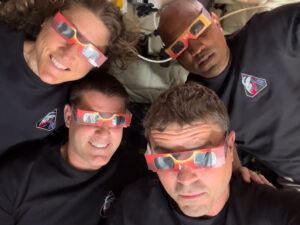
The crew exited the lunar sphere of influence at 1:23 pm ET, a demarcation between the area of cislunar space where lunar gravity or Earth’s gravity is stronger. Orion is on a free-return trajectory that slingshotted them around the Moon and they now are essentially falling back to Earth. That will take three more days. Splashdown off the coast of California will be at 8:06 pm ET on Friday.
During the day today, the crew held a conference with the science team at Johnson Space Center to answer questions and explain in more detail what they saw. Artemis II Science Lead Kelsey Young stresses the value of human eyes in seeing color and albedo on the Moon rather than relying only on cameras on the Lunar Reconnaissance Orbiter that’s been orbiting the Moon since 2009.
During an afternoon press conference today, she excitedly related that the crew saw colors right away, green and different brown hues around the Aristarchus Plateau, for example, that can “really help tell us nuances about the chemistry of lunar material.” They also saw impact flashes from micrometeorites hitting the surface, between four and six of them, which surprised her.
Views of the terminator line separating darkness and light was another valuable input. During his observations yesterday, Glover talked effusively about what he was seeing: “The Terminator right now is just fantastic. It’s the most rugged that I’ve seen from a lighting perspective.” Not a “nice smooth arc,” but “jagged.” Young said today the lighting conditions he saw “mimic in many ways” what astronauts will experience at the Moon’s South Pole, the destination for future Artemis crews. “The low sun angles, the dramatic lighting, causing the extreme shadowing and illumination also accentuating topography.”
In another first for this crew, they had a ship-to-ship communications chat with their American and European friends on the International Space Station. NASA astronauts Jessica Meir, Jack Hathaway, and Chris Williams and ESA astronaut Sophie Adenot connected with Artemis II through Johnson Space Center for about 15 minutes. All are close friends and their excitement was palpable. They joked around, talking about how the food on Orion and the ISS is pretty much the same (and delicious apparently) and reveling in the experience.
Meir and Koch are best friends and did three spacewalks together when they were on ISS in 2019-2020, the first all-female spacewalks. (They came and went on different spacecraft and Koch set a record for the longest duration space mission by any woman, 328 days.) Koch told Meir today she “always hoped we would be in space again together, but I never thought it would be like this. It’s amazing.” Meir agreed “even if we are a few miles apart,” laughing that since everyone is always interested in records, all of them ran to the far end of the ISS when Orion was on the farside of the Moon “so we could claim we were the furthest away from you in that moment.”
NASA shared the audio of the conversation in real time, but said bandwidth constraints meant they couldn’t show the video. Both ships were taping it, though, and NASA will post it in due course.
The only problem on Orion is with the urine disposal system, which vents urine into space. The issue cropped up early in the mission, but engineers have not been able to determine the root cause. They thought it was a frozen vent line, but after using heaters and turning the spacecraft toward the Sun, the blockage remains. Ascent Flight Director Rick Henfling said today it may be related to chemistry used to ensure the wastewater doesn’t create biofilms, but they won’t know until the spacecraft can be examined after it returns to Earth. In the meantime, the crew will use specially designed bags called Collapsible Contingency Urinals instead. The toilet is functional for poop, which is stored in canisters.
Orion will perform a short 15-second trajectory correction burn at 8:03 pm ET tonight.
NASA is providing 24/7 coverage of the Artemis II mission on YouTube and daily media updates. Times are subject to change, but the next is currently scheduled for tomorrow at 5:00 pm ET.
User Comments
SpacePolicyOnline.com has the right (but not the obligation) to monitor the comments and to remove any materials it deems inappropriate. We do not post comments that include links to other websites since we have no control over that content nor can we verify the security of such links.