What’s Happening in Space Policy April 5-11, 2026
Here is SpacePolicyOnline.com’s list of space policy events for the week of April 5-11, 2026 and any insight we can offer about them. The House and Senate are in recess this week except for pro forma sessions.
During the Week
Four astronauts are more than halfway to the Moon as we write this. NASA’s Reid Wiseman, Victor Glover and Christina Koch and Canadian Space Agency’s Jeremy Hansen lifted off on April 1. Other than a few minor problems with the toilet (now fixed) and one the four laptop computers, the mission is going exceptionally well. They’re sending back stunning images of the Earth and of the Moon. Here are our two favorites so far.


This is a test flight and they will not go into orbit around the Moon, much less land, but circle the Moon on a “free-return” trajectory that brings them back to Earth even if the propulsion system doesn’t perform as planned. So far, the Space Launch System (SLS) rocket and the Orion capsule’s Orbital Maneuvering System (OMS) engine put them on such a precise course that they haven’t needed to do two small course correction burns that were planned for Friday and Saturday. Another is scheduled for today as they get closer and closer to the Moon.
Tomorrow they make their lunar flyby, traveling further from Earth than any humans have been while making observations of the Moon’s farside and an eclipse as the Moon blocks the Sun. For 40 minutes, the Moon will block Earth and they’ll be incommunicado with Mission Control and the rest of humanity.
Then they head back to Earth, splashing down on Friday at 8:07 pm ET in the Pacific Ocean. The exact location is weather dependent, but generally off the coast of California.
NASA is providing 24/7 live coverage on its YouTube channel and daily press briefings also livestreamed there. The times for the press briefings can change. Today’s (Sunday’s) for example was going to be at 3:30 pm ET, but now is at 6:30 pm ET. NASA is updating the “NASA Sets Coverage for Artemis II Moon Mission” website with any changes.
As of Sunday morning, these are the timelines for the two most critical events this week: tomorrow’s lunar flyby and Friday’s splashdown. Check for updates on NASA’s website and our Calendar entries.
Lunar Flyby, Monday, April 6
12:41 a.m.: Orion enters lunar sphere of influence
2:20 a.m.: Crew sleep begins
10:50 a.m.: Flight Day 6 begins, Crew wake up
1 p.m.: NASA+ coverage of lunar flyby begins.
1:56 p.m.: The crew will surpass the record for human’s farthest distance from Earth previously set by Apollo 13, at 248,655 miles from Earth.
2:10 p.m.: Crew remarks about Apollo 13 distance record (audio only)
2:15 p.m.: Crew configures Orion’s cabin for flyby operations
2:45 p.m.: Lunar observation period begins
6:47 p.m.: Predicted loss of communications as crew heads behind the Moon (estimated 40-min.)
7:02 p.m. Orion closest approach to the Moon
7:05 p.m.: Orion reaches maximum distance from Earth
8:35 p.m.: Orion enters period with Moon eclipsing the Sun
9:20 p.m.: Lunar observation period (flyby) concludes
9:32 p.m.: Solar eclipse period concludes
10:50 p.m.: Live downlink event
Splashdown, Friday, April 10
3:05 a.m.: Crew sleep begins
11:35 a.m.: Flight Day 10, Crew wakeup
1:50 p.m.: Orion cabin configuration for re-entry begins
2:53 p.m.: Return trajectory correction-3 burn
6:30 p.m.: NASA+ coverage of the crew’s return to Earth begins
7:33 p.m.: Orion crew module and service module separation
7:37 p.m.: Crew module raise burn
7:53 p.m.: Orion entry interface
8:07 p.m.: Splashdown in the Pacific Ocean. NASA and U.S. Department of War personnel are expected to assist the crew out of Orion and fly them to a waiting recovery ship.
10:30 p.m.: Post-splashdown news conference at NASA Johnson
An exciting week for NASA, the United States, Canada, and the entire world to be sure.
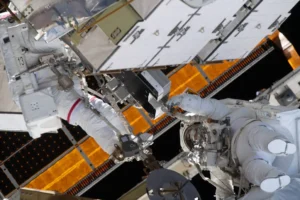
There are other very interesting events as well, including the launch of the next cargo ship to the ISS on Wednesday. Northrop Grumman’s Cygnus-24 is scheduled for launch at 8:49 am ET and arrival at the ISS on Friday at 1:10 am ET. NASA hasn’t announced any pre-launch briefings, probably because resources are stretched with coverage of Artemis, but launch and arrival will be livestreamed.
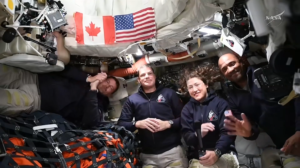
Speaking of the ISS, the Artemis II crew and the ISS crew plan to talk with each other at 2:40 pm ET on Tuesday. It’s audio-only, but a historic first to have an earth-orbiting crew talk to colleagues out at the Moon. They all know each really well, of course, but ISS’s Jessica Meir and Artemis II’s Christina Koch are best friends and performed the first all-female spacewalk at the ISS in October 2019, so that will be extra special.
The ISS is getting old — it’s been permanently occupied for more than 25 years — and NASA wants commercial space stations to replace it. On Tuesday, the Beyond Earth Institute (BEI) will hold a webinar on that topic, often generically referred to as development of Commercial LEO Destinations (CLDs). NASA sparked a bit of controversy a couple of weeks ago by proposing a major change to their involvement in facilitating CLDs. As it happened, the House SS&T Committee had already planned a hearing on CLDs for the next day. Dave Cavossa, President of the Commercial Space Federation, an industry group that represents seven companies working on commercial space stations, said what they need from NASA is to stick to the plan. BEI’s webinar includes representatives from two of the companies trying to build commercial space stations, Vast and Starlab. Should be interesting.
Meanwhile, up on Capitol Hill the House and Senate are half-way through their two-week spring break. They return the week of April 13 when we may hear more about their reaction to the FY2027 budget request the Trump Administration delivered to Congress two days ago. For NASA, the request is very similar to the FY2026 request — strong support for human exploration and deep cuts to everything else. Congress rejected that request and kept NASA roughly at its FY2025 level as well as adding $10 billion spread over several years in last summer’s One, Big Beautiful Bill Act or the “reconciliation” bill. The U.S. Space Force, on the other hand, gets a big increase as part of President Trump’s $1.5 trillion defense budget request, the largest in history. For RDT&E alone, the Space Force budget would double from $20 billion in FY2026 to $40 billion in FY2027. The administration is counting on Congress to pass another reconciliation bill to fund $350 billion of the defense increase, some of which is for the Space Force. We’ll have more on that later.
Those and other events we know about as Sunday morning are shown below. Check back throughout the week for others we learn about later and add to our Calendar or changes to these. (One more reminder that times for the Artemis II events are subject to change. Check NASA’s list and our Calendar entries for updates.)
Sunday, April 5
- Artemis II Daily Press Conference, Johnson Space Center/online, 6:30 pm ET
Monday, April 6
- NASA Live Coverage of Artemis II’s Flyby of the Moon begins 1:00 pm ET and ends with a “live downlink event” with the crew at 10:50 pm ET, see timeline of events above (watch on NASA’s YouTube channel)
Tuesday, April 7
- Minding the LEO Gap and the Future of Commercial Space Stations (BEI), virtual, 1:00-2:00 pm ET
- Artemis II Daily Press Conference, Johnson Space Center/online, 4:00 pm ET
Tuesday-Wednesday, April 7-8
- 6th Assured PNT Summit, Washington DC
Tuesday-Thursday, April 7-9
- 5th IAA Conference on Space Situational Awareness (ICSSA), Madrid, Spain
Wednesday, April 8
- Launch of Northrop Grumman Cygnus-24 to the ISS, Cape Canaveral Space Force Station, 8:49 am ET (NASA coverage begins 8:30 am ET)
- Artemis II Daily Press Conference, Johnson Space Center/online, 3:30 pm ET
Thursday, April 9
- 11th New Space Age Conference: Space as the Next Frontier (MIT), Cambridge, MA, 8:00 am-5:00 pm ET
- Artemis II Daily Press Conference, Johnson Space Center/online, 3:30 pm ET (mission status briefing) and 5:59 pm ET (crew news conference)
Friday, April 10
- Artemis II Returns to Earth, Pacific Ocean near California, 8:07 pm ET, NASA coverage begins 6:30 pm ET (see timeline of events above), watch on NASA’s YouTube channel
User Comments
SpacePolicyOnline.com has the right (but not the obligation) to monitor the comments and to remove any materials it deems inappropriate. We do not post comments that include links to other websites since we have no control over that content nor can we verify the security of such links.