What’s Happening in Space Policy January 25-31, 2026
Here is SpacePolicyOnline.com’s list of space policy events for the week of January 25-31, 2026 and any insight we can offer about them. The Senate is in session this week. The House is in recess except for pro forma sessions.
During the Week
One big event this week is the winter storm that’s affecting more than half of the United States right now including Washington, D.C. The worst of it in this area is happening today, Sunday, but travel will be hazardous at least through tomorrow and the Office of Personnel Management already decided government offices in this region will be closed Monday.
Airline disruptions are widespread and Senate Majority Leader John Thune separately decided to postpone the Senate’s return from Monday to Tuesday. That will give them one less day to complete action on the final “minibus” of six FY2026 appropriations bills before Friday when the Continuing Resolution (CR) expires that’s keeping those departments and agencies operating — Defense, Financial Services, Homeland Security, Labor-HHS, State-Foreign Ops (called National Security-State Dept in the House), and Transportation-HUD (THUD).
The House passed them as three separate bills over the course of two weeks, but the plan is to combine them for consideration by the Senate. The House will not be in session this week. If the Senate makes any changes, it would have to go back to the House for approval and since they won’t be here, that puts pressure on Senators to pass it as is to avoid another shutdown.
The prevailing view was that a desire to avoid another shutdown would outweigh dissatisfaction with any one of the bills, but that’s changed in the past 24 hours. The Homeland Security bill funds ICE and yesterday’s incident in Minneapolis hardened Democratic opposition. Senate Minority Leader Chuck Schumer said last night on X that Democrats will block consideration of the minibus if Homeland is included.
The bill was controversial in the House even before what happened yesterday, but the House needs only a simple majority to pass legislation. They also separated Homeland from the other bills. It narrowly passed 220-207. Now they plan to merge it with the others so if the Senate wants to avoid another shutdown, they have to agree to it.
Sixty votes will be needed in the Senate. Sen. Rand Paul (Kentucky), the lone Republican to vote against the CR in November, already is expressing opposition because the package includes money for refugee assistance programs. If the other 52 Republicans support it, they again need eight Democrats/Independents to join them. In November that finally happened after 41 days. (The shutdown didn’t end until two days later because the House had to come back into session to approve the Senate’s change of the CR’s expiration date to January 30.) Politico reports that three of the Democrats who broke ranks and voted to end the shutdown already have said they will oppose this minibus if Homeland is part of it (Cortez Masto, Rosen, and Schatz).
The October-November shutdown affected all departments and agencies funded through the appropriations process because none of the FY2026 bills had been enacted, but six have now. One is Commerce-Justice-Science (CJS), which funds NASA and NOAA. President Trump signed that bill (H.R. 6938) into law on Friday. Funding for those civil space activities are finalized for FY2026. National security space and the FAA’s Office of Commercial Space Transportation, however, are in the pending Defense and THUD bills respectively.
Appropriators are eager to pass these bills to restore “regular order” to the appropriations process and reinforce Congress’s authority over federal spending. Until yesterday the expectation was it might be slightly easier to get through the Senate this time. That’s not so clear now. But as we often say, anything can happen in Congress.
Separately this week, we want to note that Wednesday is the 40th anniversary of the January 28, 1986 Space Shuttle Challenger tragedy. The crew of Challenger (STS-51L) died when their space shuttle was torn apart by aerodynamic forces 73 seconds after liftoff. An “O-ring” in one of the two Solid Rocket Boosters (SRB) failed due to unusually cold weather at the launch site, allowing hot gases to escape and leading to the subsequent failure of the External Tank and the other SRB. The families of the Challenger crew created the nonprofit Challenger Center for Space Science Education “firmly committed to carrying on the spirit of their loved ones by continuing their education mission.” Through their network of Challenger Learning Centers, they’ll commemorate the anniversary over the next year by remembering them “not only for how they were lost, but for what they stood for.”

NASA held its annual Day of Remembrance last week honoring all those who lost their lives in the pursuit of space flight. Long ago they picked the fourth Thursday in January as the date for the ceremony and it came rather early this year. The Day especially honors the 17 astronauts who died in the Apollo 1, Challenger, and Columbia accidents. As is tradition the NASA Administrator, now Jared Isaacman, laid a wreath at Arlington National Cemetery. He was joined by friends and families of those honored and current and former NASA officials including past Administrators Bill Nelson (2021-2025), Charlie Bolden (2009-2017), and Sean O’Keefe (2001-2005). Bolden was a NASA astronaut at the time of the Challenger tragedy and was pilot of the flight immediately before it (STS-61C). Bill Nelson was aboard STS-61C as a Member of Congress flying as a payload specialist. O’Keefe was NASA Administrator at the time of the space shuttle Columbia tragedy in 2003. Other events were held at several NASA centers.
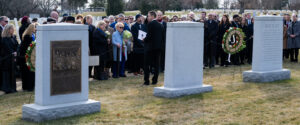

Even though the formal ceremonies are over, many of us will be thinking of the brave crews of Apollo 1 on Tuesday (January 27), Challenger on Wednesday (January 28), and Columbia on Sunday (February 1).


Elsewhere, one of the big events this week is the two-day 18th European Space Conference in Brussels. It opens on Tuesday with brief (10 minute) keynotes by four officials including European Union Commissioner for Defense and Space Andrius Kubilius and ESA Director General Josef Aschbacher. Kubilius and Aschbacher will then hold a “joint press point” with reporters. Aschbacher’s keynote and the press point will be livestreamed on ESA TV. Several other portions of the conference, including another Aschbacher keynote on the second day, also will be live on ESA TV. It’s not clear what other segments will be available virtually live or later (the conference’s website has many videos from last year), but it’s got a great lineup of speakers. Note that times on the agenda are in Central European Time; subtract 6 for EST.
Commercial Space Week is also this week in Orlando, FL. Running from Tuesday-Friday, it combines three events in one venue. The GSA Spaceport Summit is Tuesday. The Space Mobility Conference is Wednesday and the SpaceCom|Space Congress conference is Thursday-Friday. Those two have an expo Wednesday-Friday. Looks terrific as always, but no virtual option that we can see.
Another event we’ll mention even though it’s invitation-only is being sponsored by the Secure World Foundation and the Carnegie Endowment for International Peace. “Strengthening Stability at the Space-Nuclear Nexus” on Thursday is the first of two events in a two-year dialogue supported by a grant by the Carnegie Corporation of New York to look at the intersection of the nuclear policy, space security, and commercial space domains. The not-for-attribution discussion will focus on “how evolving space activities are shaping strategic stability and how coordinated policy responses can reduce risk.” Sounds really interesting!
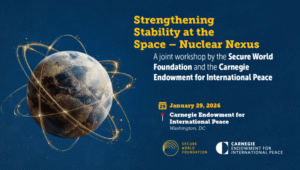
Those and other events we know about as of Sunday morning are shown below. Check back throughout the week for others we learn about later and add to our Calendar or changes to these.
Sunday-Thursday, January 25-29
- American Meteorological Society (AMS) Annual Meeting, Houston, TX
Monday-Wednesday, January 26-28
- Middle-East Space Conference (Novaspace), Oman
Tuesday, January 27
- Northrop Grumman 4th Quarter 2025 and Full Year 2025 Financial Results Telecon, 9:30 am ET, virtual
- Boeing 4th Quarter 2025 Financial Results Telecon, 10:30 am ET, virtual
Tuesday-Wednesday, January 27-28
- LSSW: Results from Early CLPS Deliveries and Upcoming CLPS Exploration Activities, virtual, 11:00 am-5:00 pm ET each day
- 18th European Space Conference, Brussels, Belgium (several events broadcast on ESA TV)
Tuesday-Friday, January 27-30
- Commercial Space Week, Orlando, FL
- GSA Spaceport Summit
- Space Mobility Conference
- SpaceCom|Space Congress
Thursday, January 29
- Strengthening Stability at the Space-Nuclear Nexus (SWF/Carnegie Endowment), 1779 Massachusetts Ave, NW, Washington, DC (invitation only)
- Lockheed Martin 4th Quarter 2025 and Full Year 2025 Financial Results, virtual, 8:30 am ET
Thursday-Friday, January 29-30
- Interagency Astronomy and Astrophysics Advisory Committee (AAAC), Alexandria, VA/virtual
Friday, January 30
- Two Crew-12 Pre-Launch Briefings (NASA), Johnson Space Center, TX, 11:00 am and 1:00 pm ET (watch on NASA’s YouTube channel)
This article has been updated.
User Comments
SpacePolicyOnline.com has the right (but not the obligation) to monitor the comments and to remove any materials it deems inappropriate. We do not post comments that include links to other websites since we have no control over that content nor can we verify the security of such links.