What’s Happening in Space Policy March 29-April 4, 2026
Here is SpacePolicyOnline.com’s list of space policy events for the week of March 29-April 4, 2026 and any insight we can offer about them. The House and Senate are in recess this week except for pro forma sessions.
During the Week
We all know about one BIG EVENT this week, the launch of Artemis II, but there’s another one as well — the White House will send the FY2027 budget request to Congress on Friday. Both big in their own ways.
Artemis II will send the first humans around the Moon since the Apollo era. The budget request will indicate the level of support for the rest of the bold lunar exploration plan NASA Administrator Jared Isaacman rolled out last week and whether other parts of the agency will be cut back to accommodate it.
First, Artemis II. If all goes according to plan, NASA’s Reid Wiseman, Victor Glover and Christina Koch and Canadian Space Agency astronaut Jeremy Hansen will lift off from Kennedy Space Center on Wednesday, April 1, at 6:24 pm ET. That’s the opening of a two-hour launch window that day.

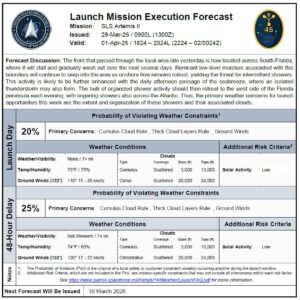
Weather and technical anomalies can always intervene, of course. The launch window is open through April 6. If they can’t launch by then, the next opportunity opens on April 30. As of this morning (Sunday), the Space Force’s 45th Weather Squadron gives a 20% Probability of Violation (POV), which is 80% “go.” Primary concerns are possible violations of the Cumulus Cloud Rule, the Thick Cloud Layers Rule, and Ground Winds. As with crew launches to the ISS, the weather also has to be good along the ascent corridor out to the east over the Atlantic Ocean should there be a need for an abort. Orion has a Launch Abort System just like Crew Dragon and Starliner that can separate the spacecraft from the rocket for the first three minutes or so of flight.
NASA has a number of public events leading up to the launch. Times are subject to change so check NASA’s website for updates. This morning (Sunday) the crew will answer questions from reporters remotely from their quarantine quarters. Originally planned for 9:30 am ET, it’s now at 11:30 am ET. Then a NASA news conference at 2:00 pm ET today, another at 5:00 pm ET Monday following the Mission Management Team meeting, the pre-launch press conference on Tuesday at 1:00 pm ET, and then launch coverage on Wednesday starts with tanking at 7:45 am ET, and at 12:50 pm ET begins on NASA+ that continues through launch at 6:24 pm ET and until Orion’s solar arrays deploy after reaching orbit. A post-launch press conference will take place about 2.5 hours after launch.
A detailed timeline of launch events is available on NASA’s website. It’s very important to bear in mind that everything may not go according to plan on this test flight, the first time humans will travel to the distance of the Moon in 53 years. Commander Reid Wiseman made clear on Friday: “April 1st is not a guarantee. April 6th is not a guarantee. We got to go feel this whole thing out.”
We’ll post whatever updates we get when we get them, but check NASA’s social media outlets and website as well.
Whenever they lift off, Artemis II will spend about a day in Earth orbit to check out systems before heading off on a 9-day trip around the Moon on a free-return trajectory that will bring them back to Earth even if the Orion propulsion system doesn’t perform as planned, splashing down in the Pacific Ocean at the end of trip.

Second, the FY2027 budget roll-out. Rumors have been circulating for a while that it would come out this week. On Thursday Senator Susan Collins (R-Maine), chair of the Senate Appropriations Committee, told Politico it would be sent to the Hill at the end of this week and Politico other news sources now report that it will be April 3.
Isaacman repeatedly says NASA does not have a “top-line” problem, meaning the roughly $25 billion a year it’s been getting for the past several years, which is unadjusted for inflation, is sufficient for everything he wants NASA to do in exploration, space operations, science, technology, aeronautics, STEM, and workforce development. It’ll be interesting to see how that is spelled out in the request.
The U.S. Space Force also has expansive plans. A substantial portion of its FY2026 budget came not through the regular appropriations process (the request was actually less than it got in FY2025), but through the reconciliation bill — the One, Big Beautiful Bill Act (OBBBA). The total was about $40 billion, a significant increase over FY2025. House and Senate Republicans are debating whether or not to go for another reconciliation bill this year, which can pass the Senate with a simple majority so unlike an appropriations bill can reflect purely partisan rather than bipartisan priorities. We’ll see what the request for USSF is this year and if that’s a harbinger of whether another reconciliation bill is on the horizon. NASA benefited from the reconciliation bill last year too, of course, with $10 billion added by Sen. Ted Cruz (R-Texas).
Hard to top all that for excitement this week, but there are several other very interesting events.
The lunar exploration plan Isaacman announced last Tuesday included a plan to launch a demonstration space nuclear fission reactor in 2028 that will drop off Ingenuity-like helicopters on Mars before continuing out into interplanetary space. As it happens, this Thursday the Association of Commercial Space Professionals and the Nuclear Energy Institute will hold a seminar on the “regulatory, technical, and safety frameworks governing the launch of nuclear power sources.” Very timely.
On the national security space front, the Mitchell Institute will hold its 4th annual Spacepower Security Forum on Wednesday in Arlington, VA. U.S. Space Force Chief of Space Operations Gen. Chance Saltzman will give the keynote address, and Air Marshal Paul Godfrey, USSF Assistant Chief of Space Operations for Future Concepts and Partnerships, will participate in a fireside chat at lunchtime. Panels include “Buying at the Speed of Threat: Acquisitions in a New Era,” “Operationalizing Spacepower,” and “Operating a Warfighting Service.” Looks terrific. No mention of a virtual option, unfortunately.
The House and Senate are on spring break. They return the week of April 13th.
Those and other events we know about as of Sunday morning are shown below. Check back throughout the week for others we learn about later and add to our Calendar or changes to these. Note that all Artemis II news conferences and other events are subject to change. Check NASA’s website for updates.
Sunday, March 29
- Artemis II Crew Media Briefing, virtual, 11:30 am ET (watch on YouTube)
- Artemis II News Conference, KSC, 2:00 pm ET (watch on YouTube)
Monday, March 30
- NASA Artemis II Post-MMT News Conference, KSC, 5:00 pm ET (watch on YouTube)
- Virgin Galactic 4th Quarter 2025 and Full Year 2025 Financial Results Telecon, virtual, 5:00 pm ET
- ISU-DC Space Café with the Netherlands Embassy, 4200 Linnean Ave, NW, Washington, DC, 6:00-8:00 pm ET
Monday-Wednesday, March 30-April 1
- STC 2026: Central Eurasia Space Tech Conference, Tashkent, Uzbekistan
Tuesday, March 31
- Direct to Device Regulation: Paving the Way for Satellite 5G/6G (ITU/GSOA), virtual, 10:00 am ET/16:00 CEST
- The Energy Imperative Driving the Push Toward Orbital Data Centers (Space News), virtual, 1:00-1:45 pm ET
- NASA Artemis II Pre-Launch News Conference, KSC, 1:00 pm ET (watch on YouTube)
Wednesday, April 1
- Launch of Artemis II
- NASA coverage of tanking begins 7:30 am ET
- NASA launch coverage begins 12:50 pm ET
- Launch, 6:24 pm ET (2-hour launch window)
- Post-Launch News Conference approximately 2.5 hours after launch
- 4th Annual Spacepower Security Forum (Mitchell Institute), Army Navy Country Club, Arlington, VA, 9:00 am-3:00 pm ET
Thursday, April 2
- Nuclear Launch Seminar (ACSP/NEI), 1201 F St, NW, Washington, DC, 8:00-5:00 pm ET
User Comments
SpacePolicyOnline.com has the right (but not the obligation) to monitor the comments and to remove any materials it deems inappropriate. We do not post comments that include links to other websites since we have no control over that content nor can we verify the security of such links.