Tory Bruno Leaves ULA, John Elbon Takes Over As Interim CEO
The owners of the United Launch Alliance rocket company announced today that CEO Tory Bruno has left the company to pursue another opportunity. In the surprise statement, Lockheed Martin and Boeing said Chief Operating Officer John Elbon will step in as interim CEO and Mark Peller will become COO. Bruno said in a post on X that his work at ULA is “now complete” and he will be cheering ULA on.
Bruno became President and CEO of ULA in August 2014 at a time when the U.S. and global launch market was undergoing rapid change.

ULA was formed in 2006 as a 50-50 Boeing-Lockheed Martin joint venture merging Boeing’s Delta and Lockheed Martin’s Atlas rocket programs. At the time, Delta and Atlas were the only U.S. rockets capable of launching heavy Department of Defense satellites, which was pretty much the entire launch market in the United States as commercial customers turned largely to less expensive foreign competitors. ULA became the sole provider of national security space launches in addition to launching occasional NASA spacecraft.
The arrival of SpaceX’s Falcon 9 in the early 2010s changed the U.S. launch industry dramatically with its reusable first stage leading to lower launch costs. SpaceX challenged the U.S. government to open national security launch opportunities to non-ULA providers. It was a hard-fought battle in part because DOD had confidence in ULA with its long history of Atlas and Delta successes and was wary of a newcomer with a slim track record, but SpaceX eventually won the right to compete.
A long-time Lockheed executive in strategic missile programs, Bruno moved over to ULA in 2014 as another sea-change was underway. A few months earlier, Russia had annexed Crimea in its first invasion of Ukraine. ULA’s Atlas V rocket uses Russian RD-180 engines, sparking concerns about U.S. reliance on Russia to put U.S. military satellites into space amid a changing geopolitical landscape. After a lengthy, bitter debate, in 2016 Congress directed that DOD could not award contracts for launches on rockets using Russian engines after December 31, 2022. ULA was the only company in that category. (The law did not cover non-military launches so Orbital ATK’s Antares was not affected.)
Bruno’s task then became designing a new all-American rocket. He decided to phase out both Atlas and Delta and replace them with Vulcan. His 2018 selection of Jeff Bezos’s Blue Origin to provide BE-4 engines for Vulcan surprised many because of Blue Origin’s lack of experience and the novelty of liquid methane-liquid oxygen engines at the time.
Development of Vulcan and of the BE-4 engines took much longer than expected, which is not unusual in the rocket business, but at the same time SpaceX was moving forward forcefully with Falcon 9, Falcon Heavy, and more recently Starship. The launch business today is almost unrecognizable from 20 years ago when ULA was formed.
Non-reusable rockets like Vulcan have their work cut out for them to compete against SpaceX and Blue Origin’s New Glenn. Bruno staunchly defends his decision to focus Vulcan on high performance in-space capability, especially for national security satellites headed to high orbits, instead of reusability. ULA hasn’t ruled out trying to recover the engines, but not the first stage as SpaceX and Blue Origin do.
It also took much longer than expected for Vulcan to be certified by the U.S. Space Force to launch national security satellites. Vulcan’s first launch in January 2024 was perfect, but the second in October 2024 was marred when the nozzle on one of the two Solid Rocket Boosters strapped to Vulcan’s side detached.
Five of ULA’s six launches this year used Atlas Vs. About 10 more are waiting to go as the transition to Vulcan continues. Amazon’s satellite broadband Internet system Amazon Leo (formerly Project Kuiper) is a major ULA customer using both rockets. ULA just launched its fourth set of Amazon Leo satellites last week.
Atlas V at work. Highlights from Amazon Leo 4.@Amazonleo pic.twitter.com/tfpUAl6LG9
— ULA (@ulalaunch) December 18, 2025
Amazon and the U.S. Space Force have booked about 60 Vulcan launches so far. The problem is increasing the cadence. As recently as August, Bruno expressed optimism Vulcan would be launching twice a month by the end of 2025, but it didn’t come close. The August launch for the U.S. Space Force was the only Vulcan liftoff all year.
In a joint statement, the co-chairs of ULA’s Board, Robert Lightfoot, President of Lockheed Martin Space, and Kay Sears, Boeing’s Vice President and General Manager of Space, Intelligence & Weapon Systems, thanked Bruno for nearly 12 years of service to ULA and the country and for his leadership.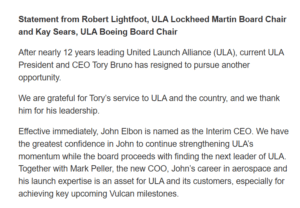
In two posts on X this afternoon, Bruno gave no hint of his new plans, simply saying thanks and praising the ULA team.
Thank you. It has been a great privilege to lead ULA through its transformation and to bring Vulcan into service. My work here is now complete and I will be cheering ULA on. https://t.co/zlmPyEfpxR
— Tory Bruno (@torybruno) December 22, 2025
Thank you for the opportunity to lead this amazing team. They have put ULA in a great position to do important things for our customers and Nation. https://t.co/xclksD2EpX
— Tory Bruno (@torybruno) December 22, 2025
Bruno started his own podcast, Burn Sequence, several months ago, where he discusses space issues, particularly rocket engineering, with a range of interesting guests. The most recent was posted earlier today where he interviews — Santa Claus! They amusingly compare launching rockets and delivering presents to every girl and boy around the world in just 24 hours.
— ULA (@ulalaunch) December 22, 2025
ULA’s COO John Elbon will move up to serve as CEO on an interim basis. Elbon spent 35 years at Boeing before joining ULA in 2018.

Peller will take over as COO. He’s been serving as ULA’s Senior Vice President for Vulcan Development and Advanced Programs.
User Comments
SpacePolicyOnline.com has the right (but not the obligation) to monitor the comments and to remove any materials it deems inappropriate. We do not post comments that include links to other websites since we have no control over that content nor can we verify the security of such links.