Final FY2026 NASA/NOAA Appropriations Bill Clears Senate, White House is Next
The Senate passed a second minibus of three FY2026 appropriations bills this afternoon that includes the Commerce-Justice-Science (CJS) bill, which funds NASA and NOAA. It is the final congressional step towards funding those agencies for the rest of this fiscal year at levels much closer to FY2025 than the deep cuts proposed by the Trump Administration. President Trump still must agree to sign it into law. The bill funds Energy-Water and Interior-Environment as well as CJS. If enacted, it would mean departments and agencies in six of the 12 appropriations bills would be set for the rest of FY2026. The other six, including Defense, remain under consideration. [UPDATE: Trump signed the minibus on January 23.]
The Senate passed H.R. 6938 this afternoon with a bipartisan vote of 82-15. The 82 yes votes were cast by 46 Republicans, 35 Democrats and one Independent. The 15 no votes were from 9 Democrats, 5 Republicans, and one Independent. Two Republicans and one Democrat did not vote.
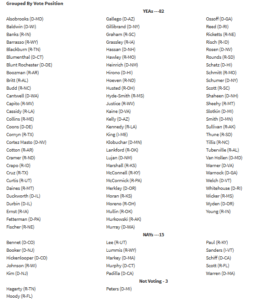
Colorado’s two Democratic Senators, John Hickenlooper and Michael Bennet, voted against the bill after Republicans blocked their amendment to maintain core funding for the National Center for Atmospheric Research (NCAR), located in Colorado. Office of Management and Budget (OMB) Director Russell Vought said on December 17 that it will be dismantled because it is a source of “climate alarmism.” NCAR is overseen by the National Science Foundation, also funded in the CJS bill.
House and Senate appropriators are striving to pass all 12 bills to reestablish regular order to the appropriations process and reassert the “power of the purse” given to Congress in Article I of the Constitution. For FY2025, none of the bills passed and all departments and agencies funded through discretionary spending operated under a year-long Continuing Resolution (CR).
Congress passed three FY2026 bills — Agriculture, Legislative Branch, and Military Construction-Veterans Affairs — as the first minibus in November along with the CR that ended the record-breaking 43 day shutdown. That set the clock ticking to pass the other nine bills before the CR expires on January 30.
When all 12 appropriations bills are collected into one it’s called an “omnibus.” A smaller set is called a “minibus.” Members on both sides of Capitol Hill and from both parties object to omnibus bills where a small group of members meet largely behind closed doors to work out the details. Ideally, each of the 12 bills would be debated individually, but over the years it’s become increasingly difficult to find consensus that way. By grouping several together enough members can get enough of what their constituents want to reach closure.
They are very close to getting this minibus enacted if Trump agrees even though funding levels for agencies like NASA and NOAA are higher than his budget request.
Congress rejected the Administration’s proposed 24.3 percent cut to NASA, from $24.8 billion to $18.8 billion, keeping NASA at roughly its current spending level: $24.438 billion instead of $24.838 billion in FY2025.

The same is true for NOAA as a whole, which will get $6.171 billion, close to the $6.183 billion it had for FY2025, instead of the $4.515 billion requested. NOAA’s Office of Space Commerce, which is developing the Traffic Coordination System for Space, TraCSS, would get $55 million, close to the $65 million it had in FY2025 instead of the $10 million requested.
TraCSS would provide a basic level of Space Situational Awareness (SSA) data to civil and commercial satellite operators to avoid satellite collisions. Such collisions produce debris that imperils all users of Earth orbit, government and commercial alike. Premium SSA services would be available from commercial providers.
The Trump Administration wanted to eliminate TraCSS even though it was created in response to Trump’s Space Policy Directive-3 (SPD-3) in his first term. The theory was that the private sector has demonstrated it can provide SSA and space traffic management (STM) services and thus the intent of SPD-3 has been met.
The Senate disagreed in its version of the bill and provided $60 million “to continue expanding the operational capabilities of TraCSS.”

But the future of the program remains unsettled. The House appropriations committee’s report language wasn’t clear about its vision for TraCSS. The committee encouraged NOAA “to avoid duplicative investments in new proprietary systems and instead prioritize the acquisition and integration of existing, government-proven technologies … operationalized” by DOD. It directed NOAA to adopt “such architectures and data frameworks, particularly those that provide scalable, federated access to orbital data from multiple sources.”
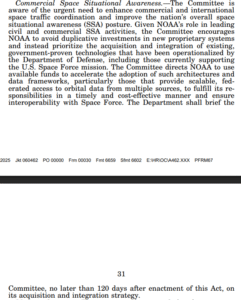
The opening paragraphs of the minibus make clear that unless otherwise stated, language in the House and Senate bills “carries the same weight as language” in the conference version.

How the appropriations committees and NOAA reconcile the differences remains to be seen.
In the meantime, President Trump signed an Executive Order on December 18 that implies the government will not provide a basic level of data for free. Under SPD-3, “basic U.S. Government-derived SSA data and basic STM services should be available free of direct user fees,” but the EO replaces “free of direct user fees” with “for commercial and other relevant use.”
This article has been updated.
User Comments
SpacePolicyOnline.com has the right (but not the obligation) to monitor the comments and to remove any materials it deems inappropriate. We do not post comments that include links to other websites since we have no control over that content nor can we verify the security of such links.