Swift Rescue Mission May Not Have Succeeded, But No Regrets
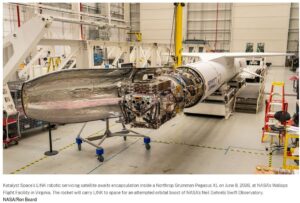
The bold mission to extend the lifetime of NASA’s Swift observatory is coming to an end in the next 24 hours. Almost exactly one year after NASA signed a contract with Katalyst Space to grapple Swift and boost its deteriorating orbit with the LINK spacecraft, LINK itself will reenter with Swift following in coming months. Though ultimately unsuccessful, NASA and Katalyst feel the mission broke through some barriers, leaving lessons for the future.
Speaking to the National Academies’ Committee on Astronomy and Astrophysics (CAA) today, Katalyst’s Kieran Wilson said he is still the Principal Investigator (PI) for LINK “for another 24 hours or so until it reenters.”
NASA signed a $30 million contract with Katalyst on September 25, 2025 to design, build and launch a robotic system, LINK, to raise Swift’s orbit back up to 600 kilometers where it was delivered in 2004 to study gamma ray bursts in the universe. Unexpectedly intense solar activity is causing the orbit to decay faster than expected. Without the reboost, NASA anticipates it will reenter later this year.
Officials from NASA and Pennsylvania State University, which operates Swift, joined Wilson in sharing the herculean efforts in the race against time. The first hurdle was getting the contract in place at the very end of FY2025 with a government shutdown looming that turned out to be the longest in history. NASA’s Science Mission Directorate and Goddard Space Flight Center found ways to expedite internal processes by walking down the hall and explaining to other parts of the agency why this was urgent.
[Katalyst] needed a huge influx of cash in order to go buy stuff. Otherwise, we never would have made it. And so the machinations that we had to do in order to get that money out the door before the government closed the doors, and we knew it wasn’t going to be a short one either last year. So it was just a fever pitch of activity, and those things don’t happen if you don’t have backing all up and down the organization. So, you know, there was an acceptance of taking a huge risk, doing something bold up and down the organization, and that resonated with the team at Katalyst. It resonated with the project management team, and you know Brad [Cenko, Swift’s PI] as well. So I commend Brad’s leadership and tone to the team as we went after this. It was never a question of should we. It was always like how, how can we do this for Swift?” — John Von Eepoel, deputy project manager for the “Swiftly” mission, NASA Goddard
Katalyst, needing to get parts on an expedited basis, found that suppliers were all-in on an exciting effort to rescue a telescope and willing to let them jump the queue for critical components.
In the meantime, Jamie Kennea, then the Swift Science Operations Lead at Penn State (now with Schmidt Sciences) and his team kept reorienting Swift to reduce drag and maintain altitude as much as possible.
But in the end, technical failures meant the reboost couldn’t happen.
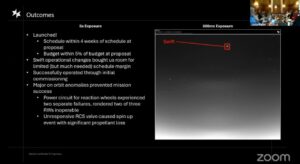
An unresponsive Reaction Control System (RCS) valve caused LINK to spin up and then a power circuit switch failure doomed the effort.
“About a week into the mission we experienced a failure of a reaction wheel switch on our power system. … We implemented a bunch of software changes on the spacecraft and operational changes in order to mitigate the cause of that issue … and then we ended up having a series of events that started with an unresponsive RCS valve, causing the spacecraft to spin up … and downstream of that was another power circuit switch failure… These two events are, really, the loss of the reaction wheels, I think is largely responsible for the fact that we weren’t able ultimately to perform rendezvous operations, capture Swift or any sort of reboost, but we came very, very close. All of our robot arms deployed as expected. … All of our thrusters, the EP thrusters, operated as expected.” — Kieran Wilson, Katalyst Space
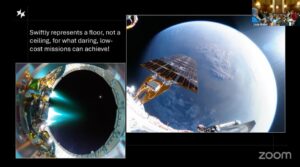
Wilson emphasized this was just a first step and they “couldn’t be more proud of the team and what we have been able to do so far.”
LINK was launched by a Pegasus-XL rocket that was taken aloft by Northrop Grumman’s Stargazer L-1011 aircraft on July 3.
Swift was not designed to be reboosted and doesn’t have grappling fixtures, but NASA viewed this as a way to demonstrate on-orbit servicing for a modest price, $30 million, and get more years of data from this unique space telescope. Swift looks at the universe in the visible, ultraviolet, X-ray, and gamma-ray bands. The name refers to its ability to swiftly repoint itself when a gamma ray burst is detected so the other instruments can study it in more detail in the other spectral bands.
User Comments
SpacePolicyOnline.com has the right (but not the obligation) to monitor the comments and to remove any materials it deems inappropriate. We do not post comments that include links to other websites since we have no control over that content nor can we verify the security of such links.