Katalyst’s LINK On Its Way to Reboost Swift
Katalyst Space’s LINK on-orbit servicing spacecraft is on its way to reboost NASA’s Swift observatory. Northrop Grumman’s Pegasus-XL rocket launched LINK this morning, July 3, and contact was successfully established, the first step in a series of checkouts before it approaches Swift in what NASA calls a high-risk, high-reward effort. [Update, July 4: orbital parameters added.]
NASA’s Neil Gehrels Swift Observatory has been in space since 2004 studying gamma-ray bursts. With three multiwavelength telescopes, Swift looks at the universe in the visible, ultraviolet, X-ray, and gamma-ray bands. Gehrels was Swift’s Principal Investigator and NASA named the observatory in his honor after he passed away in 2017.
Swift’s orbit is decaying more rapidly than expected because of increased solar activity. Last September NASA gave Katalyst a $30 million contract to demonstrate the potential of on-orbit servicing by boosting Swift into a higher, stable orbit so it can continue observations. In May, Swift’s mission director John Van Eepoel called it a “fast, high risk, high reward mission.”
In a September 2025 press release, Katalyst said it had been planning an in-space demonstration of its rendezvous, proximity operations, and docking technology for June 2026 prior to a planned 2027 launch of its NEXUS robotic spacecraft, but after NASA “raised the alarm” about Swift, they “seized the opportunity to pivot to a live rescue operation which would demonstrate similar capabilities.”
Katalyst chose Northrop Grumman’s Pegasus XL rocket to launch LINK. Pegasus was developed by Orbital Sciences Corp., which merged with ATK to form Orbital ATK and was later acquired by Northrop Grumman. Pegasus XL takes off under the wing of a specially designed Northrop Grumman L-1011 aircraft named Stargazer. After detaching at about 40,000 feet, Pegasus’s engines fire to send the payload into orbit. The first Pegasus flight was in 1990 and this is the last one under contract.
LINK was integrated into Pegasus at NASA’s Wallops Flight Facility on June 9.
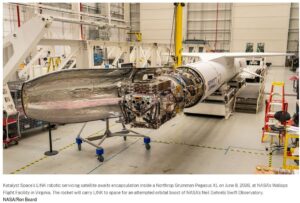
Pegasus then was attached to Stargazer and flown to Kwajalein Atoll in the Marshall Islands, chosen as the departure point because Swift is in a relatively low inclination orbit at 20.6 degrees. Weather delayed liftoff on June 30 and July 1, and a technical problem with Pegasus caused another scrub yesterday, but everything went smoothly today, July 3. Stargazer lifted off at 4:26 am Eastern Daylight Time.
Today our Pegasus XL rocket successfully launched the @KatalystSpace LINK servicing spacecraft to boost the @NASA Swift observatory. Learn more: https://t.co/cw0ltTVpNr pic.twitter.com/CSgg7oCC6p
— Northrop Grumman (@NGCNews) July 3, 2026
[Update, July 4: Jonathan McDowell of Jonathan’s Space Report posted on X (@planet4589) today that the U.S. Space Force has catalogued LINK “in a 362 x 392 km x 20.6 deg orbit, confirming a successful launch.”]
At a June 17 press conference, Katalyst’s Kieran Wilson said LINK will have a commissioning period of a few weeks before beginning its approach to Swift.
Swift was not designed to be reboosted and doesn’t have grappling fixtures. Wilson called it an “unprepared but cooperative partner.” But it’s good at pointing — the name Swift refers to its ability to quickly repoint itself when a gamma ray burst is detected so the other instruments can study it in the X-ray and UV bands.
When the two spacecraft get close to each other, they will move in tandem while LINK finds “capture locations” where at least one of its three grippers can attach. Once joined, LINK will slowly raise the orbit over two to three months.
Time is of the essence. NASA estimates that Swift’s orbit will drop below 300 kilometers in October, after which a reboost likely would not be possible.
User Comments
SpacePolicyOnline.com has the right (but not the obligation) to monitor the comments and to remove any materials it deems inappropriate. We do not post comments that include links to other websites since we have no control over that content nor can we verify the security of such links.