ULA Investigating Low Booster Performance in Vulcan Launch Failure
The United Launch Alliance said today that low performance of its first stage booster is suspected of causing the failure of Vulcan Leo 1 on Sunday. It was the first launch failure in ULA’s 30-year history.
Vulcan was launching 40 satellites for Amazon’s satellite internet constellation Amazon Leo (formerly Project Kuiper). It was the 10th ULA launch for Amazon Leo, but the previous nine were on the Atlas V rocket that Vulcan is replacing.
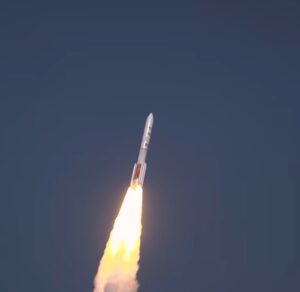
Sunday’s liftoff at 12:40:30 pm ET appeared nominal at first. On two prior Vulcan launches, Solid Rocket Boosters (SRBs) on the side of the core stage malfunctioned, but this time appeared to perform perfectly. As the launch progressed, however, something went awry. ULA’s webcast tracked the rocket’s altitude in the bottom right corner and it clearly was not ascending to orbital altitude more than 9 minutes into the flight and a “live data” notation on the top right changed to “no data.”
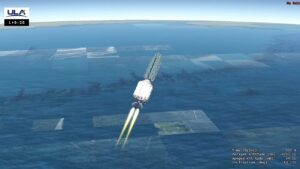
ULA ended its webcast and at 1:30 pm ET announced that an anomaly occurred 10 minutes into flight and the satellites were not delivered to orbit.
Speculation on social media quickly turned to underperformance of Vulcan’s core stage, which is powered by two BE-4 liquid methane/liquid oxygen (methalox) engines built by Jeff Bezos’s company Blue Origin and used for their own New Glenn rocket. The BE-4’s performed as planned during launch on the four previous Vulcan flights and three New Glenns.
But in May a New Glenn rocket exploded on its launch pad during a pre-launch test. In an interview prior to Sunday’s Vulcan launch, ULA President Mark Peller told Aviation Week & Space Technology that the explosion was traced to a BE-4 main oxidizer valve that is common to the BE-4s on Vulcan and changes were subsequently made for this flight.
The cause of Vulcan’s failure has not been determined yet, but ULA said today “early indications” are that the rocket “experienced low booster performance,” referring to the first stage or core stage that uses the BE-4 engines. The six Solid Rocket boosters performed as planned, ULA said, as did the Centaur V upper stage, or second stage, which is equipped with Aerojet Rocketdyne RL-10 engines, but it couldn’t compensate for the booster’s underperformance.
Immediately following our launch anomaly during the mission carrying Amazon’s Leo spacecraft on Sunday, Nov. 15, the team began its investigation and review of the data. The FAA will oversee the ULA-led investigation, be involved in every step of the process, and approve ULA’s final report, including any corrective actions. It is very early in the process, and we want to focus on the data and avoid speculation until the investigation is complete.
While we appear to have lost telemetry and the mission at approximately 10 minutes into flight, early indications are that just after liftoff the launch vehicle experienced low booster performance, resulting in stage separation occurring when the vehicle was low in altitude and below minimal velocity to reach orbit.
The Vulcan second stage appears to have started nominally, and the RL10 engines were operating as planned. The second stage was performing well but was unable to recover from the performance loss resulting in loss of mission.
All indications are that the solid rocket booster performance was nominal, following nozzle improvements implemented for this launch.
We truly understand the impact this has on our customers and are committed to returning to flight as safely and quickly as we can. — Statement from ULA, November 17, 2026
That does not mean the BE-4 engines were the problem. The investigation is continuing.
The FAA regulates commercial space launches and reentries and is requiring ULA to perform a mishap investigation.
The failure is a problem not only for ULA as a company, but for government and commercial customers relying on the rocket’s heavy lift capacity. That especially includes national security launches.
This was the fifth flight of Vulcan, ULA’s replacement for the Delta IV and Atlas V rockets that have been the mainstay of their fleet since the company was founded in 2006. Atlas V has a 100 percent success record, but uses Russian RD-180 engines. Following Russia’s annexation of Ukraine’s Crimea Peninsula in 2014, Congress required ULA to end U.S. reliance on Russian engines for national security launches. Although the law allowed Atlas to be used for civil and commercial launches, ULA decided to phase out both Atlas V and Delta IV and replace them with Vulcan. Delta IV also had a 100 percent success rate between 2006 and its final launch in 2024. Six Atlases remain, but are under contract to Boeing for Starliner.
Vulcan’s first flight in 2024 was a complete success. However, on flights two and four, in 2024 and 2026 respectively, nozzles on the Northrop Grumman Solid Rocket Boosters (SRBs) malfunctioned. Vulcan’s core stage compensated for the underperformance and delivered the payloads to their intended destinations so they count as mission successes, but the U.S. Space Force has been hesitant to use Vulcan until the anomalies are resolved. Sunday’s launch was intended to be proof that they were.
User Comments
SpacePolicyOnline.com has the right (but not the obligation) to monitor the comments and to remove any materials it deems inappropriate. We do not post comments that include links to other websites since we have no control over that content nor can we verify the security of such links.