A Great Day for Starship
SpaceX got some much needed good news today with a successful Starship flight test. After three failures in a row, tonight’s suborbital Integrated Flight Test-10 seemed to be flawless with launch, payload deployment, in-space engine relight, and soft landings of the booster in the Gulf and the ship in the Indian Ocean.
After two attempts were scrubbed on Sunday and Monday, today was the charm. From liftoff at Starbase, Texas at 6:30 pm Central Time (7:30 pm Eastern) to Starship’s splashdown an hour and six minutes later three-quarters of the way around the world, IFT-10 nailed it.
Liftoff of Starship! pic.twitter.com/d6d2hHgMa0
— SpaceX (@SpaceX) August 26, 2025
Splashdown confirmed! Congratulations to the entire SpaceX team on an exciting tenth flight test of Starship! pic.twitter.com/5sbSPBRJBP
— SpaceX (@SpaceX) August 27, 2025
Starship (“ship”) is the winged vehicle that sits atop the Super Heavy rocket (“booster”), although the combination is also referred to as Starship.

The Super Heavy booster can either splash down in the water off-shore of Starbase or fly back to the launch site and be “caught” by mechanical arms on the launch tower. Today SpaceX was using the booster for engine tests and chose to direct it to a splashdown in the Gulf, which also was successful today.
Super Heavy has splashed down in the Gulf pic.twitter.com/LGozUAmLt8
— SpaceX (@SpaceX) August 26, 2025
SpaceX needed this flight to succeed and it did. The previous three tests in January (IFT-7), March (IFT-8), and May (IFT-9), ended in RUDs — Rapid Unscheduled Disassemblies — and another Starship exploded during a static fire test in June.
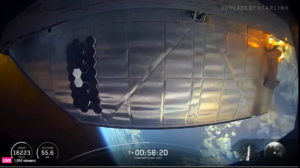
Today’s flight included the first payload deployment of eight simulated next-generation V3 Starlink satellites. Like all these test flights, Starship is on a suborbital trajectory, not achieving orbit, so the simulated Starlinks reentered and burned up in the atmosphere. But it was a successful test of deploying them through Starship’s payload bay door that many liken to a PEZ dispenser.
Open the pod bay door, HAL
Starship deploying @Starlink simulator sats pic.twitter.com/3CSOyulzcJ
— SpaceX (@SpaceX) August 26, 2025
SpaceX has cameras mounted in many places on Starship and sends imagery and data back through Starlink satellites allowing end-to-end coverage including the payload deployments, relighting of one of Starship’s Raptor engines, and reentry.
Starship successfully ignited one of its Raptor engines while in space pic.twitter.com/SNmzyygPBC
— SpaceX (@SpaceX) August 27, 2025
SpaceX was testing the heat shield and the flaps that control the ship during reentry. Some burn-through was evident, which was not surprising since they were deliberately stressing the system.
Acting NASA Administrator Sean Duffy congratulated SpaceX after the flight.
Congratulations to @SpaceX on its Starship test. Flight 10’s success paves the way for the Starship Human Landing System that will bring American astronauts back to the Moon on Artemis III.
This is a great day for @NASA and our commercial space partners.
— NASA Acting Administrator Sean Duffy (@SecDuffyNASA) August 27, 2025
Starship is an essential component of NASA’s Artemis program to return American astronauts to the lunar surface. NASA’s Space Launch System (SLS) rocket and Orion spacecraft will get astronauts to and from lunar orbit, but once there they have to transfer into a Starship Human Landing System (HLS) for the trip down to and back from the surface.
NASA contracted with SpaceX for the HLS in 2021. At the time, NASA was aiming for the Artemis III lunar landing in 2024. Many considered that unrealistic and, indeed, the mission has slipped to mid-2027, but that is just two years away. Starship has a lot of milestones to meet between now and then.
Starship cannot travel directly to the Moon. It must stop in Earth orbit to be refueled at a fuel depot. No such depots exist yet, nor has in-orbit transfer of cryogenic propellants been demonstrated. Under the $2.9 billion contract with NASA, SpaceX must first fly an uncrewed demonstration flight that lands on the Moon’s South Pole and lifts off again, although NASA is not requiring SpaceX to get Starship back into lunar orbit as part of that test.
All that must be completed by mid-2027 when Starship has to be ready to safely deliver two NASA astronauts to the lunar surface and return them to lunar orbit.

SpaceX founder and CEO Elon Musk has an even nearer term goal — launching an uncrewed Starship to Mars at the end of next year. If he misses that November-December 2026 window, he’ll have to wait another 26 months before the Earth and Mars are properly aligned to try again.
Today’s success is a step along the path, but there is much left to do.
User Comments
SpacePolicyOnline.com has the right (but not the obligation) to monitor the comments and to remove any materials it deems inappropriate. We do not post comments that include links to other websites since we have no control over that content nor can we verify the security of such links.