ESA Member States Pledge Record Level of Funding
As ESA celebrates its 50th anniversary, the agency’s 23 Member States just pledged a record 22 billion Euros for the next three years of programs from space and earth science to space transportation to human and robotic exploration to space safety and more. ESA’s budget is set by its Member States every three years and this is a 32 percent increase (17 percent when corrected for inflation) over 2022. ESA Director General Josef Aschbacher called it an “important moment” for Europe’s autonomy and leadership in space.
The two-day 2025 ESA Council at Ministerial Level meeting, CM25, in Bremen, Germany, concluded yesterday with an ebullient Aschbacher announcing the results at a press conference. Joining him were Dorothee Bär, Germany’s Minister for Research, Technology and Space, and Adolfo Urso, chair of CM25 and Minister for Enterprises and Made in Italy. Germany was the host for this meeting. Italy will host the next in 2028.

Aschbacher proposed a budget of €22.254 billion and the ministers approved €22.070 billion. While slightly less than he wanted, he exclaimed that getting this close “has never happened before” and he’d been “managing expectations” since they usually get about 90-93 percent of what they request. The “outstanding” result shows that “space is extremely needed … in everyday life,” a fast-growing economic sector, and “more and more important for security and defense.”
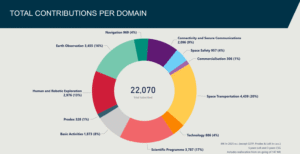
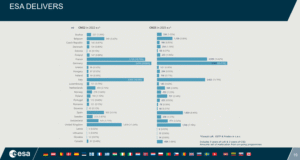
Not all Member States increased their contributions or “subscriptions.” The United Kingdom, Sweden and Romania decreased theirs, but others made up the difference. Canada has a long-standing agreement of cooperation with ESA and in terms of percentage increased its subscription the most, by 400 percent.
ESA is participating in the U.S.-led Artemis program to send astronauts to the Moon. ESA provides the Service Module for the Orion spacecraft and is building segments of the lunar orbiting Gateway space station. The United States agreed to send three European astronauts to Gateway in exchange. Aschbacher announced yesterday that the three astronauts will be from ESA’s biggest contributors — Germany, France, and Italy — and the first will be German.
The human and robotic exploration “envelope” of ESA’s budget, however, got significantly less than requested overall. Aschbacher asked for €3.773 billion and got €2.976 billion.
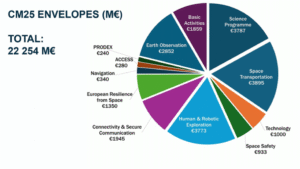
That envelope includes not only human spaceflight, but certain robotic missions to the Moon and Mars. Asked how the money will be allocated among those pursuits, Aschbacher replied ESA will be developing proposals to the Member States on how to adjust across all the programs based on over- and under-subscriptions. The proposals will be discussed at a program board meeting in February.
One robotic program that did get full funding is the ExoMars Rosalind Franklin Mars rover. Daniel Neuenschwander, ESA’s Director of Human and Robotic Exploration, said CM25 approved the full amount ESA needs to be ready for launch in 2028 and Aschbacher reiterated what he said on Wednesday that NASA confirmed its commitment to provide launch, radioisotope heating units (RHUs), and braking engines.
Although details will have to wait, ESA shared a broad outline of what was approved for the next three years. Aschbacher pointed to the “challenging geopolitical situation” as a backdrop to the CM25 decisions.
“In the face of a challenging geopolitical situation all the States contributing to the ESA budget, and indeed the European Commission, have put their faith in ESA to keep delivering programmes that will support European leadership in space, and help stretch our capabilities on Earth, in orbit, and into deep space. While we celebrated 50 years of achievements this year, the work is only beginning.”
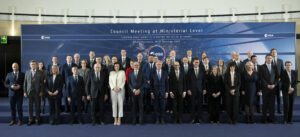
ESA was established in May 1975 as the merger of the European Launcher Development Organisation (ELDO) and the European Space Research Organisation (ESRO). Over the decades, the original 10 members have grown to 23: Austria, Belgium, Czechia, Denmark, Estonia, Finland, France, Germany, Greece, Hungary, Ireland, Italy, Luxembourg, the Netherlands, Norway, Poland, Portugal, Romania, Slovenia, Spain, Sweden, Switzerland and the United Kingdom. Slovenia is the most recent member, joining on January 1, 2025. Canada has had an agreement of cooperation with ESA since 1979 and sits on the Ministerial Council. Slovakia, Latvia and Lithuania are Associate Members. Bulgaria, Croatia, Cyprus and Malta have Cooperation Agreements.
User Comments
SpacePolicyOnline.com has the right (but not the obligation) to monitor the comments and to remove any materials it deems inappropriate. We do not post comments that include links to other websites since we have no control over that content nor can we verify the security of such links.