NASA Meets New Administrator Jared Isaacman
One day after being sworn in as NASA Administrator, Jared Isaacman held a Town Hall meeting with the NASA workforce to introduce himself and answer questions. He praised President Trump’s new Executive Order, assuring everyone that Trump is a strong supporter of NASA’s mission as are others both in the White House and Congress. Acknowledging the current state of budget uncertainty, he stressed the need for NASA to spend every dollar wisely.
The December 19 Town Hall meeting was not livestreamed, but NASA posted the video on YouTube later. After two confirmation hearings and the unauthorized release of his Project Athena document, Isaacman joked that his views already are pretty well known.
The 42-year old entrepreneur, pilot, and commercial astronaut gamely fielded a broad range of questions from across NASA’s field centers, but the overall message was that he is eager to begin learning about the agency from the inside and won’t have many answers until he does. He plans to visit the Centers to get direct input from as many people as he can.

As for Project Athena, which he drafted while preparing for his first hearing in April, Isaacman said again it was written months ago based on information he had at the time and always intended to be updated. A 62-page version was leaked just prior to his second hearing, presumably to hurt his chances because it raised questions about his commitment to NASA’s science missions, especially earth science.
Isaacman had two confirmation hearings because Trump withdrew the nomination and then reinstated it. He was confirmed by the Senate on December 17 and sworn in on December 18 with his parents by his side.
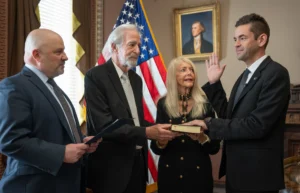
Throughout the meeting, Isaacman praised Trump and the release of the Ensuring American Space Superiority Executive Order (EO) on Thursday, shortly after he was sworn in. Trump put Michael Kratsios, Director of the White House Office of Science and Technology Policy, in charge of implementing the EO, which covers civil, national security and commercial space. Isaacman and Kratsios were in the Oval Office when Trump signed it.
Space has been a lifelong passion of mine. I’m grateful to President Trump for giving me the opportunity to serve alongside the best and brightest at NASA.
It was an honor to have stood with @mkratsios47 as @POTUS signed the most impactful executive space policy in generations.… pic.twitter.com/u0WH5ciOun
— NASA Administrator Jared Isaacman (@NASAAdmin) December 19, 2025
Isaacman insists Trump is a NASA supporter, despite the deep cuts proposed in the FY2026 budget request — a 24.3 percent reduction, from $24.8 billion to $18.8 billion. But Isaacman said he spoke with the President “at least four or five times about space priorities prior to being re-nominated” and “several times since” and found an enthusiast. The Vice President and Congress also are “excited” about the agency.
What has me so energized right now is this … almost whole-of-government support for what we’re trying to accomplish here at NASA, and, again, the President releases a national space policy on [my] day one in the job. I probably spoke with him at least four or five times about space priorities prior to being re-nominated for the job. I’ve spoken to him several times since, and the enthusiasm, the excitement from human space flight to [where] we were discussing robotic Mars missions. These are things that are all very exciting.
But it doesn’t stop there. The Vice President, you know, the leadership across the White House, obviously, you’ve seen how much Congress got engaged across two hearings, both sides of the aisle, excited and fighting for the agency. So from my perspective, sure, I’m sure a lot has evolved in my thinking over [the] time period [since I was first nominated]. But what’s most encouraging right now is how the entire United States government is getting behind this agency, and what we’re going to need to accomplish in the years ahead. That’s pretty, pretty exciting.
Congress has not completed action on the President’s budget request, but the House and Senate Appropriations Committees rejected the cuts. Isaacman said he supports Trump’s efforts to “get spending under control and bring down the national debt,” but wants NASA to know that “I will always advocate passionately for the agency, knowing that we will make the most of every dollar entrusted to us.”
Human spaceflight — not only Moon-to-Mars but the International Space Station and commercial successors to it — science, and aeronautics all got words of support in response to questions asked. One program that got a specific shout-out was planetary defense. Kelly Fast, Acting Planetary Defense Officer, asked a question about software infrastructure. After answering, Isaacman added: “I love your area of responsibility, too. I think that’s one we should be keeping an eye on. We don’t want to go the way of the dinosaurs.”
Planetary defense involves locating and tracking asteroids and comets that might impact Earth with the goal of providing sufficient warning to deflect them. The collision of an asteroid with Earth 66 million years ago is thought to have killed the cold-blooded dinosaurs when dirt and debris was thrown high in the atmosphere and cooled the planet.
For now, the priority is the Artemis II mission that will send four astronauts around the Moon as soon as February. NASA astronauts Reid Wiseman, Victor Glover and Christina Koch and Canadian astronaut Jeremy Hansen will be the first humans to travel beyond the Moon since the Apollo era. A test flight, they will not attempt to orbit the Moon much less land, but instead will be on a free return trajectory that will bring them back to the Earth even if the propulsion system doesn’t perform as planned.
The next mission, Artemis III, is the one that will put American astronauts back on the surface of the Moon. The EO asserts that will happen in 2028, but delays in development of SpaceX’s Starship Human Landing System and Axiom Space’s lunar spacesuits have continually slipped the date. Artemis originated in Trump’s first term when the goal was landing in 2024.
Isaacman said NASA “will look for every opportunity to pull forward the Artemis program to the limits that physics and safety afford.”
User Comments
SpacePolicyOnline.com has the right (but not the obligation) to monitor the comments and to remove any materials it deems inappropriate. We do not post comments that include links to other websites since we have no control over that content nor can we verify the security of such links.