Three Americans and a European Named Crew of Artemis III
Three NASA astronauts and one from the European Space Agency are the crew of the next Artemis mission, Artemis III. Instead of flying around the Moon like their predecessors, this crew will travel only as far as low Earth orbit. Their assignment is conducting critical rendezvous and docking tests with pathfinder versions of the Human Landing Systems being built by SpaceX and Blue Origin to take astronauts down to and back from the lunar surface in 2028. The companies say they’ll be ready for these tests, which NASA Administrator Jared Isaacman said could happen as soon as this time next year.
Until four months ago, Artemis III was pegged to be the first mission to land astronauts on the Moon since the Apollo era. On February 27, however, Isaacman, two months in as the new NASA Administrator, changed the plan. Instead of jumping directly from the Artemis II around-the-Moon flight to landing on the Moon, he inserted an earth-orbital test flight to give astronauts hands-on experience in docking NASA’s Orion spacecraft with the SpaceX and Blue Origin landers. This will be the first time they meet up in space and the crew will have the challenging task of docking and undocking exercises.
The four crew members are Randy Bresnik (NASA, commander), Luca Parmitano (ESA, pilot), Frank Rubio (NASA, mission specialist), and Andre Douglas (NASA, mission specialist). The first three have spaceflight experience already. Douglas is a rookie, but was one of the backups for Artemis II so has extensive knowledge of Orion.
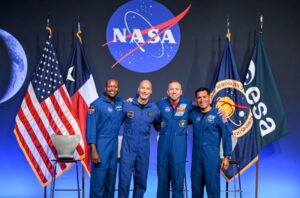
- Randy “Komrade” Bresnik will be making his third spaceflight. A retired Marine Colonel who logged more than 7,000 hours in 95 types of aircraft, he joined the NASA astronaut corps in 2004 and made his first spaceflight in 2009 on the Space Shuttle STS-129 mission to the International Space Station. From July 28-December 14, 2017, he was a member of the ISS Expedition 52/53 mission (Commander of Expedition 53). He accumulated approximately 150 days in space and conducted 5 spacewalks over his two missions.
- Luca Parmitano, a Colonel in the Italian Air Force and European Space Agency astronaut, will also be on this third spaceflight. A test pilot, he became an ESA astronaut in 2009 and made long-duration flights to the ISS in 2013 and 2019 (Commander of Expedition 61). He became well known during his 2013 mission when he remained calm even as his helmet filled with water during a spacewalk. The episode did not deter him from additional spacewalks in 2019. He’s made a total of six and spent about 367 days in space total over his two missions.
- Frank Rubio, a Colonel in the U.S. Army, is making his second spaceflight. A combat helicopter pilot and flight surgeon, he holds the record for longest continuous spaceflight by any American — 371 days. The duration was unexpected. He and his two Russian colleagues, Sergey Prokopyev and Dmitri Petelin, had to spend twice as long on the ISS as planned because their Soyuz MS-22 spacecraft lost all its coolant and was unsafe to return them to Earth. They had to wait for an empty Soyuz to be launched to bring them home, and for the standard 6-month crew rotation schedule to be maintained.
- Andre Douglas, a Commander in the U.S. Coast Guard Reserve, is making his first spaceflight. He conducted search and rescue, maritime salvage and drug interdiction missions while on active duty in the Coast Guard before joining the Johns Hopkins University Applied Physics Lab working on defense and NASA projects, including the Double Asteroid Redirect Test (DART) planetary defense mission. Selected as a NASA astronaut candidate in 2021, he was chosen as the backup NASA astronaut for Artemis II in 2024. His training on Orion and the European Service Module will come in handy.
NASA chose Bob Hines as the backup astronaut for this mission. An Air Force Colonel, he was the pilot of Crew-4, a 2022 mission to the ISS.
In pre-recorded videos shown during the event at Johnson Space Center this morning, Sen. Ted Cruz (R-TX), chairman of the Senate Commerce, Science, and Transportation Committee, and Rep. Brian Babin (R-TX), chairman of the House Science, Space, and Technology Committee, congratulated the Artemis III crew. Separately, Senate Commerce Ranking Member Sen. Maria Cantwell (D-WA) and Senate Appropriations Commerce-Justice-Science subcommittee chairman Sen. Jerry Moran (R-KS) also offered congrats.
The Artemis program began during President Trump’s first term and from the beginning was designed to establish sustained human presence on the Moon jointly with commercial and international partners. Artemis I in 2022 was an uncrewed test flight. Artemis II, just two months ago, was the first flight of humans around the Moon (they did not orbit or land) in more than 50 years and included three NASA astronauts and one from the Canadian Space Agency.
Artemis III will not go to the Moon at all. Instead it will stay in earth orbit on a mission similar to Apollo 9 in 1969 where astronauts tested docking procedures between the Apollo Command Module and its lander, the Lunar Excursion Module. One difference is that the Command Module and LEM launched together on the same rocket. In the Artemis program, the Human Landing Systems or HLSs are being procured through Public-Private Partnerships between NASA and two companies, Jeff Bezos’s Blue Origin and Elon Musk’s SpaceX. The companies design, build and launch the HLSs themselves. NASA is a customer.
Accomplishing the Artemis III mission will require launching three huge rockets and their payloads in rapid succession: NASA’s Space Launch System (SLS) rocket with the Orion capsule that’s home to the crew; Blue Origin’s New Glenn rocket with the Blue Moon Mark 2 (MK2) lander pathfinder; and SpaceX’s Super Heavy/Starship combination.
NASA’s Artemis Program Manager Jeremy Parsons outlined the mission sequence today:
- Blue Origin launches the Blue Moon MK2 lander pathfinder, which can remain in orbit up to 90 days.
- NASA launches the Artemis III crew on SLS/Orion.
- Orion docks with Blue Moon MK2 for about two days for tests and technology demonstrations, including the crew entering the lander.
- Orion detaches from Blue Moon MK2 and waits for Starship.
- Starship arrives and docks with Orion for about one day of joint operations.
- Orion undocks from Starship and returns to Earth, splashing down in the Pacific.
As NASA says — four astronauts, three launches, two dockings, and one splashdown.
No launch date was set. Isaacman said only that work is underway “to converge upon the Artemis III readiness date no earlier than this time next year.” During a discussion with reporters afterwards, posted on X by SpaceFlightNow, Isaacman said they won’t launch until they’re sure the mission’s objectives can be met. That means both landers need to be ready: “we’re not going to launch if we don’t feel like we can get enough out of it in order to ensure a follow-on lunar landing is successful.”
Blue Origin is building a cargo-only lunar-lander version of Blue Moon called Mark 1 (MK1) that the company has been planning to launch for the first time this year. A second Blue Moon MK1 will deliver NASA’s VIPER rover to the Moon next year, and NASA just awarded contracts to Blue Origin to deliver two Lunar Terrain Vehicles before the first NASA crew lands in 2028. MK2, the crew version, is what Artemis III will dock with.
The schedule for all Blue Origin launches is unclear right now, however, following the May 28 explosion of a New Glenn rocket during a pre-launch test on Blue Origin’s only launch pad. Blue Origin’s John Couluris, Senior Vice President for Lunar Permanence, nevertheless expressed optimism today. Acknowledging they had “a significant anomaly,” he said they’re making “excellent progress” on investigating what happened and cleaning up the pad while continuing with construction of a second launch pad nearby.
Determining the root cause of the explosion and rebuilding the pad are key to resuming launches of the New Glenn rocket, though conceivably a different rocket could be used. Isaacman hinted at such a possibility, telling Fox News on June 4 they are “decoupling the lander from the launch vehicle and the pad itself.” What other rocket could accommodate the MK2 lander pathfinder isn’t clear.
As for Starship HLS, SpaceX Vice President for Customer Operations and Integration Jessica Jensen was similarly upbeat. The first test flight of a new version of Starship, Version 3 (V3), was largely successful last month, but it was another suborbital test. Starship has yet to reach earth orbit. They’ll have to do that for Artemis III. Jensen said they’ll use a V3 “off the line with an added docking adapter,” apparently not the HLS version needed to land on the Moon. The first “flight fidelity Starship HLS cabin” is being “actively built” at Starbase, TX.
Starship requires in-space ship-to-ship propellant transfer to go beyond earth orbit, which has never been demonstrated. The first propellant transfer demonstration has been delayed again and again, but she said it’s currently expected later this year.
Though today’s event focused on Artemis III, there also was news about Artemis IV, currently planned as the first landing of U.S. astronauts on the Moon since the Apollo era. NASA is striving to do that by 2028, before Chinese taikonauts arrive and before Trump leaves office.
NASA contracted with SpaceX in 2021 to build the HLS for that mission. The idea so far has been that NASA’s SLS rocket and Orion spacecraft with its European Service Module would deliver the astronauts to lunar orbit. Once there, they’d transfer into SpaceX’s HLS for the trip down to and back from the surface, then return to Orion for the trip home.
Today, NASA and SpaceX confirmed rumors that instead of Starship and Orion docking in lunar orbit, now they’ll do that in earth orbit instead. Starship will propel Orion to the Moon rather than using Orion’s less powerful European Service Module. Starship can put Orion into a lower lunar orbit than the Service Module allowing the crew to return from the surface to Orion more quickly and more often.
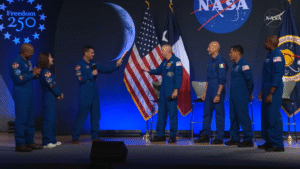
The Artemis II crew — NASA astronauts Reid Wiseman, Victor Glover, and Christina Koch, and Canadian Space Agency Astronaut Jeremy Hansen — frequently remind everyone their mission was just one step to those that follow. Artemis is about establishing a sustained presence on the Moon and then moving on to Mars and beyond, passing the baton from one mission to the next. Three of the four Artemis II crew members were at JSC today to do exactly that, pass the baton to Artemis III.
User Comments
SpacePolicyOnline.com has the right (but not the obligation) to monitor the comments and to remove any materials it deems inappropriate. We do not post comments that include links to other websites since we have no control over that content nor can we verify the security of such links.