Artemis II Crew Says Lunar Landing Doable Soon
The crew of the first mission to fly around the Moon since the Apollo era told reporters today they are still absorbing the experience and what it means to them personally, but they’re confident a lunar landing is doable soon. Gratified about the impact the flight has had especially on young people, the crew shared some advice on how they can make their own impact on the world.
Artemis II Commander Reid Wiseman (NASA), Pilot Victor Glover (NASA), Mission Specialist Christina Koch (NASA) and Mission Specialist Jeremy Hansen (Canadian Space Agency) met with the press today for the first time since they splashed down six days ago. Launched on April 1, they spent just over nine days on a path that took them around the Moon and back to Earth on the first crewed test flight of the Space Launch System rocket and Orion spacecraft.
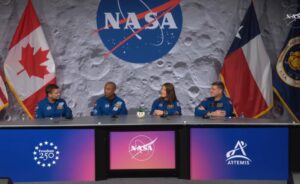
Reflections on their experience range from exuberance to philosophical.
Acknowledging he might have to eat his words, Wiseman said actually landing on the Moon instead of swinging about it is “not the leap I thought it was.” If they’d had a lunar lander on board like the Apollo 10 test flight in 1969, they’d have gone for it. “If you had given us the keys to the lander, we would have taken it down and landed on the Moon. It is not the leap I thought it was. It’s going to be extremely technically challenging, but this team needs to show up every day knowing it is absolutely doable, and it’s doable soon.”
Hansen agreed “we have to be willing to take a little more risk” and find solutions in real time. “We’re not going to be able to pound everything flat before we go. We’re going to have to trust each other and crews and Mission Control to work through real problems” even if things get “real bumpy, real fast.”
Koch added that NASA Administrator Jared Isaacman’s “Ignition” event laying out a new plan for lunar exploration the week before launch “pumped us up” because it means other astronauts soon will be able to do this all over again. Building on Isaacman’s repeated refrain that NASA can do the near-impossible, she asserted “the truth is accomplishing the near-impossible is exactly what we do, and what we just showed that we could do.”
Not that the mission was trouble free. Not only were there problems with the toilet — which Wiseman defended as a really great toilet, the problem was with the vent line — but several alarms went off including a smoke detector.
“We had a smoke detector go off on the next to last day. I mean, you want to get somebody’s attention really quick, make the fire alarm go off in your spacecraft when you’re still about 80,000 miles from home. That starts off an automated sequence of shutting down the ventilation and the power system and that was tense. It wasn’t scary, but it was tense for a few minutes until we got things reconfigured.” — Reid Wiseman
Wiseman and Glover are former Navy test pilots. As the Artemis II pilot, one of Glover’s assignments was testing the Orion spacecraft’s maneuvering capabilities in earth orbit while rendezvousing with the Interim Cyrogenic Propulsion Stage after it detached. Glover enthused it was better than the simulations on the ground. “It flew like a dream and I’m really glad everybody got to fly it.” All four of them tested it later in the mission because Wiseman wanted to determine how easy it is for Orion to be flown both by pilots and non-pilots to broaden who could fly future missions. Hansen is a former Canadian Air Force fighter pilot and Koch is an electrical engineer.
As for what it all meant, Hansen was philosophical. “I kept seeing the depth to the galaxy” and a “sense of fragility,” but also a “very powerful feeling as a human being. … Small and powerless, yet powerful together.” Koch offered that when her husband told her during the mission how much the world was watching and “you’ve made a difference” it brought tears to her eyes. Wiseman shared that after splashdown when he was back on the USS John P. Murtha he asked to see the chaplain even though he’s not religious, but when seeing the cross on his collar “I broke down in tears. It’s really hard to grasp what we just went through.” Glover added that he is religious and felt the same way, though he really hasn’t had a chance to unpack it all. He’s chosen to stay away from the news for now and try to absorb what they accomplished.
Asked what message they want to send to young people who are now excited about space exploration, each was eager to offer some advice.
Wiseman:. “I think we’re starting to lose scope as a society that you do have to go do things … really hard, really challenging things and …move the needle.”
Glover: “Get comfortable asking questions and then listening to their peers, but also to their mentors” and to “be gritty, or resilient, to be a lifelong learner, and to be a good teammate.”
Koch: “Find what you can do the slowest, the longest, and still absolutely love it and go in that direction. Do what scares you. The path of least resistance isn’t usually the path that will give the most back to the world and give you the most sense of courage and confidence.”
Hansen: “Follow the example of what people saw here — don’t do it alone. Share what you’re trying to accomplish with others because you need the support of others to do big things. … Be brave enough to share them and then you’ll be surprised how people surround you and lift you up to accomplish them.”
As for the four of them? Wiseman said the astronaut creed is to launch as friends and land as friends, and they came back from their 9 day, 1 hour, 32 minute, 15 second trip from Earth around the Moon and back again as “best friends.”
User Comments
SpacePolicyOnline.com has the right (but not the obligation) to monitor the comments and to remove any materials it deems inappropriate. We do not post comments that include links to other websites since we have no control over that content nor can we verify the security of such links.