House Committee Approves New NASA Authorization Bill
The House Science, Space, and Technology Committee unanimously approved a new NASA authorization bill today after adopting a number of amendments. Overall the bill reemphasizes congressional commitment to U.S. leadership in space, especially the Moon-to-Mars human exploration program. More than three dozen amendments were considered. Almost all were adopted by voice vote although an amendment to assess challenges with moving space shuttle Discovery to Houston was withdrawn and another to improve NASA’s ability to detect drones entering its airspace was defeated.

House SS&T Committee Chair Brian Babin (R-TX) said the “bipartisan bill—a top priority of mine and one that is especially close to my heart—strengthens our human exploration efforts, supports a growing commercial space economy, and invests in the technologies that will carry us from the Moon to Mars.” Babin represents the district that includes Johnson Space Center, home to NASA’s astronaut corps and Mission Control.
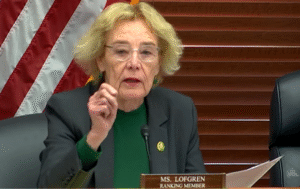
Calling the bill a bipartisan product of “collaboration, hard work, and a good measure of patience on both sides,” Ranking Member Zoe Lofgren (D-CA) said it recommits NASA “to fulfill its multiple missions in exploration, earth and space science, aeronautics, innovation, education, and inspiration.” Her district includes NASA’s Ames Research Center.
Authorization bills set policy and are important indicators of the level of congressional support for various agency activities, but do not provide any money. The most recent NASA Authorization bill was enacted in 2022 as part of the CHIPS and Science Act. House SS&T and the Senate Commerce, Science, and Transportation Committee oversee NASA and committee leaders on both sides of the aisle frequently cite the need for new legislation. The House passed a bill in 2024, but the Senate did not act on it. A Senate bill was introduced last year, but there’s been no action yet.
Babin and Lofgren introduced today’s bill, H.R. 7273, on Friday along with Rep. Mike Haridopolos (R-FL) and Rep. Valerie Foushee (D-NC), Chair and Ranking Member respectively of the Space and Aeronautics Subcommittee. The committee highlights these provisions:

In the broadest terms, the bill maintains two decades of bipartisan congressional support for NASA’s portfolio of human exploration, science, technology and aeronautics programs. That might be unremarkable except that the Trump Administration’s budget proposal last year was to significantly curtail everything other than human spaceflight. Congress rejected that in the FY2026 appropriations bill and this legislation is in complete alignment.
One aspect of NASA’s activities that’s changed over the years is the emergence of public-private partnerships where the commercial sector plays a stronger role. This bill embraces commercial services for everything from earth observation satellite data, to commercial space stations in low Earth orbit to replace the International Space Station, to deep space exploration.
That includes authorizing NASA to procure operational commercial services to take crews and cargo to and from deep space destinations even as it reaffirms support for NASA’s Space Launch System (SLS) rocket and Orion spacecraft. SLS and Orion are the foundation for the Artemis program to return astronauts to the Moon for the first time since the Apollo era. The Artemis II crew could fly around the Moon as soon as next month and will do so aboard SLS/Orion. So will Artemis III, carrying the first U.S. astronauts to land on the Moon since 1972, a mission currently planned for 2028.
Last year, the Trump Administration sought to replace SLS/Orion with commercial alternatives after Artemis III, but Sen. Ted Cruz (R-TX) included money and language in the One Big, Beautiful Bill Act (OBBBA) to continue SLS/Orion for at least two more flights after that. Many are skeptical commercial launch alternatives like SpaceX’s Starship or Blue Origin’s New Glenn will be ready to send people to the Moon by 2028. A Babin amendment adopted today endorses commercial services for lunar and Mars operations generally without mentioning a timeframe.
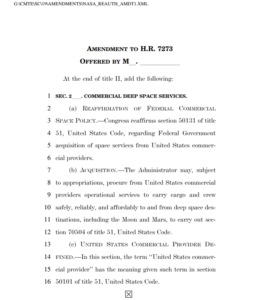
Dave Cavossa, President of the Commercial Space Federation, praised the committee’s action in an email to SpacePolicyOnline.com: “This is a big step in the right direction for the future of commercial space transportation options for deep space. Also, very much in line with this Administration’s focus on commercial solutions and competition. This amendment provides NASA with flexibility to procure additional services for moon and mars in the future!”
Among the many other adopted amendments was one (Haridopolos et al) encouraging the “fullest commercial use of space” including by the “growing and enduring presence of private citizens in Earth orbit, in cislunar space, on the surface of the Moon, and beyond.” Haridopolos represents Kennedy Space Center.
Others include one from Rep. Keith Self (R-TX) that directs the NASA Administrator to establish the initial elements of a lunar outpost by December 31, 2030, and a Rep. George Whitesides (D-CA) amendment calling for an engineering analysis of boosting the International Space Station into a higher orbit instead of deorbiting it into the ocean at the end of its lifetime.
Rep. Don Beyer (D-VA) introduced and withdrew an amendment concerning efforts to move the Space Shuttle Discovery to Houston from its current home at the National Air and Space Museum’s Udvar-Hazy Center near Dulles Airport in Northern Virginia. His district is close to Dulles.
A Cruz provision in the OBBBA requires NASA to transfer a space vehicle that has carried astronauts into space to Houston. Although the bill is not specific about what vehicle it must be, Sen. John Cornyn (R-TX) has separate legislation specifying Discovery. The idea of moving Discovery has sparked concern on many levels, not least of which is cost and possible damage Discovery might endure. The two Boeing 747 Shuttle Carrier Aircraft once used to transport space shuttles around the country are themselves now in museums. Moving Discovery now likely would require cutting it into pieces.

As required by the OBBBA, in August then-Acting NASA Administrator Sean Duffy approved the move of a vehicle, but NASA consistently refuses to identify which one it is. Soon after being confirmed as NASA Administrator in December, Jared Isaacman left open the question as to whether it would be Discovery for exactly those reasons — cost and potential damage. Isaacman noted that with astronauts about to travel to the Moon again, other historic human spaceflight vehicles soon will be available.
Beyer would have amended the OBBBA to require federal officials to “ensure” the transfer doesn’t cause “physical harm, whether intentionally or unintentionally” to the vehicle. Also, one year before implementing the transfer, NASA would have to inform Congress of the cost and the impact on the vehicle.
He and Babin apparently had discussed the matter prior to the markup. Addressing Babin, Beyer said he respected Houston’s “desire to have important parts of space history” to display and didn’t want to “stand in the way of Texas getting that kind of treasure,” but the key should be ensuring the integrity of the vehicle “for generations to come.” Babin agreed it would be “tragic if Houston were to receive a vehicle that had been damaged in transit” and said he’s committed to working to find a resolution.
With one exception, all the amendments were either approved by voice vote or withdrawn. The exception was an amendment by Rep. Haley Stevens (D-MI) that she stressed was requested by NASA. Stevens is Ranking Member of the committee’s Research and Technology Subcommittee. Her amendment would have enhanced NASA’s ability to detect, identify, monitor and track drones entering airspace around NASA facilities.
In the one instance of partisan divide during the markup, Republicans argued that while the rising number of drone incursions is alarming, Stevens’ amendment was beyond the scope of this bill. Babin said a coordinated approach is required with other federal agencies. Rep. Pat Harrigan (R-NC) said it was more appropriately a matter for the House Armed Services Committee. The exchange was genial, but after Babin asked if she would withdraw the amendment, Stevens insisted on a recorded vote noting the amendment was requested by NASA and the vote would signal other committees it is needed. Her amendment was defeated on a party-line vote: 18 yes, 19 no.

The bill itself was adopted unanimously, 37-0.

User Comments
SpacePolicyOnline.com has the right (but not the obligation) to monitor the comments and to remove any materials it deems inappropriate. We do not post comments that include links to other websites since we have no control over that content nor can we verify the security of such links.