LTG David Miller Nominated as Next Leader of U.S. Space Command
U.S. Space Force Lieutenant General David Miller, Jr. has been nominated as the next Commander of U.S. Space Command, succeeding Gen. Stephen Whiting who will retire early next year.
Yesterday, the White House sent Congress the nomination for Miller to be promoted to General and today U.S. Space Force (USSF) Chief of Space Operations Gen. Douglas Schiess confirmed on X that he also is being nominated as the new USSPACECOM Commander.
Congratulations to Lt. Gen. Miller on his nomination to serve as Commander, U.S. Space Command. He is an exceptional Guardian who has represented our service with distinction, and we believe he is a strong candidate for this critical joint leadership role.@US_SpaceCom
— General Douglas A. Schiess (@SpaceForceCSO) September 30, 2026
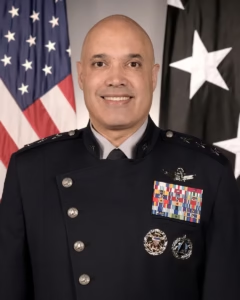
Miller is currently USSF Deputy Chief of Space Operations, Strategy, Plans, Programs and Requirements, responsible to the Secretary of the Air Force and Schiess for USSF strategies and concepts, requirements, and budget.
Commissioned in 1993, among his earlier assignments was Director of Operations and Force Development for USSPACECOM, and Commander of USSF’s Space Operations Command, later renamed Combat Forces Command.
The U.S. Space Force and U.S. Space Command are often confused. The Space Force is one of the six military services, while Space Command is one of the 11 Unified Combatant Commands. The services (Army, Navy, Marine Corps, Air Force, Space Force, and Coast Guard) organize, train and equip personnel. Those personnel are assigned to the Combatant Commands as needed, which provide command of military forces both in times of peace and war across the military services. USSPACECOM’s Area of Responsibility (AOR) extends “from 100 kilometers to infinity” as USSPACECOM officials point out.
Miller will be the fourth USSPACECOM commander since it was reestablished by President Trump during his first term. Originally created in 1985, the first Space Command was abolished in 2002 after the September 11, 2001 terrorist attacks led to a reorganization of the combatant commands. Trump reinstated it in 2019 as space increasingly became a warfighting domain just like air, sea, land, and cyber. A few months later, Trump and Congress created the U.S. Space Force as a new military service.
Gen. John “Jay” Raymond (U.S. Air Force/U.S. Space Force) was appointed to head the revived USSPACECOM and also was the first USSF Chief of Space Operations. He was succeeded as head of USSPACECOM by Gen. James Dickinson (U.S. Army) and then Gen. Whiting (U.S. Space Force).
Miller has a B.A. in Arts, Anthropology and Sociology from Lafayette College (Easton, PA); an MBA with honors from Regis University (Denver, CO); and a Master of National Security and Strategic Studies (Distinguished Graduate) from the Naval War College. Among his many awards, he received NDIA’s General James V. Hartinger Award earlier this year.
The nomination requires confirmation by the Senate, which is getting ready to leave town until after the midterm elections. They are scheduled to return on November 9 and in session for 22 days between then and the end of the 119th Congress. That should be sufficient time to get Miller through the confirmation process, but nothing is certain. If not, the nomination would have to be resubmitted when the 120th Congress begins on January 3, 2027. Whiting’s three-year term as USSPACECOM Commander began on January 10, 2024, so ideally his successor will be in place by January 10, 2027.
Miller will be taking over as the space domain becomes ever more congested and contested and the role of USSF and USSPACECOM increasingly integral to U.S. warfighting and deterrence.
On a more earthly level, he also will oversee the move of USSPACECOM headquarters from Colorado Springs, CO to Huntsville, AL following a four-year bruising bipartisan battle between the two states. The ribbon-cutting was this past May and some personnel immediately began moving into temporary quarters there, but it will be 2031 before a new building is ready and another year after that before the transition is complete. Yesterday, USSPACECOM awarded an $85 million contract to Parsons Corporation to serve as “Owner’s Advisor” on development of the headquarters, which has a total estimated cost of $2 billion to design and build.

User Comments
SpacePolicyOnline.com has the right (but not the obligation) to monitor the comments and to remove any materials it deems inappropriate. We do not post comments that include links to other websites since we have no control over that content nor can we verify the security of such links.