Senate Committee Clears New NASA Authorization Bill, Calls for Moon Base
The Senate Commerce, Science, and Transportation Committee approved a new NASA authorization bill today. Among its many provisions, the bill supports recent changes to the Artemis program, directs NASA to build a Moon base, extends operations of the International Space Station until 2032 while requiring NASA to move forward with commercial space stations to replace it, and strongly supports NASA’s science, technology, and aeronautics programs.

The bipartisan NASA Authorization Act of 2026 is co-sponsored by Senate Commerce Committee Chair Ted Cruz (R-Texas) and Ranking Member Maria Cantwell (D-Washington). It builds on previous Senate versions introduced in 2024 and 2025, but reflects the changing landscape of space activities over that seemingly short period of time.
For starters it rejects the dramatic NASA budget cuts proposed by President Trump last year. While the FY2026 appropriations bill already did that, it signals support from authorizers, too. They also recommend a 2.5 percent increase for FY2027. Authorization bills don’t provide any money, only appropriators do, but it’s an indication of the steadfast congressional support NASA enjoys.
The bill endorses NASA activities across the board, but the Artemis program to return American astronauts to the Moon gets special attention, driven by determination to stay ahead of China. In the committee’s words:
“The nation that leads in space will shape the global economy, define international norms, and secure the ultimate strategic high ground. China understands this and is moving rapidly to claim it. The NASA Authorization Act of 2026 ensures that America – not China – leads the next era of exploration. It strengthens the U.S. presence from low-Earth orbit into deep space, protects sensitive technologies from adversaries, restores accountability, and positions the United States to lead from the Moon to Mars.” — Senate Commerce Committee
Last week, NASA Administrator Jared Isaacman announced significant modifications to the plan for executing Artemis. They include ending plans to upgrade the Space Launch System (SLS) rocket that were required in the 2010 NASA Authorization Act, crafted largely by this committee.
Despite long-standing congressional support for building the Block 1B and Block 2 versions of SLS required in the 2010 law, this bill doesn’t mention them even though an earlier draft did. Instead it calls for a briefing from NASA on how to reduce the complexity and cost of producing and operating SLS, including a “standardization” of design, exactly what Isaacman wants. For years, NASA has been working on an Exploration Upper Stage (EUS) for Block 1B plus a taller, stronger Mobile Launcher (ML-2) to support the larger vehicle, but the bill doesn’t require NASA to proceed with either. A NASA press release yesterday already stated the agency no longer is planning to use EUS or ML-2.
After decades of space enthusiasts aspiring to establish a permanent Moon Base, the bill directs NASA to do that “as soon as practicable.”

The “Lunar Surface Moon Base” will be a permanently crewed U.S. presence on the Moon “capable of long-duration habitation, robotic, and industrial operations to advance science, technology and strategic interests” leading to an “enduring lunar presence.” Leveraging and incorporating commercial infrastructure is encouraged to “reduce costs, enhance resiliency and improve capacity.” NASA is to ensure to the maximum practical extent that “capabilities are scalable to Mars missions and adaptable to evolving national exploration and science needs.”
This committee is also a long-time champion of the International Space Station for both scientific and strategic interests. The first ISS modules were launched in 1998 and it’s been permanently occupied for more than 25 years so is nearing the end of its lifetime. This bill wants to ensure U.S.-led commercial space stations are ready to replace it before the ISS is terminated, however, lest China become the only country with crews in earth orbit.
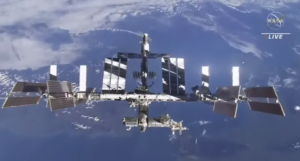
NASA wants to be just one of many customers buying space station services from commercial operators, not build another facility itself. The agency began working with several companies years ago to facilitate their efforts, but plans to release a Phase 2 solicitation stalled last year after then-Acting Administrator Sean Duffy changed important criteria. This bill requires NASA to issue a solicitation for two commercial space stations immediately and to continue operating ISS until one or more U.S. commercial space stations are ready to take over. NASA must operate the ISS until 2032, two years longer than currently planned, to ensure there’s no gap.
The comprehensive bill provides strong support to NASA’s other activities, too. The text of the bill plus amendments that were adopted today are available on the committee’s website. This is far from a comprehensive list, just a sample of a few key provisions.
- Space Technology and STEM
- directs NASA to maintain a separate Space Technology Mission Directorate;
- supports the development of space nuclear power and propulsion, including fusion and fission, in collaboration with other agencies and industry;
- allows the Administrator to establish a demonstration program for active orbital debris remediation;
- provides direction on the National Space Grant College and Fellowship Program;
- allows the Administrator to conduct or support STEM Engagement activities.
- Aeronautics
- directs NASA to continue carrying out basic and applied hypersonics research in coordination with the FAA and DOD and in consultation with academia and industry;
- allows NASA to carry out research on emerging technologies related to hydrogen aviation.
- Science
- reaffirms support for a balanced and adequately funded set of science activities with priorities guided by the scientific community through Decadal Surveys from the National Academies of Sciences, Engineering, and Medicine (NASEM);
- directs NASA to enter into agreements with the NASEM for Decadal Surveys “not less frequently than every 10 years” instead of “on a periodic basis” as in earlier law, with mid-Decadal reviews every 5 years;
- directs NASA to control cost growth in science missions;
- directs NASA to terminate the existing Mars Sample Return program and establish a new one with a cost cap of $8 billion, allowing for participation of international partners only if it does not unduly increase cost or risk and preserves U.S. leadership and custodianship of the samples, and keeping the Mars Telecommunications Orbiter program separate;
- finds that NASA’s lunar and Martian orbital missions are aging and directs NASA to develop a plan for continuity of operations working with private and international partners;
- expresses support for the Nancy Grace Roman Space Telescope and its “exemplary job” in staying within cost and schedule;
- directs NASA not to take any action to reduce or preclude operations of the Chandra X-Ray Telescope, Hubble Space Telescope, or James Webb Space Telescope before the next triennial reviews;
- requires a plan for gathering data about the asteroid Apophis that will fly past Earth in 2029 including collaborating with other federal, industry or international partners and using existing space infrastructure;
- expresses support for the VIPER lunar mission and requires a briefing on plans to launch it no later than December 31, 2027;
- requires a study on Mars-focused missions using commercial heavy-lift systems.
- Policy
- provides direction on the NASA Advisory Council;
- reinstates the positions of Chief Scientist, Chief Technologist, and Chief Economist, which were eliminated as part of the DOGE cuts in March 2025.
The bill was approved unanimously, but Sen. Tim Sheehy (R-Montana) offered and withdrew an amendment that would have struck several provisions. Among them is the language reinstating the Chief Scientist, Chief Technologist and Chief Economist, “positions NASA says they do not need and has not asked for and would cost more taxpayer dollars.” He said he would pursue those changes as the legislation works its way through the legislative process.
This is just one step in that process. The House Science, Space, and Technology Committee passed its NASA authorization bill on February 4. The two bills have significant differences. The House and Senate will have to agree on identical text before it can clear Congress and go to the President for signature.
This article has been updated.
User Comments
SpacePolicyOnline.com has the right (but not the obligation) to monitor the comments and to remove any materials it deems inappropriate. We do not post comments that include links to other websites since we have no control over that content nor can we verify the security of such links.