Starship Achieves Orbit for the First Time
The flight did not go exactly as planned, but SpaceX’s Starship Integrated Flight Test-14 did make it into orbit for the first time today and deployed 26 operational Starlink V3 satellites. One of the six second stage engines cut off early and although SpaceX proceeded with the orbital insertion burn, they decided to bring Starship back to Earth without completing all six orbits that were planned.
Liftoff from Starbase, TX was at 7:48:59 am Central Time (8:48:59 am Eastern).
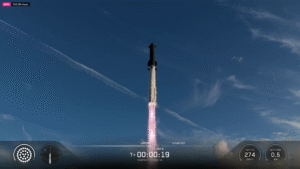
Starship is a two-stage vehicle and although it’s the second stage that’s named Starship, the word is often used to refer to the entire vehicle. The first stage is Super Heavy or “Booster.”
Booster lost one of its 33 engines shortly after liftoff, but that didn’t affect its performance. SpaceX did not attempt a “catch” back at the launch tower — they haven’t tried that since IFT-8 — and Booster made a soft landing in the Gulf.
What was brand new this time was sending Starship into orbit. Several previous test flights traveled through space on the way to the Indian Ocean, but those were suborbital missions.
Starship, or “Ship,” lost one of its three RVAC (Raptor Vacuum) engines during ascent as can be seen in the image in the lower right corner. The three circles around the outside are RVACs, while the three in the center are sea-level Raptor engines. All should be white to show they’re firing.
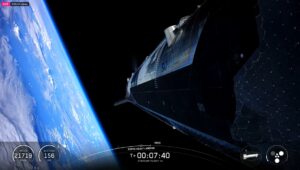
SpaceX had to decide whether to commit to going into orbit anyway or keep Starship on a suborbital path and land in the Indian Ocean like previous flights. Communications director Dan Huot was in the middle of explaining they’d decided to land in the Indian Ocean when new information came in that they were reviewing the decision. Ultimately they chose to proceed and soon exuberantly announced “Starship is orbital.”
They quickly began deploying the first operational Starlink Version 3 (V3) satellites. All 26 were released within about 30 minutes of the payload bay door — which many liken to a Pez dispenser — opening. Contact with each satellite was soon established. The V3 satellites have 10 times the downlink and 22 times the uplink capacity of V2. (Although Starlink V3s were ejected from Starship on earlier flights, those were just tests. They were on the same suborbital path as Starship and reentered.)
Starship has begun deploying its payload of 26 @Starlink V3 satellites. This deployment sequence will take ~30 minutes pic.twitter.com/ycIdAx5Lbe
— SpaceX (@SpaceX) September 28, 2026
SpaceX decided to bring Starship home from orbit early, however. The flight was supposed to last almost 10 hours, landing in the south Pacific west of Chile after six orbits. Instead they brought it down in the north Pacific after 3 hours 8 minutes and 27 seconds. Planning for such a contingency was made in advance to ensure airspace was clear, for example, and SpaceX had a recovery team in both locations. As of press time, SpaceX hadn’t publicly explained its decision, but usually does in due course.
Starship settled onto the ocean upright, fell over, and, as usually happens, exploded due to the release of residual fuel. The camera sending back the video during flight was on one of the wings, moving as the wing moved to adjust the flight path. A buoy captured the landing.
Splashdown confirmed. Congratulations to the entire SpaceX team on the first orbital flight of Starship! pic.twitter.com/urjmiwnvNl
— SpaceX (@SpaceX) September 28, 2026
Post-splashdown explosions happened on all the previous test flights except the last one, IFT-13. To everyone’s surprise, Starship remained intact and SpaceX had to mount an unexpected and complicated effort to retrieve it. They shared what that entailed in “The Holy Grail of Rocketry,” the third episode of their Starship series, as well as the valuable data they fortuitously were able to obtain especially about the performance of the heat shield.
Today’s flight is one more step towards making Starship an operational system, which is critical not only for SpaceX’s business plans, but NASA’s goal of getting astronauts back on the surface of the Moon before President Trump leaves office in January 2029 and before Chinese taikonauts arrive.
SpaceX is under contract to NASA to build a Human Landing System (HLS) version of Starship to ferry astronauts between lunar orbit and the lunar surface. That version requires cryogenic refueling at an earth-orbiting fuel depot. Even after Starship routinely begins flights to earth orbit, SpaceX still needs to build the fuel depot and demonstrate in-space cryogenic refueling is possible. SpaceX hasn’t officially said how many launches it will take to fill the depot, but in January 2024, SpaceX’s Jessica Jensen said a “rough guess” was “10-ish.”
NASA Administrator Jared Isaacman congratulated SpaceX on today’s achievement.
Congrats @SpaceX! Gorgeous launch, getting Ship to orbit and managing every step in a safe, responsible, and especially inspirational way. @NASA, along with the rest of the interested public, is excited to help where we can and for Starship missions to become routine! https://t.co/6DSKmMUT4T
— NASA Administrator Jared Isaacman (@NASAAdmin) September 28, 2026
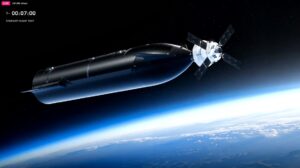
In April, four astronauts (three American, one Canadian) completed the Artemis II mission, the first trip around the Moon since the Apollo era. Under NASA’s original plan, Artemis III would be the flight to land people on the surface, but soon after taking office Isaacman changed Artemis III into an earth orbital test flight to practice rendezvous and docking operations with Starship and Blue Origin’s HLS, Blue Moon Mk2. Artemis III is planned for next summer. SpaceX does not need in-orbit refueling for that test flight that will simply dock with NASA’s Orion capsule. During the July 16, 2026 broadcast for IFT-13, SpaceX showed a rendering of Starship and Orion docked, illustrating the size difference.
User Comments
SpacePolicyOnline.com has the right (but not the obligation) to monitor the comments and to remove any materials it deems inappropriate. We do not post comments that include links to other websites since we have no control over that content nor can we verify the security of such links.