What’s Happening in Space Policy November 15-21, 2026
Here is SpacePolicyOnline.com’s list of space policy events for the week of November 15-21, 2026 and any insight we can offer about them. The House and Senate are in session this week.
During the Week
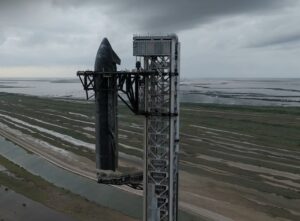
It’s tough to top the excitement of yesterday’s Starship “catch” by SpaceX, but there are plenty of great events coming up this week including another milestone that’s really important though in a different way — Voyager 1 reaching the one-light-day threshold in interstellar space.
But let’s start with Congress, which will be busy this week as Republicans try to get as many of their priorities enacted before Democrats take control of both chambers on January 3. As of this morning (Sunday), the Senate will have 55 Democrats (including two Independents who caucus with them) and 44 Republicans, with the Alaska race still uncalled. The House will have 256 Democrat and 169 Republicans, with 10 races uncalled.
From a space policy standpoint, the key tasks for this lame-duck session include passing FY2027 appropriations bills that fund DOD (Defense), NASA and NOAA (Commerce-Justice-Science or CJS), FAA (Transportation-HUD or THUD), and FCC (Financial Services and General Government or FSGG); the FY2027 National Defense Authorization Act (NDAA); and possibly a NASA Authorization Act and a commercial space bill. President Trump is also eager to pass a third reconciliation bill with $350 billion more for DOD on top of the $1.15 trillion requested through appropriations, taking the total for FY2027 to $1.5 trillion. The U.S. Space Force would get $12 billion of that and most of the FY2027 Golden Dome money, $17 billion, also is here. Republicans and Democrats both are signaling $350 billion is too much, however.

Of everything that’s on the plate, getting appropriations passed is at the top of the list. Otherwise there’ll be another government shutdown when the Continuing Resolution (CR) expires on December 11. Memories of the disruption caused by last year’s historic 43-day shutdown haven’t faded, but none of the FY2027 bills have been enacted yet.
The House Appropriations Committee cleared all 12 appropriations bills and the House passed three (Agriculture, Milcon-VA, and National Security-State). By contrast, the Senate Appropriations committee hasn’t approved any, but last week seven of the 12 subcommittees, including CJS (NASA/NOAA), released their recommendations. We’ll see if others, like Defense, come out this week. Senate Appropriations Chair Susan Collins (R-Maine), who was defeated in her reelection bid, hasn’t scheduled any full committee markups yet and could decide to negotiate with the House using the subcommittee marks. Or they could simply decide to extend the CR into next year. Or there could be another shutdown. Stay tuned.
The NDAA is considered a “must-pass” bill because it sets priorities and authorizes funding for U.S. military activities. It has passed Congress every year since the first in 1961. The almost certainty of passage makes it a tempting target to add other legislation even if only tangentially related. Although the NDAA traditionally gets broad support from both parties, this year it passed the House in July on basically a party-line vote and Democrats are blocking its consideration in the Senate. They object that it doesn’t place limits on the war in Iran, that the SAVE America voting eligibility bill and partisan provisions on social issues were included in the House version, and that the authorized funding level of $1.15 trillion is too high. The road ahead is challenging, but it still would be surprising if they can’t find a compromise before the end of the Congress.
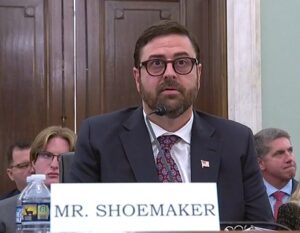
Meanwhile, on Wednesday, the Senate Commerce Committee will vote on several nominations and bills. Among the nominations are Joshua Shoemaker to be NASA Chief Financial Office, Robert Steinau to be NASA Inspector General, and Danielle Thumann Severs to be an FCC Commissioner.
Shoemaker and Steinau’s nominations were not controversial during the hearing last week, but Democrats strongly opposed Thumann’s. She is currently Senior Counsel to FCC Chairman Brendan Carr. The FCC ordinarily has five commissioners, three from the president’s party and two from the other party. Historically the FCC was independent and presidents could not fire commissioners of independent agencies, but the Supreme Court ruled in June 2026 that presidents can fire them at will. The FCC needs three commissioners for a quorum, which is what they have right now: two Republicans and one Democrat. Democrats are worried that if Thumann is confirmed, Trump will fire the one Democrat and only Republicans will be on the Commission. The FCC plays a big role in space activities, assigning the radio frequencies needed by all satellite operators to communicate with their spacecraft, and sets rules on orbital debris. The FCC created its own Space Bureau in 2023 as satellite operations began to boom with the advent of SpaceX’s Starlink and Amazon’s Leo megaconstellations.
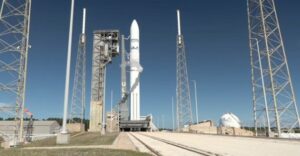
Speaking of Amazon Leo, earlier this afternoon the United Launch Alliance launched 40 Amazon Leo satellites on Vulcan, but an anomaly 10 minutes into flight prevented them from reaching orbit. We have a separate article about that. It’s the first total failure for ULA in the company’s history.
Lots of other great events this week, including a House SS&T hearing on Space Weather on Thursday, but we’ll highlight just one more — NASA’s Voyager 1 spacecraft reaching a signature milestone.
Launched in 1977, Voyager 1 entered interstellar space in 2012 and today continues its journey out into the galaxy. Early Wednesday morning, at 5:16:07 am ET, it will reach a distance of 16.09 billion miles (25.89 billion kilometers) from Earth where it will take an entire day — “one light day” — to receive a signal from Earth. It’ll take another day for a reply to be received back here where a team at the Jet Propulsion Laboratory (JPL) in Pasadena, CA monitors and controls the spacecraft. They recently sent energy-saving commands, dubbed the Big Bang, to reduce the amount of power being used by Voyager’s Radioisotope Thermal Generator (RTG) in the hope of extending its lifetime even more.
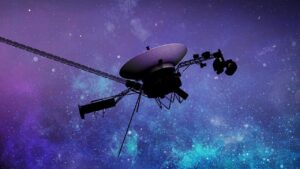
The Planetary Society will hold a virtual event Wednesday evening to celebrate, and NASA will hold another one Thursday at noon ET in-person at JPL and webcast. Members of the Voyager team over these decades will be there to talk about both Voyager 1 and its twin, Voyager 2, that’s also in interstellar space, but went in a different direction. The energy-saving commands sent to Voyager 1 were also implemented for Voyager 2. Voyager 1 flew past Jupiter and Saturn. Voyager 2 flew past those two planets as well as Uranus and Neptune. It’s remarkable that they continue to communicate back to Earth providing data on what’s out there, like the interstellar “hum.”
Those and other events we know about as of Sunday morning are shown below. Check back throughout the week for others we learn about later and add to our Calendar or changes to these.
Sunday, November 15
- Vulcan Launch for Amazon Leo (ULA), CCSFS, 12:11 pm ET
Monday-Tuesday, November 16-17 (continued from last week)
- ITU Plenipotentiary, Doha, Qatar
Tuesday, November 17
- Threat Status: Golden Age of Space (Washington Times), Ritz-Carlton Pentagon City, Arlington, VA, 8:00 am-12:00 pm ET
- FAA Public Scoping Meetings on Increased Starship Launches at Starbase, TX, virtual, 1:00-3:00 pm and 5:30-7:30 pm CENTRAL Time (all five meetings now are virtual)
Tuesday-Thursday, November 17-19
- Space Tech Expo Europe 2026, Bremen, Germany
Wednesday, November 18
- Senate Commerce Committee Executive Session, 253 Russell Senate Office Building, 10:0 am ET (webcast)
- MSBR Luncheon with Taylor Jordan, Director, Office of Space Commerce, Department of Commerce, Martin’s Crosswinds, Greenbelt, MD, 11:30 am-1:00 pm ET
- Space in the New Congress (GSG/SPG), virtual, 2:00 pm ET
- FAA Public Scoping Meetings on Increased Starship Launches at Starbase, TX, virtual, 5:30-7:30 pm CENTRAL Time (all five meetings now are virtual)
- Celebration of Voyager 1 Reaching One-Light-Day Milestone (Planetary Society), virtual, 8:00-9:00 pm ET
Wednesday-Friday, November 18-20
- Mid-Term Review of 2021 Pathways to Discovery in Astronomy and Astrophysics (Natl Acad), National Academies of Sciences building, 2101 Constitution Ave, NW, Washington, DC, public sessions will be livestreamed
Thursday, November 19
- Traffic Jams in Space (CSIS), 1616 Rhode Island Ave, NW, Washington, DC/online, 9:00-10:00 am ET
- House SS&T Hearing on Space Weather, 2318 Rayburn House Office Building, 10:00 am ET (webcast)
- FCC Open Commission Meeting, 45 L St., NE, Washington, DC/online, 10:30 am-12:30 pm ET
- NASA Discussion of Voyager 1’s One-Light-Day Milestone, JPL, Pasadena, CA/online, 12:00 pm ET
- FAA Public Scoping Meetings on Increased Starship Launches at Starbase, TX, virtual, 1:00-3:00 pm and 5:30-7:30 pm CENTRAL Time (all five meetings now are virtual)
Thursday-Friday, November 19-20
- NEWSPACE Nexus SSB 2026: International Partner Workshop, Washington, DC
Friday-Monday (November 20-23)
- International Lunar Sample Research Symposium 2026, Hong Kong SAR, China
User Comments
SpacePolicyOnline.com has the right (but not the obligation) to monitor the comments and to remove any materials it deems inappropriate. We do not post comments that include links to other websites since we have no control over that content nor can we verify the security of such links.