Astrobotic Unveils Griffin “Moon Base II” Lander
Astrobotic unveiled its Griffin lunar lander today as it gets ready to ship to JPL for environmental testing prior to launch later this year. When it lands, it will be designated Moon Base II as part of NASA’s evolving Moon Base project. Astrobotic CEO John Thornton was joined by Voyager Space’s Matt Magaña. Voyager announced earlier this month that it is acquiring Astrobotic.
Astrobotic launched the first Commercial Lunar Payload Services (CLPS) mission for NASA in January 2024. The Peregrine lander never made it to the Moon due to a propulsion failure, but Astrobotic was undeterred and proceeded with development of the larger Griffin lander. Introducing it to the public today, Thornton called it the “first infrastructure-class lander.”
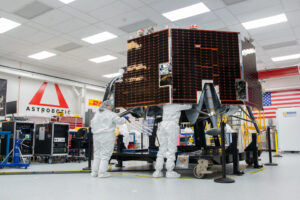
Griffin can put 625 kilograms (about 1,400 pounds) of payload onto the lunar surface. Astrobotic’s Alivia Chapla said Griffin is “named for a mythical winged creature that is known for protecting its treasures” and Griffin “is going to fly to the Moon carrying her scientific valuables.”
Originally the first “valuable” was going to be NASA’s VIPER rover. In June 2024, however, worried the failure of Astrobotic’s Peregrine lander earlier that year might lead to more delays and higher costs for Griffin, the agency first canceled and then reinstated the VIPER program, reassigning it to fly on a Blue Origin Blue Moon MK1 lander in 2027. NASA retained its $323 million contract with Astrobotic on the premise that eventually it would benefit the agency.
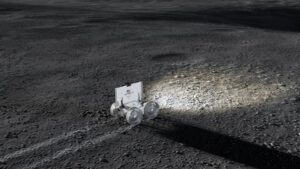
Astrobotic continued developing Griffin and signed Astrolab as the main customer.
Astrolab’s 500 kg (1,100 lb) FLEX Lunar Innovation Platform — FLIP — rover will carry four NASA payloads: METAL, a multicolor camera and radiometer; a Laser Retroreflector Array; a Lunar Dust sensor; and a lunar LIDAR demonstration to generate high-resolution 3D surface maps. Griffin has other small payloads from the USA, ESA, Canada, Germany, Japan, and Australia.
Thornton said today the launch on a SpaceX Falcon Heavy will take place in the fourth quarter of this year.
The spacecraft still has several steps to go between now and then. Engineers could be seen hard at work on Griffin today during the press conference at the Moonshot Museum, co-located with Astrobotic’s headquarters in Pittsburgh, PA.
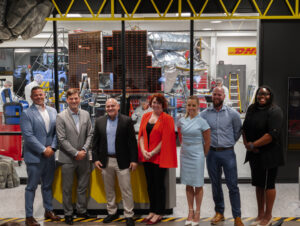
When they’re done — Thornton said in a couple of weeks — Griffin will be shipped to JPL for environmental testing. Then it returns to Pittsburgh for additional integration before being sent to SpaceX’s Falcon Heavy integration facility at Kennedy Space Center. FLIP will be integrated onto Griffin at KSC. The launch date has slipped many times. As recently as October 2025, it was slated for next month.
Once launched, Griffin will take several days to reach the Moon and then descend autonomously for a landing at the Nobile Crater at the Moon’s South Pole. At that point, it will become NASA’s Moon Base II.
NASA’s Moon Base Program Manager Carlos Garcia-Galan was at Astrobotic today for Griffin’s unveiling. At the March 24 Ignition event, Garcia-Galan laid out NASA’s three-phase plan for creating a Moon Base starting with dozens of robotic landers. The first three, including Griffin, are targeted to launch this year followed by 10 per year.
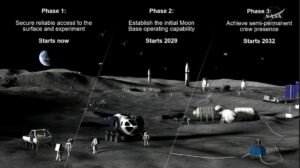
On May 26, NASA designated the first three as Moon Base I, II and III. Moon Base I is the first Blue Origin Blue Moon MK1 cargo lander. Its launch date is up in the air following the May 28 explosion of Blue Origin’s New Glenn rocket on the pad during a pre-launch test. Repairing the pad may take some time, but the company asserts it will be launching again by the end of this year.
Griffin-1 is Moon Base II. Intuitive Machines’ IM-3 (Trinity) is Moon Base III. Ramping up the cadence to reach 10 per year after that is still in work.
Meanwhile, on June 2 Voyager announced it is acquiring Astrobotic. Magaña spoke today about how Voyager is investing not only in landers, but other lunar infrastructure including power systems, communications, and guidance and navigation. Another part of Astrobotic’s business is LunaGrid to provide commercial power on the lunar surface, including systems that can survive the frigid cold of the 14-day lunar night.
User Comments
SpacePolicyOnline.com has the right (but not the obligation) to monitor the comments and to remove any materials it deems inappropriate. We do not post comments that include links to other websites since we have no control over that content nor can we verify the security of such links.