ASAP Worries About ISS, GAO Wonders What Comes Next
NASA’s Aerospace Safety Advisory Panel and the Government Accountability Office are raising concerns about the future of the International Space Station and the pace of efforts to build commercial space stations to replace it. ASAP is cautioning NASA not to cut the ISS budget because managing risks on the aging facility is increasingly difficult. GAO found that NASA has not made an assessment of the likelihood or duration of a gap between the end of the ISS and the availability of commercial space stations, nor has it documented the process it will use next year to decide whether or not to deorbit the ISS in 2030 as planned.
The ISS overall is in good shape, but it’s old. The first modules of the U.S.-Russian-European-Japanese-Canadian earth-orbiting laboratory were launched in November and December 1998 and it’s been permanently occupied by rotating international crews since November 2, 2000. That’s more than 27 years of exposure to temperature extremes, radiation, micrometeoroids and space debris, and 25 years of continuously supporting humans.

The current plan is to deorbit the ISS in 2030, using a SpaceX U.S. Deorbit Vehicle (USDV) and several Russian Progress cargo vehicles to send it into the Pacific Ocean. But NASA doesn’t want to do that until U.S. commercial space stations are in orbit to replace it. Timing is the problem — how long can ISS safely support crews versus when at least one U.S. commercial space station is available.
Air leaks in the PrK transfer tunnel on the Russian segment, which connects that end of the space station with a docking port used for Progress cargo vehicles, have persisted since 2019. NASA told the House Science, Space, and Technology (SS&T) Committee in March that the leaks finally were sealed, but they came back. Three weeks ago, five of the seven ISS crew members were instructed to take shelter in SpaceX’s Crew Dragon-12 as a precaution while the other two got ready to make major repairs. Ultimately Russia decided not to proceed with those repairs and used sealant again.
During a telecon on Monday summarizing their most recent quarterly meeting with NASA, Lt. Gen. Susan Helms (Ret.), chair of NASA’s Aerospace Safety Advisory Panel (ASAP) and a former astronaut, praised NASA’s decision to direct the five crew members — all three Americans (one of whom is a member of Russia’s Soyuz MS-28 crew) and a European and a Russian who are members of NASA’s Crew-12 — to take refuge in Dragon. She called the ongoing leaks “one of the most significant safety risks of the program” and said ASAP “will continue to monitor NASA’s efforts to properly protect its crew members.”
NASA and Roscosmos do, in fact, closely monitor everything on the ISS 24/7 and agreed some time ago that Russia will keep the PrK hatch closed unless the cosmonauts need to transfer items to or from a Progress at that docking port. When the PrK hatch is open, the hatch between the Russian and U.S. segments is closed as a precaution.
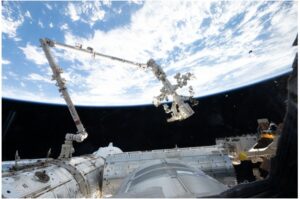
A completely separate issue arose on May 27 when a wrist joint on Canada’s Canadarm2 malfunctioned during normal operations. The robotic arm is a critical piece of hardware on the exterior of the space station used for capturing Cygnus and HTV-X cargo spacecraft and maneuvering them onto berthing ports, assisting astronauts on spacewalks, and myriad other tasks. Next Tuesday NASA astronauts Chris Williams and Jessica Meir will go on a spacewalk to repair it, but it’s another indication that the ISS and its components are aging.
Helms warned that any “temptation” to reduce the ISS budget at this point in time be “disregarded.”
As budgets decline, it is increasingly difficult for NASA to ensure the ISS risks remain manageable for day-to-day operations with enough contingency margin. This ISS program team continues to perform an outstanding job of managing those risks, but the margin to do so is now reduced to an alarming level.
NASA is still targeting 2030 to decommission the ISS and additional extensions to that decommissioning timeframe would need to consider the growing risk. — ASAP Chair Lt. Gen. Susan Helms (Ret.)
The ISS’s lifetime has been extended several times already, most recently in 2021 when President Joe Biden directed NASA to extend operations from 2024 to 2030. Congress codified it in the 2022 NASA Authorization Act (Title VII of the CHIPS and Science Act, P.L. 117-80) and Europe, Japan and Canada concurred. Russia agreed to support the ISS only through 2028, but NASA anticipates it will adopt 2030 at a later time.
The question is what comes after the ISS, whenever it ends.
NASA doesn’t want to build another space station in low Earth orbit (LEO), but needs to continue doing research with crews in the microgravity environment. For the past several years, it’s been working with commercial companies to help them develop commercial space stations where NASA can be one of many customers in what it envisions will be a burgeoning LEO space economy. There also is broad bipartisan congressional support to ensure China is not the only country with human presence in LEO.
NASA’s been working toward that goal since the 2017 NASA Transition Authorization Act (P.L. 115-10) directed the agency to develop a transition plan to a non-governmental space station model. In FY2019, NASA first requested funding for what is now called Commercial LEO Destinations (CLDs) to facilitate commercial space stations through public-private partnerships. The first contract was awarded in 2020 and three Space Act Agreements followed in 2021 as part of Phase 1 of the effort.
Progress has been slow and the clock is ticking. Plans to award Phase 2 agreements last year were delayed as NASA reconsidered its strategy. Three months ago, NASA made a completely new proposal, offering to build a new government-owned module that would attach to the ISS where commercial companies could temporarily dock their space stations and use ISS utilities like electricity. NASA’s premise was that a commercial market didn’t yet exist to ensure the CLDs would succeed, but the companies emphatically disagreed. NASA then decided to stick with the original plan.
Now a new report from the GAO finds that while NASA has identified risks that could lead to a gap between the end of ISS and the availability of CLDs, it hasn’t assessed the likelihood or potential duration of such a gap. Nor has it documented the process it will use to decide whether or not to deorbit the ISS in 2030, a decision to be made next year.
GAO prepared the report for the chairman of the Senate Commerce, Science, and Transportation Committee, Sen. Ted Cruz (R-TX), who represents NASA’s Johnson Space Center. JSC is home to the NASA astronaut corps and NASA Mission Control.
In March, the committee approved the NASA Authorization Act of 2026 that would extend the ISS another two years while moving forward with CLDs. The bill, S. 933, requires NASA to issue a solicitation for two commercial space stations immediately and to continue operating ISS until one or more U.S. commercial space stations are ready to take over, but at least until 2032. The House SS&T Committee’s version of the bill, H.R. 7273, similarly warns against a gap and while it doesn’t direct that the ISS be extended beyond 2030, it does require a report from NASA on options including that possibility.
GAO considers NASA’s current plan to be “ambitious.”
… if NASA awards Phase 2 agreements in 2026, the companies would have about 4 years to have their stations certified for NASA crew use, launched and on-orbit. Our analysis of NASA projects that have launched since 2010 found that on average it took the projects a little over 5 years to go from beginning development to launch. If the companies take as long as the average for NASA major projects, they would be more likely to achieve their initial station capabilities in 2031. — GAO
GAO and ASAP’s Helms both point out that extending ISS has its own risks, however, because of its age.
ASAP was briefed on the CLD program at its last meeting and plans to meet with the ISS transition team before their next meeting in August to get a better idea of what capabilities NASA wants from the CLD providers. They also want to learn how the contract will be structured to ensure the health and safety of NASA astronauts aboard a CLD are protected.
ASAP was created by Congress following the 1967 Apollo 1 tragedy that killed astronauts Virgil “Gus” Grissom, Ed White, and Roger Chaffee during a pre-launch test. It reports both to Congress and the NASA Administrator. GAO is Congress’s own “watchdog” agency.
User Comments
SpacePolicyOnline.com has the right (but not the obligation) to monitor the comments and to remove any materials it deems inappropriate. We do not post comments that include links to other websites since we have no control over that content nor can we verify the security of such links.