Ukrainian Missiles Strike Russian Soyuz Rocket Factory
Ukrainian President Volodymyr Zelensky confirmed today that Ukrainian Flamingo missiles hit Russia’s Progress production facility in Samara. He cited the Progress Center’s role in producing electronics, but Soyuz rockets also are built there. Soyuz rockets launch crews and cargo to the International Space Station among other purposes.
In a post on X, Zelensky cheered Ukrainian “deep strikes” into Russia about 900 kilometers (560 miles) from the border. In Russia’s Samara region, “one of the key enterprises within Roscosmos – the Progress Center, which was involved, among other things, in electronics production – was hit. Flamingo missiles were used. A good achievement.”
The Kyiv Post cited the General Staff of the Armed Forces of Ukraine as specifying it was a “direct hit” that caused a fire. The newspaper noted that the Progress Rocket and Space Center “is one of the key enterprises in the Russian Federation’s rocket and space industry, producing launch vehicles of the ‘Soyuz’ family … used to launch Russian spacecraft for military, reconnaissance, and communications purposes into orbit” as well as earth observation satellites “which the enemy uses for reconnaissance purposes.”
U.S.-based Russian space expert Anatoly Zak of RussianSpaceWeb.com wrote that RKT Progress is a prime developer of rockets, spacecraft, and military satellites, including the Soyuz-2 and Soyuz-5 rockets. Citing imagery analysis from the Ukrainian group CyberBoroshno, he added that the missiles apparently hit a clean-room facility for avionics that is adjacent to a vehicle integration building. Zak also noted that orders of Soyuz rockets were exceeding production capacity at the plant by “as much as 30 or even 50 percent for a planned launch campaign period from 2027 to 2030.”
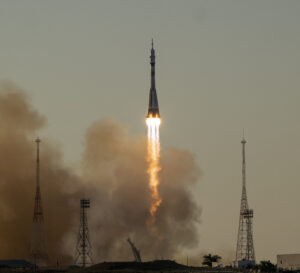
The Soyuz-2.1a version is used to launch crews and cargo to the ISS. The Soyuz MS-29 crew with Roscosmos’s Pyotr Dubrov and Anna Kikina and NASA’s Anil Menon lifted off on July 14 for an eight month mission.
The Progress MS-34 cargo spacecraft launched on April 26 (NASA designates it Progress 95), joining Progress MS-33 (Progress 94) that arrived in March. In addition to cargo delivery, Progress spacecraft are used to reboost the ISS periodically to compensate for atmospheric drag. Engines on Russia’s Zvezda Service Module also can be used for that purpose, as well as SpaceX’s Cargo Dragon and Northrop Grumman’s Cygnus cargo spacecraft.
Any potential impact on ISS operations cannot be evaluated until details are known about whatever damage was sustained to Soyuz rocket production. Zak told SpacePolicyOnline.com that “it is hard to fully destroy production on the first strike” and it’s likely some rockets already are at launch sites. The concern is if there is long-term damage to the Soyuz manufacturing line since Roscosmos “does not have any practical alternative to this system.”

The ISS is an international partnership among the United States, Russia, Japan, Canada, and 11 European countries operating through the European Space Agency. The Russian and U.S. segments of the ISS are interdependent and the partnership has endured since Russia invaded Ukraine in February 2022 despite the changed geopolitical environment.
This article has been updated.
User Comments
SpacePolicyOnline.com has the right (but not the obligation) to monitor the comments and to remove any materials it deems inappropriate. We do not post comments that include links to other websites since we have no control over that content nor can we verify the security of such links.