New Russian-American Crew Arrives at ISS
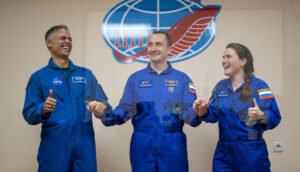
Russia launched a new crew to the International Space Station today, Soyuz MS-29. Roscosmos cosmonauts Pyotr Dubrov and Anna Kikina, and NASA astronaut Anil Menon, docked at the ISS about three hours later for an 8-month mission.
Liftoff from the Baikonur Cosmodrome in Kazakhstan on a Soyuz-2.1a rocket was on time at 10:47 am Eastern Daylight Time (7:47 pm local time at Baikonur) and the crew arrived at the ISS at 1:52 pm EDT. Dubrov and Kikina are spaceflight veterans, Menon is a rookie.
.@NASA astronaut Anil Menon and Roscosmos cosmonauts Pyotr Dubrov and Anna Kikina lifted off atop the Soyuz MS-29 spacecraft at 10:47 a.m. EDT today for a 1:56 p.m. docking to the International Space Station. More… https://t.co/OgfE3jFh0Y pic.twitter.com/D0IWMdUbZP
— International Space Station (@Space_Station) July 14, 2026
With rare exception, Roscosmos and NASA include a crew member from the other’s agency on ISS launches to ensure that at least one person from each country is always aboard the space station to operate the interdependent Russian and American segments. Roscosmos’s Andrey Fedyaev is a member of NASA’s Crew-12 that’s aboard the ISS right now together with Russia’s Soyuz MS-28 crew that includes NASA’s Chris Williams. The arrangement is called “seat-swaps.”
NASA representatives are always at Baikonur for the launch of NASA astronauts, but today the NASA Administrator himself, Jared Isaacman, was there along with Deputy Administrator Matt Anderson. Isaacman and Roscosmos Director General Dmitry Bakanov met in person for the first time. Bakanov attended the Crew-11 launch at Kennedy Space Center in July 2025, but Isaacman wasn’t Administrator then. Sean Duffy was Acting Administrator.
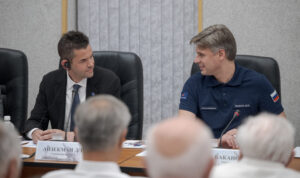
Isaacman is the first NASA Administrator to attend a launch at Baikonur since Jim Bridenstine in October 2018, largely because of the strained U.S.-Russian relationship. Bridenstine’s visit was unusually eventful when the Soyuz MS-10 launch aborted about two minutes after launch. Onboard systems separated the crew capsule and sent it on a trajectory to land safely downrange. Roscosmos’s Aleksey Ovchinin and NASA’s Nick Hague were quickly returned to Baikonur where their families, Bridenstine and others greeted them with relief. (Hague and Ovchinin took it all in stride and flew to the ISS on Soyuz MS-12 a year-and-half later. Each has also flown again.)
The NASA-Roscosmos relationship has remained relatively steadfast despite the changed geopolitical environment on the ground. The two countries need to work together to maintain the ISS in orbit and to deorbit it at the end of its lifetime. The ISS is a partnership among the United States, Russia, Japan, Canada and 11 European countries working through the European Space Agency. The facility is comprised of the Russian Orbital Segment (ROS), and the U.S. Orbital Segment (USOS) that includes modules from Europe and Japan and Canada’s robotic Canadarm2. The segments are interdependent — Russia’s Service Module and Progress cargo spacecraft reboost the ISS periodically to compensate for atmospheric drag so it doesn’t reenter; the U.S. segment provides electrical power to both sides.

Isaacman and Bakanov have a lot to discuss. In 2021, President Joe Biden extended the U.S. commitment to the ISS from 2024 to 2030. Europe, Canada and Japan concurred, but so far Russia had agreed only to 2028. The U.S. wants to ensure American commercial space stations are ready to replace the ISS before it’s deorbited and while 2030 remains the official date, the Senate version of the pending NASA authorization bill would extend that to 2032. Overall the ISS is in good shape, but it’s old and persistent air leaks in a transfer tunnel at the end of the Russian segment are troublesome. Roscosmos and NASA experts disagree on the seriousness of the leaks. Whenever it happens, the U.S. and Russia will have to work cooperatively to safely deorbit the ISS into the Pacific Ocean using Progress vehicles and a U.S. Deorbit Vehicle now in development.
[UPDATE: Bakanov told TASS they agreed to continue operating ISS through 2030 and seat-swaps throughout that time. They also will coordinate satellite operations to avoid collisions.]
Isaacman also wanted to be at the launch because Menon is a close friend. Menon’s wife, Anna, was a member of Isaacman’s Polaris Dawn private astronaut mission in 2024, a 5-day flight on a SpaceX Crew Dragon that included the first commercial spacewalk. She was a SpaceX engineer at the time.
Congratulations to @astro_anil and his Soyuz MS-29 crew on a successful launch and on their voyage to the International Space Station. Anil has spent his entire life preparing for this moment. He is a scholar, military officer, physician, pilot, husband, father and will… pic.twitter.com/KwJFhUHliH
— NASA Administrator Jared Isaacman (@NASAAdmin) July 14, 2026
The Menons have gone back and forth between NASA and SpaceX over the past several years. Anna Menon was a NASA biomedical flight controller and Anil Menon a NASA flight surgeon before they both moved over to SpaceX in 2018, he as SpaceX’s first flight surgeon and she as a senior engineer. Anil was selected as a NASA astronaut candidate in 2021 and Anna in 2025.

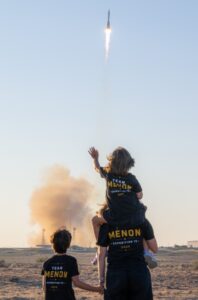
The couple have two young children who also were at Baikonur for the launch.
This article has been updated.
User Comments
SpacePolicyOnline.com has the right (but not the obligation) to monitor the comments and to remove any materials it deems inappropriate. We do not post comments that include links to other websites since we have no control over that content nor can we verify the security of such links.