What’s Happening in Space Policy September 27-October 3, 2026
Here is SpacePolicyOnline.com’s list of space policy events for the week of September 27-October 3, 2026 and any insight we can offer about them. The Senate is in session this week. The House is in recess until after the midterm elections, except for pro forma sessions.
During the Week
If all goes according to plan, it’s a busy week with the first Starship launch to orbit, an update on Starliner, the launch of Crew-13 to the International Space Station and more.

First a quick congressional update. The House left town for the midterm elections on September 16, but the Senate is still here for one more week. The only space-related hearing we know about is an update on Golden Dome at the Strategic Forces Subcommittee of the Senate Armed Services Committee, chaired by Sen. Deb Fischer (R-Nebraska). None of the witnesses are from DOD. Instead they are David Trachtenberg from the National Institute of Public Policy, Thomas Karako from CSIS, and David Mosher from the Congressional Budget Office (CBO). Cost is likely to be a major focus of the hearing. In May, CBO concluded the pricetag of a notional national missile defense system like that proposed by the Trump Administration would be $1.2 trillion over 20 years, while noting they had insufficient information to produce a firm estimate. By contrast, Golden Dome Director Gen. Michael Guetlein reiterated just three days ago in the Washington Post that the cost is $185 billion. Quite a difference. Should be an interesting discussion.
We don’t know of any space-related bills on the docket this week, but we’ll be keeping an eye out. Two passed last week by unanimous consent (UC) — Sen. Fischer’s Secure Space Act and Sen. Gary Peters’ (D-Michigan) Satellite Cybersecurity Act. It’s not uncommon for the Senate to take up bills that can pass by UC before leaving for an extended recess so there could be surprises.
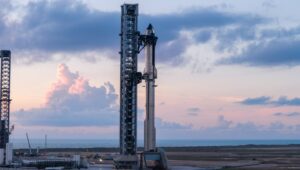
Outside D.C., SpaceX’s Starship Integrated Flight Test-14 (IFT-14) will certainly garner a lot of attention if it lifts off tomorrow morning (Monday) as planned. Originally scheduled for September 22, this is the first attempt to put Starship in orbit. Most of the previous flights flew through space on the way to the Indian Ocean, but didn’t attain orbit.
This time the goal is six orbits of the planet, deploying 26 Starlink V3 satellites while there, and then splashing down in the Pacific Ocean to the west of Chile. As with all launches, weather or technical issues could intervene, but for now liftoff is planned during a 75-minute launch window (8:15-9:30 am EDT) with splashdown 9 hours 50 minutes and 30 seconds later. Live launch coverage begins about 30 minutes before liftoff on SpaceX’s website and X. Those are the places to look for updates if there are delays, too. Even if liftoff is on time, SpaceX says they won’t take the final step to put Starship in orbit until they’re certain “there is sufficient redundancy on hardware critical to doing the subsequent deorbit burn at the end of the mission.” They don’t want Starship to get into orbit and not be able to control when and where it comes down, endangering anyone under the flight path.
Also tomorrow, while SpaceX’s Starship may be orbiting overhead, NASA will provide an update on Boeing’s Starliner commercial crew vehicle. NASA Administrator Jared Isaacman will be at KSC along with Boeing’s John Mulholland, Vice President and Program Manager for Commercial Crew, NASA’s Dana Weigel, manager, Low Earth Orbit Program, and NASA astronaut Woody Hoburg. Starliner has had a troubled history, most recently in 2024 when it experienced thruster problems while delivering NASA astronauts Butch Wilmore and Suni Williams to the ISS. NASA decided the spacecraft wasn’t safe enough to bring them back to Earth and Starliner landed with no one aboard almost exactly two years ago. Butch and Suni remained on the ISS for more than 9 months waiting to return to Earth on a SpaceX Crew Dragon.

Two years later, Starliner still hasn’t flown again as Boeing, with NASA’s help, tries to resolve the thruster problems. Isaacman declared the 2024 flight a Type A Mishap and replaced top NASA leaders for poor decision-making and leadership. Boeing has had to pay at least $2 billion of its own money on Starliner because its contract with NASA is fixed price. SpaceX’s Crew Dragon remains the only U.S. vehicle that can ferry crews to and from the ISS, but SpaceX is planning to terminate Crew Dragon and the Falcon 9 rocket once Starship is operational. NASA just contracted for three more Crew Dragons in 2027 and 2028, but also needs Starliner. At the moment the ISS is set to be deorbited in 2030, but the Senate Commerce Committee is trying to extend it to 2032. NASA reduced the number of contracted Starliner operational flights from six to four last November and decided the next launch, Starliner-1, will carry cargo only. It will be interesting to hear what the plan is going forward and if they’ll reinstate the two flights they discontinued now that SpaceX has publicly said Crew Dragon’s future is limited.
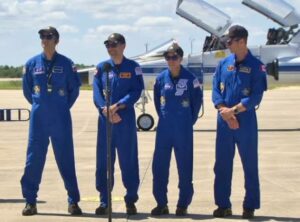
Speaking of Crew Dragon, Crew-13 is getting ready to launch to the ISS on Thursday at 11:10 am ET, weather permitting. The four person crew includes NASA’s Jessica Watkins (commander) and Luke Delaney (pilot), Canadian Space Agency astronaut Joshua Kutryk (mission specialist), and Roscosmos cosmonaut Sergey Teteryatnikov (mission specialist). They landed at KSC yesterday. A pre-launch news conference is on Wednesday.
Those and other events we know about as of Sunday morning are shown below. Check back throughout the week for others we learn about later and add to our Calendar or changes to these.
Monday, September 28
- Starship IFT-14 (first orbital flight attempt), Starbase, TX, launch window 8:15-9:30 am ET, splashdown approximately 10 hours later (watch on SpaceX’s website and X channel)
- NASA/Boeing Update on Starliner, KSC, 3:00 pm ET (watch on NASA’s YouTube channel)
Monday-Wednesday, September 28-30
- Committee on Biological and Physical Sciences in Space (National Academies), Keck Center, 500 5th St., NW, Washington, DC/online (some sessions are closed)
Tuesday, September 29
- SASC Sbcmte Hearing on Golden Dome, SR-222 Russell Senate Office Building, 4:00 pm ET (webcast)
Wednesday, September 30
- Space Solar Power Symposium (Space Frontier Foundation), Omni Shoreham Hotel, Washington, DC, 8:00 am-12:00 pm ET
- FCC Open Commission Meeting, 45 L St., N.E., Washington, DC/online, 10:30 am-12:30 pm ET
- Crew-13 Pre-Launch News Conference, KSC, 2:30 pm ET (watch on NASA’s YouTube channel)
- ISU-DC Space Café with Arianespace and Amazon LEO, 525 14th St S (Amazon HQ), Arlington, VA, 6:00-8:00 pm ET
Thursday, October 1
- Launch and Docking of Crew-13 (NASA coverage TBA)
- Launch, 11:10 am ET, Cape Canaveral Space Force Station, FL
- Dock, 8:00 pm ET, International Space Station
- Future of Military Space Communications (Mitchell Inst), virtual, 11:00 am-12:00 pm ET
User Comments
SpacePolicyOnline.com has the right (but not the obligation) to monitor the comments and to remove any materials it deems inappropriate. We do not post comments that include links to other websites since we have no control over that content nor can we verify the security of such links.