Department of Commerce Takes Step Towards Mission Authorization
Today the Department of Commerce took a step towards helping companies obtain government certification to conduct novel activities in space. Mutiple Congresses and administrations have failed to agree on a “mission authorization” regime for space activities not already regulated by existing law. This new Space Commerce Certification could make it easier for industry to navigate the complex government environment, but does not appear to be a complete solution.
The Department of Commerce’s (DOC’s) Office of Space Commerce (OSC) issued a draft of the proposal in December 2025 to get stakeholder feedback, and an updated version this March. OSC Director Taylor Jordan testified to the House Science, Space, and Technology committee about it last week.
Today Secretary of Commerce Howard Lutnick and Jordan posted a video on X announcing that “in coming weeks” they will publish a “call for interest” to allow companies to indicate if they want to participate.
@CommerceinSpace is pleased to announce that our “Space Commerce Certification” is taking a big step forward.
In the coming weeks, OSC will publish a “call for interest” for initial applications in the Federal Register.
Read more:https://t.co/KXnVdjaQjx#SpaceEconomy pic.twitter.com/eXyMRYTMRU
— U.S. Office of Space Commerce (@CommerceinSpace) July 23, 2026
Lutnick said the process is built on a “presumption of approval” to “keep regulations out of the way and make it easy and fast” for companies to get through government requirements.
DOC is responding to President Trump’s August 2025 Executive Order on “Enabling Competition in the Commercial Space Industry.” An accompanying fact sheet stressed that it “is imperative that new space-based industries, space exploration capabilities, and cutting-edge defense systems are pioneered in America rather than by our adversaries.”
The space industry has been seeking clarity and predictability on the regulatory regime for novel space activities for many years.
Article VI of the Outer Space Treaty requires governments to authorize and continually supervise the space activities of non-government entities, like companies. Congress has passed laws giving the DOC responsibility for regulating commercial remote sensing satellites, the Department of Transportation (DOT) for commercial launch and reentry, and the Federal Communications Commission (FCC) for assigning radio frequencies required for communications between Earth stations and satellites.
But the commercial space sector is booming with many novel in-space activities that don’t fit within those categories, like on-orbit servicing, commercial space stations, active debris removal, fuel depots, and much more. The question of which agency or agencies should regulate novel activities has pitted DOC and DOT against each other for years, along with debate over how much regulation is needed.
The 2015 Commercial Space Launch Competitiveness Act required the Obama Administration to submit a plan. It chose DOT. Congressional Republicans disagreed and legislation that would have assigned it to DOC almost passed in 2018, but was defeated for unrelated reasons at the last minute. The first Trump Administration expanded DOC’s responsibilities to include Space Traffic Management in Space Policy Directive-3, but grand plans for a much broader role didn’t materialize. The Biden Administration was next to pick up the gauntlet, but in 2023 waited until the last minute to send a proposal to Congress on the cusp of a House SS&T markup of a bill that was entirely different and everything stalled again.
Now the Trump Administration is moving forward on its own, without Congress. Navigating through the various government agencies that have roles in decision-making can be daunting for any company and DOC is offering to be a “clearinghouse” to help them through the interagency process, while cautioning that they still might need to deal directly with those agencies.
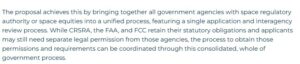
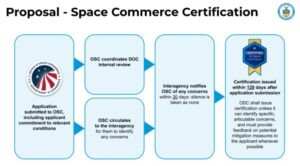
Jordan told the House SS&T committee last week that OSC would gather information from companies who choose to participate in the process, circulate it to the Department of War, Department of State, the FAA, the FCC, and NASA for review, and issue a certification if all agree. It would be up to the FAA and FCC to decide whether to waive any of their regulations, however.
Committee chairman Rep. Brian Babin (R-TX) appeared noncommittal, saying he needed to assess whether the proposal “fully meets the needs of the commercial space sector, or whether legislative action is needed” and whether “this proposed process, while thorough, avoids establishing unnecessary or burdensome requirements for operators and imposing barriers to industry innovation.” Ranking Member Rep. Zoe Lofgren (D-CA) noted that Congress has seen many proposals over the years but “We have not yet landed on a solution — and we need to.”
User Comments
SpacePolicyOnline.com has the right (but not the obligation) to monitor the comments and to remove any materials it deems inappropriate. We do not post comments that include links to other websites since we have no control over that content nor can we verify the security of such links.