NASA Shares Moon Base Progress, Contract Awards
NASA provided another update on the Moon Base project this weekend in conjunction with the MAX POWER airshow at Kennedy Space Center. Billions of dollars were awarded or soon will be for cargo landers, a nuclear-powered lunar rover, launch and transportation, as well as architecture and infrastructure capabilities. Although the agency is full steam ahead on Moon Base plans, the three CLPS missions expected to launch this year have all slipped to 2027 and hopes for another 10 in 2027 will wait until 2028.
The Moon Base update took place amidst NASA Administrator Jared Isaacman’s MAX POWER event that featured flyovers by the Thunderbirds, Isaacman in his own F-5 and MIG-29, NASA T-38 trainers, and other aircraft, along with skydives by a group including Isaacman as well as the U.S. Army Golden Knights.
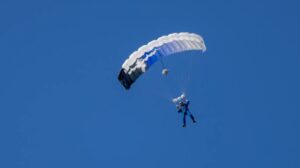
After the skydive on Saturday, Isaacman joined Moon Base Program Manager Carlos García-Galán, Science Mission Directorate head Nicky Fox, and the acting director of Moon Base’s Utility and Infrastructure Office Dayne Ise, at a press conference to announce the task order and contract awards and other Moon Base updates. NASA also announced that applications are open for the next class of astronauts.
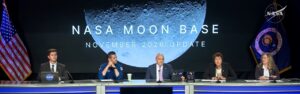
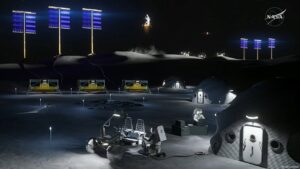
The successful Artemis II mission around the Moon in April and plans to return American astronauts to the lunar surface in 2028 are just part of NASA’s plans for lunar exploration. Isaacman rolled out the long term vision at his Ignition event in March — a Moon Base at the South Pole starting with commercial robotic landers, rovers, and supporting infrastructure including communications and solar and nuclear power.
The first three commercial robotic landers carrying NASA payloads landed on the Moon already, part of the Commercial Lunar Payload Services (CLPS) program that started in 2018. Through CLPS, NASA purchases services from companies that design, build and launch the landers. The companies are expected to close the business case by finding other customers. Of the four launched so far, one didn’t reach the Moon (Astrobotic), two landed but tipped over so not all objectives were met (both Intuitive Machines), and one was a complete success (Firefly’s Blue Ghost Mission-1).
NASA wants many more landers and rovers to explore the South Pole before astronauts arrive to get data on what the surface is really like, including the nature of the regolith, lighting and thermal conditions.
The first CLPS contracts, CLPS 1.0, had a total value of $2.6 billion through 2028. At the March Ignition event, NASA greatly expanded plans for CLPS, saying they’d launch 10 per year in 2027, 2028, and 2029. At the time, several missions were already close to launch and in May, three were expected in 2026. NASA designated them Moon Base 1, 2 and 3: Blue Origin’s Blue Moon MK1 cargo lander Endurance, Astrobotic’s Griffin (Astrobotic was recently acquired by Voyager), and Intuitive Machines’ IM-3 Trinity.
None of those will launch this year, however. Endurance and Trinity slipped soon thereafter and on Saturday García-Galán acknowledged Griffin will not launch until January at the earliest not only because of when the lunar launch windows are favorable, but because engine testing is still underway. At a meeting of the Mars Exploration Program Analysis Group (MEPAG) today, Lori Glaze, Associate Administrator for the Human Spaceflight Mission Directorate which oversees the Artemis program, also said they now anticipate just four CLPS missions in 2027 — those three plus one from Firefly. At the American Astronautical Society’s Von Braun Symposium last month, Fox said the target of 10 per year now starts in 2028.
At the Saturday event, NASA announced they are increasing CLPS 1.0 to $4.2 billion. In addition, a new CLPS 2.0 has a maximum value of $10 billion, with deliveries over 10 years. Eight companies are eligible to compete for those awards:
- Blue Origin
- Firefly Aerospace
- Intuitive Machines
- ispace-US
- Lockheed Martin Space
- Northrop Grumman Space Systems
- SpaceX
- Voyager Technologies (which recently acquired Astrobotic)
Saturday’s announcements covered several other awards, including six task orders under the Venture-Class Acquisition of Dedicated and Rideshare (VADR) launch services contract with a total value of $1.3 billion under a VADR contract with a total value of $5 billion. Those awards went to:
- Arrow Science and Technology
- Blue Origin
- Impulse Space
They will develop systems to transport cargo from Earth to lunar orbit including testing communications and navigation capabilities, delivering NASA’s MoonFall drones to the lunar surface, and demonstrating Orbital Transfer Vehicle capabilities. Some of those missions will launch on Blue Origin’s New Glenn, Relativity Space’s Terran R, and SpaceX’s Falcon 9 rockets. In-space transportation will be provided by Blue Origin, Firefly Aerospace, Impulse Space, and Quantum Space. SpaceX also will conduct a Cislunar Communications Deployment Demonstration under an existing lunar logistics contract. (Cislunar space is the area between the Earth and the Moon.)
Finally, NASA said it plans to purchase commercial components for a Mini-Communications and Solar Tower (miniCAST) to provide power and communications on the surface. Initially it is components only, not an integrated system. A solicitation for a fully integrated system is expected next year. The agency did not mention the dollar value, but the companies receiving the awards are:
- Honeybee Robotics, a Blue Origin company, for energy storage
- Redwire, for power generation
- Yank Technologies, for wireless power transfer
NASA also provided more information about plans to repurpose an engineering test model of an existing Mars rover and send it to the Moon. In June, Isaacman revealed that he was looking at the possibility of taking that rover, currently used by the Jet Propulsion Laboratory for tests if anything goes awry with the Curiosity or Perseverance rovers on Mars, and use it on the Moon. NASA wants more lunar rovers and this one has a Radioisotope Thermal Generator (RTG) that can keep the rover warm through the 14-day lunar night. Most landers and rovers equipped only with solar panels and batteries cannot survive the lunar night when temperatures can drop to as low as -208°C (-348°F).
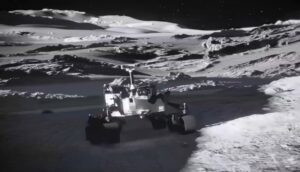
Now called the Polar Rover for Observation, Mapping and In-Situ Exploration or PROMISE, it has a drill that can penetrate 1 meter (3 feet) below the surface along with spectrometers, temperature and radiation sensors, visible-light cameras, and will demonstrate a next-generation, radiation tolerant computing system and advanced autonomy sensors and algorithms. NASA wants to launch it in 2028 for an 18-month mission on the lunar surface. Blue Origin was awarded a $94 million base contract with an option period worth another $140 million to deliver PROMISE to the lunar South Pole using one of its Mark 1 landers.
That doesn’t include the cost for JPL to alter the rover so it can work on the Moon. García-Galán said they have a firm commitment from JPL to do that for $400 million. Some Mars scientists are concerned that the engineering test article will no longer be available to troubleshoot problems with Curiosity, but Fox said a review team of subject matter experts concluded Curiosity can continue its work on Mars with low risk.
User Comments
SpacePolicyOnline.com has the right (but not the obligation) to monitor the comments and to remove any materials it deems inappropriate. We do not post comments that include links to other websites since we have no control over that content nor can we verify the security of such links.