Repercussions of New Glenn’s Explosion Still Coming Into Focus
The repercussions of last night’s explosion of Blue Origin’s New Glenn rocket during a pre-launch test will take some time to assess. Among the key questions are not only what happened, but how badly the launch pad was damaged, which will determine how quickly launches can resume, and whether other hardware at the nearby Horizontal Integration Facility was damaged. All of the company’s customers will be impacted, but especially NASA’s Moon program.
No one was injured, but live video from SpaceflightNow and NASASpaceflight.com cameras immediately conveyed the magnitude of the destruction. Aerial shots posted on X today by NASASpaceflight.com’s Jerry Pike drive home the work that lies ahead for the Jeff Bezos-owned company to restore the launch pad. It is Blue Origin’s only operational pad.
Absolute carnage on the ground at LC-36 this afternoon pic.twitter.com/SZKmuWowpn
— Jerry Pike (@JerryPikePhoto) May 29, 2026
The launch site is on Cape Canaveral Space Force Station, part of the U.S. Space Force’s Eastern Range and operated by Space Launch Delta 45. SLD45 and Blue Origin posted warnings on X that dangerous debris could wash ashore over the next days and weeks and to avoid contact with it.
Do not touch or attempt to recover suspected debris. Report debris to the Blue Origin Wreckage Management Hotline: 321-222-4355 or missionrecovery@blueorigin.com
If the debris poses an immediate public safety hazard, call 911 and the hotline.
— Space Launch Delta 45 (@SLDelta45) May 29, 2026
Debris from our recent hotfire anomaly may wash ashore in the coming days/weeks. If you encounter any debris, do not touch or approach it for your safety.
Please report the location immediately:
Call: 1-321-222-4355
Email: MissionRecovery@blueorigin.com— Blue Origin (@blueorigin) May 29, 2026
Apart from that, Blue Origin has said little, referring to the conflagration as an “anomaly” in a post on X last night. That post and another from Bezos offered assurances that all personnel were accounted for and safe. Bezos added: “it is too early to know the root cause, but we’re already working to find it. Very rough day, but we’ll rebuild whatever needs rebuilding and get back to flying. It’s worth it.”
They’ll need not just to determine the root cause, but fix it and restore the pad before the next launch can occur. Commercial launches are regulated by the FAA, but the agency told SpacePolicyOnline today via email that this test was “not within the scope of FAA licensed activities.”

The rocket was intended to launch 48 Amazon Leo satellites as part of Amazon’s satellite broadband Internet system. Blue Origin did not respond to questions from SpacePolicyOnline.com about the status of the satellites. The static fire (or “hotfire”) test that went awry last night is a routine step in space launches and payloads usually are not installed prior to the test just in case something like this happens.
Standing 98 meters (322 feet) tall with a diameter of 7 meters (23 feet), New Glenn can put 45 metric tons into low Earth orbit or 13 MT into geostationary transfer orbit. The first stage BE-4 engines, designed and built by Blue Origin, are powered by liquid methane and liquid oxygen and are the same engines used by the United Launch Alliance (ULA) for its new Vulcan rocket. What impact yesterday’s failure will have on Vulcan launches is unclear. ULA still has several Atlas V rockets in inventory (one is launching tonight, in fact, with a different set of Amazon Leo satellites), but are booked. With New Glenn out of service indefinitely and SpaceX’s Starship still in the test phase (and currently undergoing a mishap investigation due to the failure of the Booster landing engines on May 22), if Vulcan is also grounded, SpaceX’s Falcon Heavy may become the workhorse for heavy payloads. How easily customers can switch from one rocket to another is unclear.
That can be particularly challenging for government payloads that have unique requirements. The U.S. Space Force awarded Blue Origin contracts to launch national security satellites including a $2.4 billion Phase 3 Lane 2 award last year for launches between 2025-2029, but has not yet certified New Glenn for those launches. (Update: Unlike Phase 3 Lane 2, Phase 3 Lane 1 awards don’t require certification. Late today the Space Force announced that yesterday afternoon (presumably before the explosion, though the time zone isn’t specified) they awarded a task order to Blue Origin to launch a National Reconnaisance Office mission between 4th quarter Calendar Year 2027/1st quarter CY2028, saying yesterday’s “anomaly is a solemn reminder that the critical capability this community provides is rocket science and inherently challenging.”) Space Force also has contracts with ULA for Vulcan launches, but Vulcan is currently grounded because of a Solid Rocket Motor failure on its most recent launch in February.
Gen. B. Chance Saltzman, Space Force Chief of Space Operations, expressed pride in the “men and women of @SLDelta45 who immediately sprang into action” and confidence that Blue Origin will learn “immensely” from the failure and the Space Force “stands ready to support our industry partners.”
Last night’s anomaly is a stark reminder that our business is inherently dangerous and complex. I’m proud of the men and women of @SLDelta45 who immediately sprang into action to protect the public and our vital infrastructure. I’m confident @BlueOrigin will learn immensely from…
— General Chance Saltzman (@SpaceForceCSO) May 29, 2026
NASA is counting on New Glenn to deliver Blue Origin’s Blue Moon Mark 1 (MK1) robotic landers to the Moon beginning this year, and Blue Moon Mark 2 (MK2) crewed landers to put astronauts back on the surface of the Moon in 2028 — before China lands taikonauts there and before President Trump leaves office. Just three days ago, NASA outlined Phase 1 of its plans to build a Moon Base, with four MK1 robotic landers. An earth-orbital test flight of the MK2 Human Landing System (HLS) is scheduled for next year and lunar landing(s) in 2028 by Blue Origin and/or SpaceX’s Starship.
- 2026:
- The first Blue Moon MK1 would become “Moon Base 1,” putting the Endurance robotic lander at the lunar South Pole’s Shackleton Crater with two NASA payloads.
- 2027:
- A second Blue Moon MK1 lander would deliver NASA’s VIPER rover to the lunar South Pole.
- Separately, NASA Administrator Jared Isaacman recently reformulated the Artemis program to add an earth-orbital test flight next year where astronauts on the Orion capsule would practice rendezvous and docking tests with Blue Origin’s MK2 HLS lander and SpaceX’s Starship HLS.
- 2028:
- Two Blue Moon MK1 landers would deliver Lunar Terrain Vehicles (LTVs) being built by Lunar Outpost and Astrolab
- The first U.S. astronauts return to the lunar surface on either Blue Moon MK2 or SpaceX’s Starship, or perhaps both (Isaacman said he is “protecting against” two human landings in 2028).
In a post on X last night, Isaacman said the agency will “work with our partners to support a thorough investigation of this anomaly, assess near-term mission impacts, and get back to launching rockets.”
NASA is aware of the anomaly that occurred tonight at Launch Complex 36 involving Blue Origin’s New Glenn rocket at Cape Canaveral Space Force Station. ⁰⁰Spaceflight is unforgiving, and developing new heavy-lift launch capability is extraordinarily difficult. We will work with…
— NASA Administrator Jared Isaacman (@NASAAdmin) May 29, 2026
Today, he traveled to Florida to meet with Bezos, Blue Origin CEO Dave Limp and others to assure them NASA would “take an active role alongside our partners, just as we did in the 1960s, to overcome setbacks, remove obstacles, and deliver intended outcomes.” On X, Bezos and Limp thanked Isaacman for coming there to express support to the Blue Origin team, and vowed to get back to flight as soon as possible.
NASA’s goal of getting American boots back on the Moon before China arrives has strong bipartisan support in Congress. With Congress in recess this week for the Memorial Day holiday, reaction has been muted, but Rep. Brian Babin (R-TX), who chairs the House Science, Space, and Technology Committee and represents Johnson Space Center, home to the NASA astronaut corps, issued a statement.
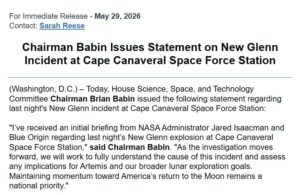
Rep. Mike Haridopolos (R-FL), who represents Florida’s Space Coast and chairs HSS&T’s space subcommittee, posted a statement on X last night and shared an interview he did on Good Day Orlando today. Several posts on X last night indicated the explosion was felt all the way over to Orlando, about 60 miles west.
🚨 Update from Washington, DC on the Blue Origin explosion last night. I joined @GoodDayOrlando ⬇️ pic.twitter.com/53O28hpbTa
— Congressman Mike Haridopolos (@RepHaridopolos) May 29, 2026
Sen. Jerry Moran (R-KS), chair of the Senate Appropriations Commerce-Justice-Science subcommittee that funds NASA, said he remains committed to the Artemis program and “building a robust space economy with multiple providers capable of carrying our nation to the Moon, Mars & beyond.”
Blue Origin’s test anomaly is a reminder that spaceflight is difficult & dangerous. America’s leadership in space depends on competition, innovation & redundancy. That’s why I remain committed to Artemis & building a robust space economy with multiple providers capable of…
— Senator Jerry Moran (@JerryMoran) May 29, 2026
The words of support are undoubtedly welcome at Blue Origin, but the company faces what could be a long road back to flight not only finding and fixing what caused this, but restoring or entirely rebuilding the launch pad. That may well turn out to be the pacing item.
Launching Blue Moon MK1 this year certainly seems unlikely and whether Blue Origin can get both the rocket and the Blue Moon MK2 crew lander demonstrator ready for Artemis III next year will be a herculean feat.
This article has been updated.
User Comments
SpacePolicyOnline.com has the right (but not the obligation) to monitor the comments and to remove any materials it deems inappropriate. We do not post comments that include links to other websites since we have no control over that content nor can we verify the security of such links.