Trump Will Re-Nominate Isaacman for NASA Administrator
This afternoon President Trump announced that he will nominate Jared Isaacman to be NASA Administrator. Isaacman was Trump’s original nominee for the job on January 20, but he withdrew it on May 31 after a falling out with Elon Musk who had recommended Isaacman. The Senate could act quickly on the nomination since Isaacman was already approved by the Senate Commerce Committee, but with the government shutdown breaking the record for the longest in history and many other nominations pending, time will tell if they treat this with urgency.
After lots of chatter that Secretary of Transportation and Acting NASA Administrator Sean Duffy was trying to keep the job and integrate NASA into the Department of Transportation, Trump ended speculation about his plans for NASA in a 5:42 pm ET post on Truth Social saying he is nominating Isaacman. No mention was made of the earlier Isaacman nomination or why it was withdrawn, just praise for both men.

Isaacman has remained above the fray throughout. On podcasts and in social media posts since the original nomination was withdrawn, he has graciously thanked Trump for nominating him in the first place, reasserted his vision for NASA as explained during his April 9 confirmation hearing, and urged the space community to focus on what NASA needs to succeed.
In a lengthy post on X just today, he responded to recent news stories about a paper he wrote — Athena — during the months he was Trump’s first nominee laying out his ideas. A shortened 62-page version has been circulating in Washington with speculation that Duffy or his supporters have been using it to discourage Senators from voting for Isaacman if he was renominated because some of the suggestions would disrupt the status quo.
It is unfortunate that NASA’s team and the broader space community have to endured distractions like this. There are extraordinary opportunities and some risks ahead and so the focus should be on the mission. With many reporters and other interested parties reaching out, I want… https://t.co/IyPVmHUAzo
— Jared Isaacman (@rookisaacman) November 4, 2025
Trump’s announcement that he’s nominating Isaacman happened about three hours later and Isaacman posted his appreciation to Trump and to Duffy “who skillfully oversees @NASA alongside his many other duties.” He thanked the “overwhelming” support from the “space-loving community” and vowed “to do everything I can to live up” to their expectations.
Thank you, Mr. President @POTUS, for this opportunity. It will be an honor to serve my country under your leadership. I am also very grateful to @SecDuffy, who skillfully oversees @NASA alongside his many other responsibilities.
The support from the space-loving community has… pic.twitter.com/CUpyTXfB14
— Jared Isaacman (@rookisaacman) November 4, 2025
The nomination now must be formally submitted to the Senate. How long it will take before the Senate votes on it depends on many factors.
At the top of the list is whether the Senate Commerce Committee under the leadership of Sen. Ted Cruz (R-TX) and Sen. Maria Cantwell (D-WA) decides to hold a second confirmation hearing.
Several consequential months have passed since the April 9 hearing. Importantly, that took place before the Trump Administration submitted it’s FY2026 budget request. Isaacman surprisingly told the committee he thought NASA could pursue human missions to the Moon and Mars simultaneously within NASA’s existing budget and spoke glowingly of “a Golden Age of Science and Discovery.” But the very next day the Office of Management and Budget informed NASA it would cut the agency’s budget by 24.3 percent, including a nearly 50 percent reduction to science. The formal budget request sent to Congress on May 30 proposed just that. Senators might well want an opportunity to ask Isaacman how he’ll cope with such a budget if it comes to pass.
Cruz posted on X that he’s looking forward to working with Isaacman “to continue the Moon-to-Mars mission and Artemis mission, our best chance of beating China to the Moon,” but didn’t signal whether another hearing will be held.
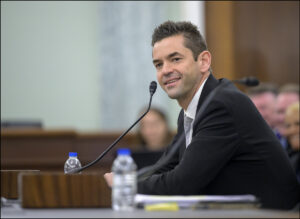
Isaacman was approved by the committee April 30 by a vote of 19-9 with all Republicans and four Democrats voting yes and nine Democrats voting no. All seemed to be going well until Trump’s surprise decision to withdraw the nomination on May 31 after he and Elon Musk argued over provisions in the reconciliation bill under consideration at the time — now the One, Big Beautiful Bill Act (OBBBA).
Trump asserted during a June 5 press conference with German Chancellor Friedrich Merz that he’d learned Isaacman “happened to be a Democrat, like, totally, Democrat … and one of the privileges is we don’t have to appoint a Democrat.” Isaacman portrays himself as “relatively apolitical” and the fact he had contributed to both Democrats and Republicans was well known before his confirmation hearing.
Meanwhile, NASA and other parts of the government are shut down except for essential activities due to a lapse in appropriations. Operations of the International Space Station and NASA’s armada of spacecraft in Earth orbit and beyond as well as work on the Artemis program are continuing, but everything else is paused.
The House has not met since September 19. The Senate is still working with hearings taking place, nominations being approved, and votes on whether to reopen the government rejected 14 times. Eventually it will reopen — what it will take is being vigorously debated at the White House and on Capitol Hill — but the FY2026 appropriations bills still need to pass both chambers and be signed into law. None have so far.
The House and Senate appropriations committees did not agree with the Trump Administration’s proposed deep cuts to NASA and would keep it funded at roughly its FY2025 level, a great improvement over the request, but still much less than the agency was expecting just two years ago when it made plans for its multi-year programs. If Isaacman makes it through this time, he’ll have difficult choices to make although he believes NASA can “reorganize and empower” to do more with less.
Isaacman, nicknamed “Rook,” is a billionaire entrepreneur who quit high school at 16 to found the Shift4 payment processing company in his parent’s basement. He developed a passion for flying jets and eventually went back to school, graduating from Embry-Riddle Aeronautical University at the age of 28. In addition to Shift4, he founded Draken International, a defense firm that owns the largest commercial fleet of ex-military aircraft and trains Air Force pilots. He sold a majority stake in it to Blackstone in 2019.
Isaacman first interacted with Elon Musk and SpaceX when Shift4 became the payment processing company for SpaceX’s Starlink system. That led to Isaacman commanding the first all-private astronaut mission, Inspiration4, on SpaceX’s Crew Dragon with three companions. He flew again on Polaris Dawn with three others in 2024, conducting the first commercial spacewalk. His association with Musk was sharply questioned by Democrats during his confirmation hearing, a time during which Musk was leading Trump’s DOGE effort that slashed government agencies and personnel. Isaacman has pushed back on the extent of Musk’s role in his original nomination.
This article has been updated.
User Comments
SpacePolicyOnline.com has the right (but not the obligation) to monitor the comments and to remove any materials it deems inappropriate. We do not post comments that include links to other websites since we have no control over that content nor can we verify the security of such links.