NASA Looking for New Ways to Return Perseverance Samples From Mars
In January, NASA will begin assessing new strategies to return the samples now being collected by the Mars Perseverance rover to Earth. The agency ended an earlier Mars Sample Return mission last year because of cost concerns.
At a virtual NASA Town Hall meeting for the planetary science community today, Program Executive for Mars Exploration George Tahu said the Perseverance Sample Retrieval Architecture (PSRA) strategy team will kick off in January and spend a year looking at alternative ways to get the samples back to Earth.
Perseverance landed on Mars in 2021 and has been collecting carefully selected samples from Jezero Crater ever since. NASA and the European Space Agency developed various designs to put a lander on the surface where the samples could be delivered by Perseverance and lofted by a rocket into orbit around Mars to meet up with an ESA spacecraft for return to Earth.
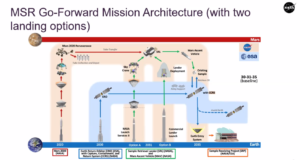
Congress and the agency itself expressed concerns after costs escalated to $11 billion. In January 2025, outgoing NASA Administrator Bill Nelson punted a decision on how to accomplish the Mars Sample Return (MSR) mission to the incoming Trump Administration. Their FY2026 budget request called for its cancellation. Congress provided $110 million for Mars Future Missions, but not specifically MSR.
Meanwhile, Perseverance continues its work collecting samples of tremendous scientific interest. NASA Administrator Jared Isaacman has said several times that returning the samples would be one of the most important scientific achievements in history. The question is how to do it affordably.
Tahu said the agency is standing up an internal team in January to “assess lessons learned, past recommendations, assess current agency and evolving industry capabilities, [and] look at different implementation approaches.” That includes determining whether certain constraints can be removed and new acquisition approaches considered. “The goal is to develop a high-level architecture approach and recommendations by the end of next year.”
The United States and China are the only two countries to successfully land on Mars.
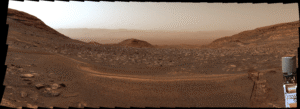
The first U.S. landers were Viking 1 and 2 in 1976, followed by Mars Pathfinder/Sojourner (1997), Spirit and Opportunity (2004), Phoenix (2008), Curiosity (2012), InSight (2018), and Perseverance with the Ingenuity helicopter in 2021. Curiosity and Perseverance continue to explore the Red Planet today. Curiosity achieved a milestone on August 26 by reaching an altitude of 1 kilometer above the floor of Gale Crater and sent back this image.
China’s Tianwen-1 successfully landed in 2021 and operated for about one year. China plans to launch Tianwen-3 to Mars in 2028, returning samples to Earth in 2031. (Tianwen-2 is an ongoing asteroid sample-return mission.)
Mars landing attempts by the Soviet Union in the 1970s and by Europe more recently were not successful. The European Space Agency plans to launch the Rosalind Franklin rover (formerly ExoMars) in 2028 in partnership with NASA, but like all the previous landers/rovers will not return samples.
User Comments
SpacePolicyOnline.com has the right (but not the obligation) to monitor the comments and to remove any materials it deems inappropriate. We do not post comments that include links to other websites since we have no control over that content nor can we verify the security of such links.