Next Crewed Boeing Starliner Flight Not Until 2028
Two years after Boeing’s Starliner spacecraft landed in the New Mexico desert without NASA’s Butch Wilmore and Suni Williams, Boeing and NASA said today it will not be ready to fly astronauts again until 2028. An uncrewed flight test is expected no sooner than the end of this year, but they want another year or more to evaluate those results before putting people aboard.
One clear message from the NASA-Boeing news conference at Kennedy Space Center is that both remain committed to Starliner despite persistent problems since the first test flight in 2019.
In 2014, NASA awarded fixed-price contracts to Boeing and SpaceX to design, build, and launch “commercial crew” spacecraft to restore America’s ability to send astronauts to the International Space Station. From 2011 when the Space Shuttle was terminated until SpaceX’s Crew Dragon made its first flight in 2020, NASA had to pay Russia for crew transportation services at a price that ultimately reached $90 million per seat.
From the beginning NASA wanted two commercial crew providers to ensure redundancy and competition. That remains the goal today, but SpaceX is the only one because of Starliner’s repeated technical failures. SpaceX’s 13th operational flight is getting ready to launch later this week.
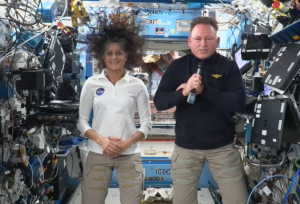
By contrast, Starliner has delivered only one crew to the ISS, Butch and Suni, on the 2024 Crew Flight Test (CFT). Failures in the propulsion system during the flight up to the ISS and while docking led NASA to conclude it wasn’t safe enough to bring them back to Earth. Starliner CFT landed empty while Butch and Suni remained aboard the ISS for more than 9 months until they could return on a SpaceX Crew Dragon.

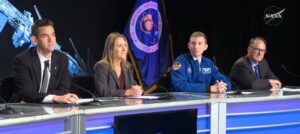
Today NASA Administrator Jared Isaacman and NASA’s Low Earth Orbit (LEO) Program Manager Dana Weigel repeatedly stressed that NASA still wants two commercial crew systems and remains committed to getting Starliner operational.
“We are living through the most exciting era of space exploration since Apollo. As this domain continues to open, there will be growing demand for launch vehicles, transfer stages, landers, and, of course, spacecraft that carry astronauts. NASA has been committed to having multiple crew transportation options since the beginning of the Commercial Crew Program. We have worked closely with Boeing to address the issues identified on previous Starliner flights, and we intend to see this vehicle return to flight in support of the International Space Station and future commercial destinations.” — Jared Isaacman
NASA decided last year that the next Starliner flight, Starliner-1, will be an uncrewed test flight with cargo only. Starliner-2 will be the next to carry a crew and Isaacman announced Hoburg will command that mission. Hoburg praised Butch and Suni as “American heroes” who “conducted themselves with the utmost of professionalism, confidence and humility.” An engineer and commercial pilot, he added that Starliner is “a pilot’s spacecraft” and “there’s a lot that’s right with this vehicle.”
Isaacman said Starliner-1 will launch no earlier than December of this year and Starliner-2 not until 2028. Mulholland added later that Boeing is targeting the middle of 2028. Weigel said her goal is for Starliner-2 to be a routine crew exchange mission, not a test flight, meaning four crew members will be aboard, likely including some from other countries.

The long gap between Starliner-1 and Starliner-2 is because a number of engineering problems remain to be resolved. Chief among them are problems with “poppets,” movable parts of valves inside Reaction Control System (RCS) thrusters in the Service Module that control the flow of nitrogen tetroxide (NTO) oxidizer. During the Starliner CFT mission, thermal and mechanical forces caused the poppets to “extrude” out of their proper position. Five of the 28 RCS valves on Starliner CFT failed during the one-day trip to the ISS.
Through extensive service module thruster testing, we now understand that the thruster’s valve poppet extrudes under certain thermal and mechanical conditions. On the thermal side, Boeing has implemented thermal shunts and barriers to the spacecraft. We expect that to substantially reduce the temperature that the thruster will see. It’ll be really important to us during Starliner-1 to see how those performance enhancements yield in a thermal environment. On the mechanical side, we’re not able to address that with the current design. That’s what’s driving the need to do a modification to the poppet. That will take some time, but those design modifications will be implemented on the crewed vehicle. — Dana Weigel
Work on redesigning the poppets is just beginning. They are affected by other parts of the RCS system where changes already have been made. NASA and Boeing want to test them on Starliner-1 before making final decisions. “We need to understand the rest of the story and the rest of the (thermal) environment … and factor that into final design and certification,” Weigel explained.
Starliner CFT also experienced helium leaks while on orbit and, during reentry, a thruster in the Crew Module failed. No one was aboard and the capsule landed safely, but it was another indication of engineering lapses that have bedeviled the program since the beginning.
For both Boeing and SpaceX, NASA required an uncrewed flight test and then a crewed flight test before the systems were certified to fly government astronauts. Boeing’s first uncrewed Orbital Flight Test in December 2019 almost ended catastrophically due to software errors. Boeing decided to refly that test before putting anyone aboard, but the first attempt at launching OFT-2 in August 2021 was scrubbed about two hours before launch when 13 propulsion valves wouldn’t open. OFT-2 finally succeeded in 2022. They were getting ready for the Starliner CFT mission with Butch and Suni in July 2023 when more problems emerged — parachute lines that didn’t meet required safety factors and the discovery of flammable tape around wiring harnesses. Fixing those issues delayed Butch and Suni’s flight to 2024. The thruster failures and helium leaks on the first day of that flight demonstrated Starliner’s problems were not fully resolved.
In February 2025 as Butch and Suni were preparing to return to Earth on Crew Dragon, NASA chartered a Program Investigation Team (PIT) to “investigate the technical, organizational, and cultural contributions to the test flight issues.” One year later, Isaacman, just two months into the job as NASA Administrator, released the report and declared Starliner CFT as a “Type-A mishap,” the most serious designation, criticizing NASA itself for not having done it sooner and poor management overall. Although Boeing built Starliner, NASA agreed to fly it: “NASA’s limited-touch acquisition and management posture left the agency without the systems knowledge and development insight required to confidently certify a human-rated spacecraft, and insight versus oversight was not applied consistently.”
But the agency remains committed to Starliner not only because of sunk investments, but because SpaceX plans to discontinue Crew Dragon as well as Cargo Dragon and the Falcon 9 rocket when its new Starship is fully operational. Starship reached orbit for the first time today. Although NASA and SpaceX just signed a contract for three more Crew Dragons to support the ISS in 2027 and 2028, whether more will be available after that is unclear.
That opens the market for Starliner and although NASA plans to deorbit the ISS in 2030, future opportunities could await from commercial companies planning to build replacements for it. NASA wants to continue sending astronauts to conduct microgravity experiments on space stations, but doesn’t want to build another one itself. Instead it wants to be one of many customers for Commercial LEO Destinations or CLDs. Several companies are working on that already and although some question the commercial viability of CLDs, Mulholland said Boeing is excited about future prospects.
Boeing generally has to pay for the cost overruns on Starliner since it is a fixed-price contract. The price tag reached $2 billion by February 2025. In November 2025, NASA modified the Starliner contract, reducing the number of flights from six to four, but Weigel said today they are beginning the process to reinstate those two flights and agreed to a $359 million contract modification to cover some of the costs of returning Starliner to flight.
NASA also will help get Starliner certified to fly on United Launch Alliance’s new Vulcan rocket. It’s currently certified to fly on ULA’s Atlas V, which is being replaced by Vulcan. Only six Atlas Vs remain and are all under contract to Boeing for Starliner, which would cover the uncrewed Starliner-1 and five crewed missions, but none beyond that.
User Comments
SpacePolicyOnline.com has the right (but not the obligation) to monitor the comments and to remove any materials it deems inappropriate. We do not post comments that include links to other websites since we have no control over that content nor can we verify the security of such links.