Russia Agrees to ISS Operations, Seat-Swaps, Through 2030
During meetings this week with NASA Administrator Jared Isaacman, Roscosmos Director General Dmitry Bakanov agreed that Russia will support operations of the International Space Station through 2030. Until now, Russia was committed only through 2028 even though the other ISS partners adopted 2030 several years ago. Bakanov also agreed to continue seat-swaps where Russia launches NASA astronauts, and NASA launches Russian cosmonauts, to the ISS on a no-exchange-of-funds basis.
Isaacman and Bakanov met at the Baikonur Cosmodrome in Kazakhstan in conjunction with the launch of Soyuz MS-29 that included NASA astronaut Anil Menon. Isaacman is the first NASA Administrator to attend a launch at Baikonur since Jim Bridenstine in 2018. Bakanov was at Kennedy Space Center for the Crew-11 launch one year ago and met with then-Acting NASA Administrator Sean Duffy.

Russia’s TASS news agency reported on Tuesday that Bakanov and Isaacman agreed on operating ISS through 2030, continuing the seat-swap arrangement, and to coordinate satellite operations to avoid collisions. NASA has not issued a statement, but confirmed to SpacePolicyOnline.com today that Bakanov’s “account is correct” and that the two also “discussed continued safe operation of the ISS, which includes a PrK resolution.” PrK is a transfer tunnel between the end of the Russian segment and a docking port used for cargo ships. Air leaks have been a persistent problem there for several years.
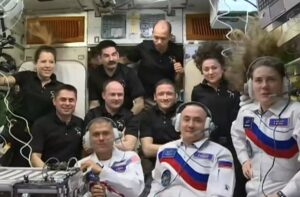
Tuesday’s launch sent Menon and his Russian crewmates Pyotr Dubrov and Anna Kikina to the ISS where they docked about three hours later to begin an 8-month mission. They are replacing Soyuz MS-28 and joining Crew-12. Soyuz MS-28 with Roscosmos’s Sergey Kud-Sverchkov and Sergei Mikaev, and NASA’s Chris Williams, arrived in November 2025. Crew-12 came aboard in February 2026 with NASA’s Jessica Meir and Jack Hathaway, ESA’s Sophie Adenot, and Roscosmos’s Andrew Fedyaev.
The ISS is a partnership among the United States, Russia, Japan, Canada, and 11 European countries working through the European Space Agency. It’s been occupied by rotating international crews for more than 25 years who launch on either Russia’s Soyuz or the U.S. space shuttle (through 2011) or Crew Dragon (since 2020). Russians and Americans routinely launch on each other’s spacecraft, but NASA had to compensate Russia when no American vehicle was available like the nine years between the end of the space shuttle in 2011 and the beginning of SpaceX Crew Dragon missions in 2020.
One person from each country must be aboard the ISS at all times to operate the interdependent U.S. and Russian segments. In 2022, the two sides agreed to fly one person from the other’s country on a no-exchange-of-funds basis — a “seat-swap.” The agreement has been renewed periodically. This new arrangement takes it through the end of ISS operations in 2030.
Until now, Russia hadn’t agreed to operating ISS through 2030, only to 2028, unlike the other ISS partners. The ISS’s lifetime has been extended several times, most recently in 2021 when President Joe Biden announced the 2030 date. Congress codified the extension in the 2022 NASA authorization act. Europe and Japan agreed in 2022 and Canada in 2023.
The ISS is old — the first modules were launched in 1998. Generally it’s in good shape, but the PrK leaks are concerning. NASA told Congress in March there were no more leaks, but they reappeared and in June five of the seven ISS crew members had to shelter in Crew Dragon while the other two prepared to make extensive repairs. Ultimately Roscosmos decided to apply more sealant instead, but the problem remains. NASA and Roscosmos disagree on the severity and consequences of the leaks.
NASA didn’t elaborate on what Isaacman and Bakanov discussed about the leaks, or about coordinating satellite operations to avoid collisions. Bakanov told TASS that “NASA colleagues made a very reasonable request to begin more detailed coordination between satellite constellations…There are risks of collisions, which must not be allowed. Therefore, Roscosmos and NASA will work very closely in this area.”
User Comments
SpacePolicyOnline.com has the right (but not the obligation) to monitor the comments and to remove any materials it deems inappropriate. We do not post comments that include links to other websites since we have no control over that content nor can we verify the security of such links.