What’s Happening in Space Policy February 1-7, 2026
Here is SpacePolicyOnline.com’s list of space policy events for the week of February 1-7, 2026 and any insight we can offer about them. The House and Senate are in session this week.
During the Week
Today (Sunday) is the 23rd anniversary of the Space Shuttle Columbia tragedy that took the lives of NASA’s Rick Husband, William McCool, Michael Anderson, Kalpana Chawla, David Brown, and Laurel Clark and Israeli Air Force Pilot Ilan Ramon. As we noted last week, NASA’s Day of Remembrance was early this year because of where the fourth Thursday in January fell, but many of us will be remembering the brave Columbia crew today along with all those who lost their lives in the pursuit of spaceflight.

Space shuttle flights resumed two-and-a-half years later and NASA continues sending crews to the International Space Station in earth orbit. Next up is Crew-12, who could launch as soon as February 11, but their launch date is somewhat dependent on when Artemis II lifts off. We’ll have more on Crew-12 next week.
Artemis II could launch before them and take astronauts not just to earth orbit, but around the Moon for the first time since the Apollo era. The four-person Artemis II crew is in quarantine right now ready to go, but first the Space Launch System (SLS) rocket must pass the Wet Dress Rehearsal (WDR) test. NASA will fill SLS with liquid hydrogen and liquid oxygen propellant — called “tanking” — while conducting a series of countdown tests with various holds until they get to the point where they will count down to about 30 seconds before liftoff would occur. They’ll stop there and drain the tanks.

The WDR was delayed two days by frigid weather in Florida and although it’s still unusually cold they began the roughly 49-hour test last night. A 24/7 livestream is available. The simulated launch window opens at 9:00 pm tomorrow, February 2, and continues through about 1:00 am on February 3. NASA posted the timeline. A go/no-go decision on whether to proceed with tanking will be made at the L-10 hour 20 minute mark.

If the WDR goes well, Artemis II could launch as soon as February 8. The previous target of February 6 no longer is possible. This is a test flight and they will fly around the Moon on a free-return trajectory so they will come back to Earth even if the Orion propulsion system doesn’t perform as planned. They will not orbit the Moon, much less land. (The first landing since Apollo is currently targeted for 2028.)
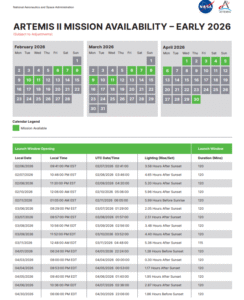
This is the second SLS launch. The first was Artemis I, an uncrewed test flight of SLS and the Orion crew capsule in November-December 2022. A number of issues arose during several WDRs for Artemis I and, together with hurricane-related delays, it was eight months between when it first rolled to the launch pad and actually lifted off. This WDR is designed to wring out any problems with the rocket, spacecraft, or ground systems and while NASA is applying lessons learned from Artemis I, it would not be surprising if some were discovered. The Earth and Moon must be properly aligned for such missions. A number of days every month are possibilities. If they can’t launch one month, then can launch another. Here’s NASA’s list of opportunities for the next three months.
Up on Capitol Hill this week, Congress will try to finish more of the FY2026 appropriations bills. They completed action on NASA’s FY2026 funding two weeks ago and five others are done, but the remaining six aren’t to the finish line yet. Those include Defense and Transportation-HUD. The U.S Space Force is funded in the Defense bill and FAA’s Office of Commercial Space Transportation is in THUD.
The House passed all six, but as three separate bills. The Homeland Security bill, which funds ICE, is very controversial and the House dealt with that one by itself. It passed by a narrow margin. The House then combined it with the others and sent it to the Senate expecting the package would get enough votes in order to avoid another government shutdown. But the incident in Minneapolis last weekend changed the dynamics and the Senate could pass only five of the six, not Homeland Security. With White House support, they substituted a two-week CR for Homeland to provide time to find a resolution. Since the Senate changed what the House passed, it now must be voted on again by the House.
At the same time, House Speaker Mike Johnson’s (R-LA) slim Republican majority is getting even slimmer. On January 1, it was 220-213, but due to the unexpected death of Rep. Doug LaMalfa (R-CA) and the resignation of Rep. Marjorie Taylor Greene (R-GA), Republicans are down to 218 members. Meanwhile, Christian Menefee (D-TX) should be sworn in tomorrow, the first day the House is back in session. Yesterday Menefee won the run-off election to fill the seat of Rep. Sylvester Turner (D-TX) who died last March. That will put the party split at 218-214. There will be two Republican and one Democratic (for the seat held by Mikie Sherrill, now Governor of New Jersey) vacancies at that point.
The appropriations vote is expected to happen early this week, but the timing is uncertain. Until then, departments and agencies in those bills, including Defense, are once again in a shutdown. The shutdown affects activities funded through the appropriations process, but not by other sources like the reconciliation bill — the One Big Beautiful Bill Act (OBBBA) — that passed last summer. DOD got about $156 billion in the OBBBA, including $13.8 billion for the Space Force.
Also on Capitol Hill this week, the House Science, Space, and Technology Committee will hold a full committee markup of a new NASA Authorization bill on Wednesday. The committee announced the markup on Friday and provided the bill number, H.R. 7273, but the text is not publicly available yet. [UPDATE: the text is now posted here.] The most recent NASA authorization was enacted in 2022 as part of the CHIPS and Science Act. House SS&T and the Senate Commerce, Science, and Transportation Committee oversee NASA. Committee leaders on both sides of the aisle and both sides of the Hill have expressed intent to pass a new one for quite some time and the House passed one in 2024, but the Senate did not act on it. Senator Ted Cruz (R-TX) and Senator Maria Cantwell (D-WA), Chairman and Ranking Member of Senate Commerce, introduced a bipartisan NASA authorization bill last year, but there’s been no action on it yet. Authorization bills set policy and may recommend funding levels, but not do provide any money.
Senate Commerce will take up two other bipartisan space-related bills this week. The ORBITS Act (Hickenlooper, D-CO) seeks to ensure space sustainability by remediating space debris, and the SAT Streamlining Act (Cruz, R-TX) seeks to make it easier for commercial satellite companies to get approval from the FCC.
Those and other events we know about as of Sunday morning are shown below. Check back throughout the week for others we learn about later and add to our Calendar or changes to these.
Monday-Tuesday, February 2-3
- Simulated Launch Window for Artemis II Wet Dress Rehearsal, 9:00 pm-1:00 am ET, KSC (livestreamed)
Monday-Friday, February 2-6 (continues next week)
- Scientific and Technical Subcommittee of the U.N. Committee on Peaceful Uses of Outer Space (UNCOPUOS), Vienna, Austria (portions livestreamed)
Tuesday, February 3
- Committee on Earth Science and Applications from Space (National Academies), National Academy of Sciences building, 2101 Constitution Ave, NW, Washington DC, 9:00 am-12:00 pm ET (livestreamed)
- Senate Commerce Committee Executive Session, 253 Russell Senate Office Building, 10:00 am ET (webcast)
Wednesday, February 4
- House SS&T Full Committee Markup NASA Authorization Bill, 2318 Rayburn House Office Building, 10:00 am ET (webcast)
This article has been updated.
User Comments
SpacePolicyOnline.com has the right (but not the obligation) to monitor the comments and to remove any materials it deems inappropriate. We do not post comments that include links to other websites since we have no control over that content nor can we verify the security of such links.