What’s Happening in Space Policy June 28-July 4, 2026
Here is SpacePolicyOnline.com’s list of space policy events for the week of June 28-July 4, 2026 and any insight we can offer about them. The House is in session for part of the week. The Senate is in recess except for pro forma sessions.
During the Week
Saturday is July 4, America’s 250th birthday. Happy Birthday, United States of America!

The federal government is closed on Friday to celebrate and a lot of people already are on vacation including the Senate. But the House plans to be in session through Thursday and there are quite a few other events this week.
Among the bills the House plans to take up is the FY2027 National Defense Authorization Act (NDAA). The NDAA sets policy and recommends funding levels for DOD and is considered “must-pass” legislation. The first NDAA was enacted in 1961 and it’s cleared Congress every year no matter the level of partisan discord. Consequently members try to attach other legislation to it even if it’s only vaguely related, if at all. For example, some House Republicans intent on passing President Trump’s voting bill want to attach it to the NDAA after blocking floor action last week over the issue. Rep. Anna Paulina Luna’s (R-FL) amendment (#1058) is one of 1,363 amendments the House Rules Committee will consider tomorrow (Monday). The topic is well outside the remit of this website and we mention it only because it’s quite controversial and actually could affect passage of the NDAA, history notwithstanding. It will be interesting to see if the Rules Committee allows it and, if so, what happens next.
One of the Space Force-related amendments that caught our eye is #1342 from Rep. Michael Cloud (R-TX) directing DOD to conduct a pilot program to evaluate the use of commercial orbital data center services and space-based cloud computing for national security space and joint mission requirements. Some of the others address orbital debris (#213, Neguse), American Space Leadership for the 21st Century (#90, Biggs), and a detailed study of China’s space capabilities (#433, Self). Another amendment (#1326) that’s related to space, but not the Space Force, is from Rep. Mike Haridopolos (R-FL). It would authorize the NASA Administrator to conduct a pilot program for private and public investment in infrastructure projects at NASA’s field Centers.
The Senate is expected to take up their version of the NDAA soon after they return on July 13. Senators also try to attach other legislation to the NDAA and the bipartisan leadership of the Senate Commerce Committee is proposing to include the NASA authorization act. That’s one of 729 amendments so far on that side of the Hill.
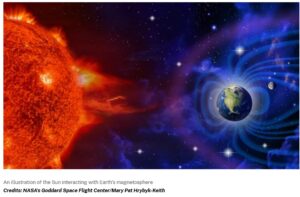
Also on the Hill this week, the House Science, Space, and Technology Committee will hold a hearing on space weather on Wednesday. “Weathering the Solar Storm: Advancing America’s Space Weather Capabilities” features NASA’s Joseph Westlake, head of SMD’s Heliophysics division, Ken Graham, Director of NOAA’s National Weather Service, Geoffrey Crowley, Co-Founder of American Commercial Space Weather Association, and Ian Cohen, Group Supervisor, Solar and Space Physics, from Johns Hopkins University Applied Physics Lab. NASA has a useful website explaining why understanding space weather is important and NOAA’s Space Weather Prediction Center’s website is invaluable.
Off the Hill, Tuesday is an especially busy day. If all goes according to plan, it starts off at 6:23 am EDT with the liftoff of Northrop Grumman’s special L-1011 aircraft carrying the Pegasus XL rocket that will send Katalyst Space’s LINK spacecraft to reboost NASA’s Swift spacecraft. We wrote about it last week because it was originally scheduled for June 27, but now will take off on Tuesday, June 30. NASA posted the launch date/time on its website Friday. We asked NASA if there would be any coverage at all, even just updates on X, but didn’t receive a reply. If we find out, we’ll add a note here and in our Calendar item. [The launch was scrubbed due to weather. They’ll try again on July 1. Information apparently will be posted on this NASA website.]
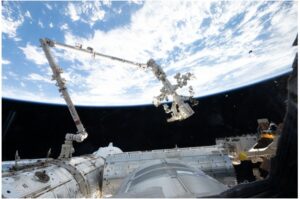
Next is a spacewalk by NASA’s Chris Williams and Jessica Meir to repair Canadarm2’s wrist joint, which malfunctioned on May 27. Canada’s Canadarm2 is a critical component of the ISS used to capture and berth the Cygnus and HTV-X cargo spacecraft, assist astronauts on spacewalks like this, and myriad other tasks. NASA and CSA provided a very useful overview of what they’ll be doing on Thursday. The spacewalk is expected to begin at 8:35 am ET and last about 6.5 hours. NASA will provide live coverage beginning at 7:00 am ET.
Among Tuesday’s other events are an in-person Washington Space Business Roundtable (WSBR) luncheon about “When Launch Stops: Is the Space Economy Built for Disruption” with former FAA AA for Commercial Space Transportation Kelvin Coleman (now with Baines Advisory Group), Mike French from the Space Policy Group, Sean Mulligan from Virginia Spaceport Authority, and Isaiah Wonnenberg from the Commercial Space Federation, moderated by Lisa Wood of Sophon Consulting. Also, the International Association for the Advancement of Space Safety (IAASS) will have a webinar with Dr. Nina Purvis on “White Mars: A Doctor’s Personal Experience at Concordia Station, Antarctica.”
At 2:30 pm ET, NASA will have a virtual “conversation” with Administrator Jared Isaacman and Moon Base Program Manager Carlos Garcia-Galán. They’ll announce new awards for lunar lander missions and preview upcoming opportunities. Watch on NASA’s YouTube channel.
Tuesday also is International Asteroid Day, as so designated by the United Nations in 2016 to recognize the anniversary of the 1908 Tunguska event when an airburst leveled trees in a 2,150 kilometer area of Siberia. An asteroid plummeting through the atmosphere is suspected of causing the mid-air explosion. Interest in asteroids is rising as the close flyby of Apophis nears on April 13, 2029. Just before they left town on Wednesday, the Senate passed a bipartisan resolution sponsored by former NASA astronaut Sen. Mark Kelly (D-AZ), chairman of the Senate Appropriations CJS subcommittee Sen. Jerry Moran (R-KS), and Sen. John Cornyn (R-TX) “reaffirming the importance of planetary defense, scientific innovation, public engagement, and international cooperation in addressing near-Earth object threats.” Asteroid Day events take place globally on or around June 30. A list is available on the Asteroid Day website.
As always there are too many terrific events to highlight here, but those and others we know about as of Sunday morning are shown below. Check back throughout the week for others we learn about later and add to our Calendar or changes to these.
Monday, June 29
- NASA, SBA Announce Partnership, NASA HQ, Washington, DC, 1:00 pm ET (in-person only)
Tuesday, June 30
- International Asteroid Day, global
- Launch of Pegasus-XL to Reboost Swift Observatory, Kwajalein Atoll, Marshall Islands, 6:23 am EDT
- NASA Spacewalk at ISS, Earth orbit, 8:35 am ET (NASA coverage begins 7:00 am ET)
- WSBR Luncheon on Launch Disruption, Sheppard Mullin, 2099 Pennsylvania Ave, NW, Washington, DC, 11:30 am-1:30 pm ET
- Inside “White Mars”: A Doctor’s Personal Experience at Concordia Station, Antarctica (IAASS), virtual, 2:00-3:30 pm ET
- NASA Moon Base Update, virtual, 2:30 pm ET
Tuesday-Thursday, June 30-July 2
Tuesday-Saturday, June 30-July 4
Wednesday, July 1
- House SS&T Hearing on Space Weather, 2318 Rayburn House Office Building, 10:00 am ET (webcast)
- Schriever Spacepower Series with Brig. Gen. Nikki Frankino and Melissa Blakesly (Mitchell Inst), virtual, 10:30-11:30 am ET
Friday, July 3
- Independence Day (observed), Federal Holiday
Saturday, July 4
- Independence Day 2026 — America’s 250th Birthday!

User Comments
SpacePolicyOnline.com has the right (but not the obligation) to monitor the comments and to remove any materials it deems inappropriate. We do not post comments that include links to other websites since we have no control over that content nor can we verify the security of such links.