What’s Happening in Space Policy June 21-27, 2026
Here is SpacePolicyOnline.com’s list of space policy events for the week of June 21-27, 2026 and any insight we can offer about them. The House and Senate are in session this week.
During the Week
Three hearings/markups on Capitol Hill top the list this week: House Appropriations marks up the defense bill; Senate Appropriations marks up the Commerce-Justice-Science bill; and Senate Armed Services holds a nomination hearing that includes two space-related nominees.
On Wednesday, the House Appropriations Committee takes up the FY2027 Defense Appropriations bill. The Administration is requesting a record $1.5 trillion for defense in FY2027, up from about $1 trillion in FY2026. The $1.5 trillion is split between the regular appropriations process governed by the appropriations committees ($1.15 trillion) and what the Administration hopes will be a third reconciliation bill ($350 billion). The Defense Subcommittee approved $1.072 trillion on June 11 for defense overall. Of that, $55.5 billion is for the Space Force: $1.78 billion for Military Personnel, $8.80 billion for Operations & Maintenance, $9.62 billion for Procurement, and $35.32 billion for RDT&E.
The Administration requested another $12 billion for the Space Force through an anticipated third reconciliation bill, although Senate leaders are saying there isn’t enough support for a third such bill. The first two were the One, Big Beautiful Bill Act (OBBBA, or the Working Families Tax Cut Act) last summer, and a bill that funds ICE and CBP that passed two weeks ago. Reconciliation bills are a useful Senate tool because they can pass with a simple majority on a party-line basis, but three have never passed in a single Congress before (two is the most). Time will tell what happens on that front, but the Space Force’s appropriations request itself is a big increase over the $40 billion it got in FY2026.
The Senate Appropriations Committee hasn’t marked up its defense bill yet, but on Thursday will proceed with four others including the Commerce-Justice-Science (CJS) bill that funds NASA, NOAA and NSF. The committee postponed it from June 4 because of controversy over matters in the Justice portion of the CJS bill. That’s outside the remit of this website and we don’t know how or if they were resolved, but committee leadership is moving forward. The markup begins at 10:00 am ET and will be webcast. CJS is third on the list of four bills (Military Construction was added to the original list that also includes Agriculture and Legislative Branch). We haven’t seen any details yet on what’s recommended for NASA. Congress rejected the deep cuts proposed for NASA in FY2026. The Administration proposed deep cuts again for FY2027 for everything other than human exploration. House Appropriators rejected them again in May. Expectations are the Senate will as well.
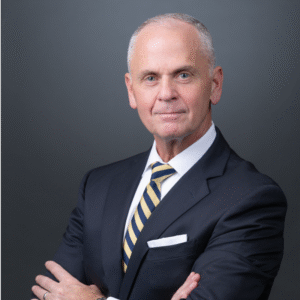
Also on Thursday, the Senate Armed Services Committee will consider four nominations, two of which are space-related: Roger Mason to be Director of the National Reconnaissance Office (NRO) and Erich Hernandez-Baquero to be Assistant Secretary of the Air Force for Space Acquisition and Integration (ASAF/SQ).
Mason would succeed Chris Scolese as Director of NRO. NRO designs, builds and operates the nation’s intelligence satellites, working closely with the Space Force and Space Command. Scolese has been in the job since 2019 and was at NASA for years before that. Mason is currently Chief Growth Officer at defense contractor V2X and previously was at Parsons Corp., Peraton and Noblis, and from 2009-2014 was Assistant Director of National Intelligence for Systems and Resource Analysis.
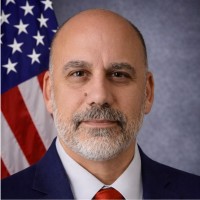
Hernandez-Baquero is currently Vice President, Space Intelligence, Surveillance & Reconnaissance, at Raytheon after a long career in the U.S. Air Force including a number of positions at NRO. The Space Force is part of the Department of the Air Force and as ASAF/SQ he would be the “senior architect for space systems and programs” across DOD. He would replace Thomas Ainsworth, who’s been acting in that job since Maj. Gen. Stephen Purdy’s term as acting ASAF/SQ ended in January. (Purdy took the job when Frank Calvelli’s term ended at the change in administrations.)
The other two nominees are Jules Hurst III to be Under Secretary of Defense (Comptroller), and Richard O’Malley to be Deputy Under Secretary of Defense for Acquisition and Sustainment.
Off the Hill, we’ll highlight just two more events even though there are many other great choices.
Tomorrow (Monday), NASA’s Aerospace Safety Advisory Panel (ASAP) will report out on its most recent quarterly meetings with NASA officials. Created by Congress after the 1967 Apollo 1 fire that killed astronauts Gus Grissom, Ed White and Roger Chaffee, ASAP reports both to Congress and the NASA Administrator. ASAP meetings are always interesting, though the format of listening over a telephone line as panel members read prepared statements is quaint. As far as we know, ASAP is one of only two active NASA advisory committees (Bob Cabana’s ISS Advisory Committee is the other). Administrator Jared Isaacman hasn’t appointed members to the NASA Advisory Council (NAC) yet, which traditionally provides outside advice and recommendations to the Administrator and has several subcommittees with experts on specific topics like science.
The other event we’ll highlight is on Saturday. That’s the targeted launch time for Northrop Grumman’s Pegasus-XL rocket to send Katalyst Space’s LINK on-orbit servicing spacecraft to try and attach to NASA’s Neil Gehrels Swift Observatory and boost it back up to a stable orbit. As we reported last week, Swift’s orbit is decaying more rapidly than anticipated because of solar activity. If nothing is done, it’s expected to reenter this fall. Launched in 2004, Swift studies gamma ray bursts.
NASA realized the problem last year and in September gave Katalyst Space a $30 million contract to come up with a quick solution. At a press conference last week at Wallops Flight Facility, VA, as LINK was being integrated onto the Pegasus-XL rocket, Katalyst’s Kieran Wilson called it an “absolutely unprecedented development timeline,” but they are ready for launch.
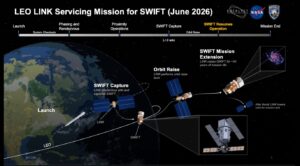
Pegasus is attached to a specially modified Northrop Grumman L-1011 Stargazer aircraft that is flying from Wallops to Kwajalein Atoll in the Marshall Islands. Wilson said that’s the chosen departure point because of Swift’s low inclination orbit (20.6 degrees). He said once in orbit, LINK will have a commissioning period of a few weeks before beginning its approach to Swift to capture it and raise the orbit over 2-3 months. We haven’t heard of a livestream for Stargazer’s departure from Kwajalein. Neither NASA nor Katalyst shared the time for the departure during the press briefing, but Next Spaceflight reports the take-off window is Saturday 5:00-10:28 am Eastern Daylight Time, which is Saturday 2:00-7:28 am PACIFIC. [UPDATE: liftoff was postponed to June 30 EDT.]
Should be fascinating if it works. As Wilson emphasized at the briefing, Swift wasn’t designed to be captured, but they’re confident the observatory can point well and LINK and Swift will perform maneuvers in tandem so LINK can determine the best spot for its “grippers” to grab on.
Those and other events we know about as of Sunday morning are shown below. Check back throughout the week for others we learn about later and add to our Calendar or changes to these.
Sunday-Friday, June 21-26 (continued from yesterday)
- International Planetary Probe Workshop, Washington, DC
Monday, June 22
- Pre-Launch Interviews with NASA Astronaut Anil Menon, virtual (from Star City, Russia), 9:00 am ET
- NASA Aerospace Safety Advisory Panel, virtual, 2:00 pm ET
Monday-Friday, June 22-26
- European Lunar Symposium, Nancy, France
Tuesday, June 23
- Space Superiority Through the Spectrum of Conflict (Mitchell Inst), virtual, 11:00 am-12:00 pm ET
Wednesday, June 24
- House Appropriations Full Committee Markup FY2027 Defense Bill, 2359 Rayburn House Office Building, 11:00 am ET (webcast)
- ISU-DC Space Café with Scout Space’s Eric Ingram, 1020 N Highland St, Arlington, VA, 6:00-8:00 pm ET
Thursday, June 25
- SASC Nomination Hearing for Roger Mason to be NRO Director, Erich Hernandez-Baquero to be ASAF/SQ,and others, SD-G50 Dirksen Senate Office Building, 9:30 am ET (webcast)
- Senate Appropriations Committee Markup of Commerce-Justice-Science (CJS) bill and others, 106 Dirksen Senate Office Building, 10:00 am ET (webcast)
- Golden Dome: How Could Sensors Protect the United States? (Space News), virtual, 1:00-1:45 pm ET
- The Apollo Lunar EVA Experience, with Andy Chaikin (IAASS), virtual, 2:00-3:30 pm ET
Saturday, June 27
- Targeted Date for Launch of Pegasus-XL with Katalyst’s LINK On-Orbit Servicing Spacecraft, Kwajalein Atoll, Marshall Islands [time not announced by NASA or Katalyst, but Next Spaceflight reports it as 5:00-10:28 am EDT]
User Comments
SpacePolicyOnline.com has the right (but not the obligation) to monitor the comments and to remove any materials it deems inappropriate. We do not post comments that include links to other websites since we have no control over that content nor can we verify the security of such links.